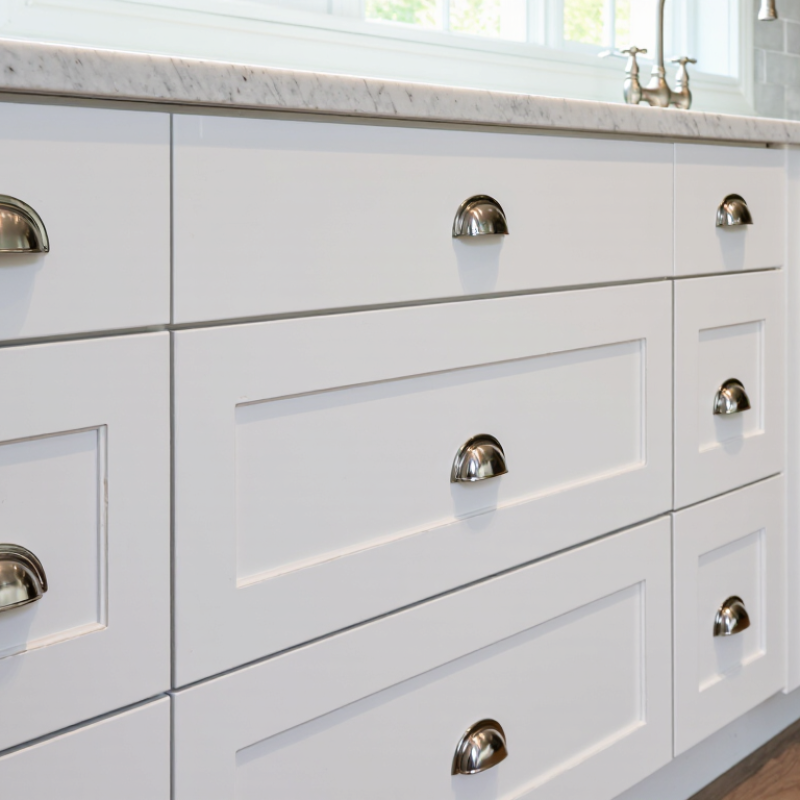
| Cabinet Knobs | Single-point handle used to open doors, small drawers, and lightweight cabinet fronts. | Solid brass, stainless steel, zinc alloy with a durable finish, or aluminum for lightweight applications. | Common knob diameters are approximately 25–40 mm. Most use a single screw with metric or imperial thread options. | High Solid or thick-wall construction, clean machining, secure screw threading, consistent finish, and no visible plating defects. | Confirm screw length against the door or drawer-front thickness. Check that the mounting screw matches the knob thread and cabinet material. | Traditional, transitional, and modern cabinet doors; compact drawers; furniture-style cabinetry. | Evaluate hand comfort, projection from the cabinet face, finish resistance, and whether replacement screws are included. |
| Cabinet Pulls | Two-point or multi-point handle that provides greater leverage than a knob. | Stainless steel, solid brass, aluminum, or zinc alloy with a properly bonded protective finish. | Common center-to-center drilling distances include 76 mm, 96 mm, 128 mm, 160 mm, and 192 mm, although many other sizes are available. | High Accurate hole spacing, rigid construction, smooth edges, stable mounting posts, and uniform finish across the entire pull. | Measure the existing center-to-center hole spacing before replacement. Verify pull projection and clearance from adjacent doors or walls. | Wide drawers, frequently used kitchen doors, utility rooms, bathrooms, and high-traffic cabinetry. | Choose a length that suits the cabinet scale. Longer pulls can improve leverage but require precise drilling and sufficient clearance. |
| Concealed Hinges | Controls cabinet-door movement while remaining hidden when the door is closed. | Nickel-plated steel, stainless steel, or corrosion-resistant steel components with hardened pivot and adjustment parts. | European-style hinges commonly use a 35 mm cup. Typical opening angles include approximately 95°, 105°, 110°, and 120°, depending on the model. | High Smooth movement, reliable closing action, precise three-dimensional adjustment, strong cup attachment, and consistent door alignment. | Check full-overlay, half-overlay, or inset compatibility. Verify cup depth, mounting-plate position, door thickness, opening angle, and frame construction. | Frameless and face-frame kitchen cabinets, bathroom vanities, wardrobes, and concealed furniture doors. | Soft-close mechanisms should engage smoothly without slamming or excessive resistance. Use the correct hinge type for door weight and overlay. |
| Surface-Mount Hinges | Visible hinge that supports and pivots a cabinet door without requiring a concealed hinge cup. | Steel, stainless steel, solid brass, or iron with a protective coating suitable for the installation environment. | Available in various leaf widths, heights, and mounting-hole patterns. The correct dimensions depend on door thickness and cabinet construction. | High Flat leaves, accurate screw holes, tight knuckles, minimal lateral play, and a finish that remains stable around the hinge joint. | Confirm whether the hinge is designed for inset, overlay, or partial-overlay doors. Check screw type, pilot-hole size, and door swing direction. | Shaker-style cabinetry, furniture restoration, farmhouse interiors, display cabinets, and decorative applications. | Visible hardware should be selected for both load capacity and appearance. The hinge leaf must sit flat to prevent door binding. |
| Side-Mount Drawer Slides | Supports a drawer from both sides and guides horizontal opening and closing. | Cold-rolled steel or stainless steel with formed channels, ball-bearing assemblies, and corrosion-resistant coatings. | Common lengths range from about 250–600 mm. Full-extension and three-quarter-extension versions are widely available. | High Smooth ball-bearing travel, low side-to-side play, consistent extension, positive stops, and a clearly stated load rating. | Measure cabinet depth, drawer-box length, side clearance, and mounting position. Many models require approximately 12.5–13 mm clearance per side, but the manufacturer specification controls. | Face-frame and frameless cabinets, retrofit projects, workshops, kitchens, and utility storage. | Load ratings are usually based on a specified slide length and testing method. Select a rating above the expected loaded drawer weight. |
| Undermount Drawer Slides | Supports the drawer beneath the box, keeping the slide mechanism mostly hidden for a clean appearance. | Precision-formed steel, coated steel, stainless steel components, polymer locking devices, and reinforced adjustment parts. | Usually designed for full-extension drawers. Length must match the cabinet depth and drawer-box dimensions; side clearance is typically smaller than with side-mount slides. | High Smooth synchronized movement, secure locking clips, accurate adjustment, quiet travel, and stable performance under the stated load. | Verify drawer-box width, bottom clearance, rear-notch requirements, front-panel construction, slide length, and cabinet-member compatibility. | Modern kitchens, premium bathroom vanities, built-in furniture, and applications where concealed hardware is preferred. | Installation tolerances are less forgiving than with many side-mount slides. Accurate cabinet and drawer-box construction is essential. |
| Soft-Close Slides | Uses a damping mechanism to slow and pull the drawer closed during the final portion of travel. | Steel slide channels with hydraulic or mechanical damping components and reinforced closing mechanisms. | Available in side-mount and undermount designs, with partial-extension or full-extension travel depending on the product. | High Consistent closing speed, reliable latching, smooth operation across the rated load range, and no excessive bounce at the end of travel. | Check whether the mechanism is compatible with the drawer weight, slide length, cabinet clearance, and required opening force. | Kitchens, bedrooms, offices, nurseries, and other spaces where reduced noise and controlled closing are important. | Soft-close performance depends on correct alignment and load distribution. Avoid exceeding the stated dynamic load capacity. |
| Finish and Corrosion Quality | Protects exposed surfaces from wear, moisture, handling, and ordinary household cleaning. | Electroplated finishes, powder coating, PVD coatings, anodized aluminum, or naturally patinating solid metals. | Common finishes include polished chrome, satin nickel, matte black, brushed brass, oil-rubbed bronze, and stainless steel tones. | High Even color, strong adhesion, smooth edges, consistent sheen, resistance to normal handling, and clearly stated care instructions. | Consider humidity, salt exposure, cleaning chemicals, and proximity to sinks or exterior doors. Confirm whether the finish is intended for damp locations. | Kitchens, bathrooms, coastal homes, laundry rooms, commercial interiors, and high-touch areas. | Finish names are not standardized across all manufacturers. Compare physical samples when matching existing cabinet hardware. |
| Load and Durability Verification | Provides a practical basis for comparing performance, service life, and suitability for repeated use. | Depends on the product: reinforced steel for slides and hinges, solid or heavy-wall metal for knobs and pulls, and wear-resistant moving components. | Performance varies by size, installation method, cycle count, door or drawer weight, and environmental conditions. | High Published load capacity, installation instructions, adjustment limits, testing information, replacement parts availability, and clear warranty terms. | Compare products using the same measurement basis. Check whether load ratings apply per pair, per drawer, or to a particular slide length. | Any project where long-term reliability, repairability, and predictable performance are more important than the lowest initial price. | Do not judge quality from appearance alone. Installation accuracy, correct sizing, and appropriate use are essential to real-world performance. |