o
p
t
i
m
a
r
o
b
o
t
i
c
s

Make a Call


Make a Call
Blogs
2026 Best Robotic Automation Solutions for Global Buyers
Global manufacturers are entering 2026 with a sharper question: which robotic automation solution delivers dependable value, not impressive demonstrations? The International Federation of Robotics reported 541,302 industrial robots installed worldwide in 2023, while the global operational stock exceeded 4.28 million units. These figures show strong adoption, but they do not guarantee a successful purchase.
Real factories reveal the difference. A robotic arm must repeat a precise pick beside conveyors, sensors, safety fencing, and human operators. It must also handle product changes, maintenance delays, local service needs, and imperfect data. IFR’s World Robotics reports identify Asia as the largest installation market, with Europe and the Americas maintaining substantial demand. For global buyers, supplier coverage and integration expertise matter as much as payload or cycle time.
The best solution is rarely the most expensive one. Deloitte’s industrial automation research highlights the importance of workforce skills, connected systems, and measurable operational outcomes. Buyers should compare total cost of ownership, deployment time, cybersecurity controls, spare-parts access, and training support. These criteria are practical, though not always easy to measure consistently. That is a weakness worth acknowledging.
This guide evaluates leading robotic automation solutions for 2026 across manufacturing, logistics, food processing, electronics, and other regulated environments. It considers robot type, software compatibility, safety performance, scalability, and supplier reliability. Independent testing remains essential. Vendor claims can look polished. Production evidence is harder to fake.
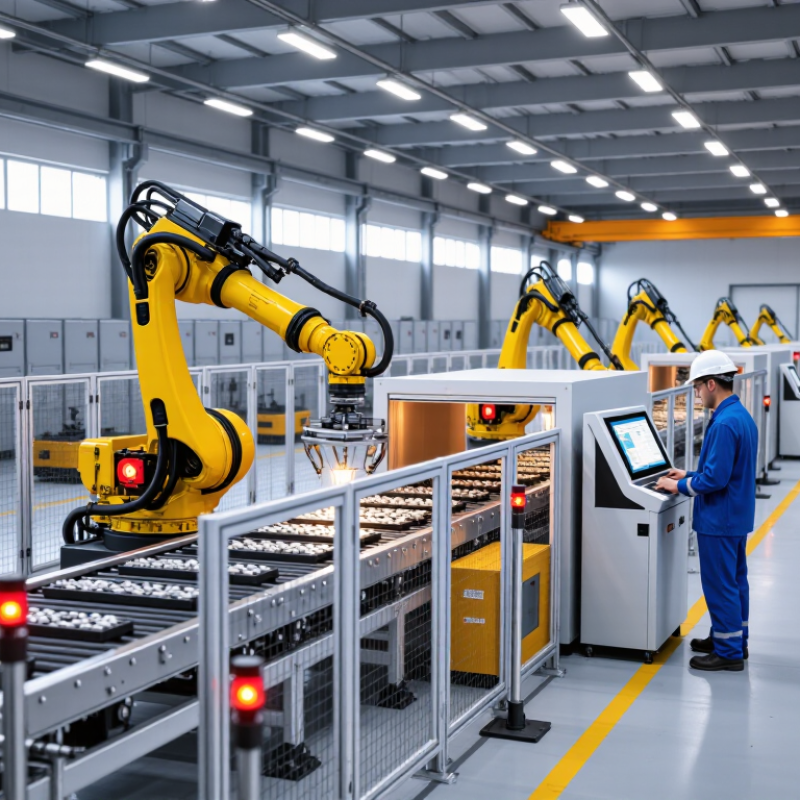
Table of Contents
[Hide]
What Robotic Automation Solutions Are and How They Work
Robotic automation solutions combine machines, sensors, control software, and human supervision. They perform repeatable tasks such as assembly, palletizing, inspection, and material movement. A typical system begins with a digital task plan. Sensors then detect position, weight, speed, and unexpected obstacles. The controller compares this information with programmed limits. The robot adjusts its movement within milliseconds.
The International Federation of Robotics reported 541,302 industrial robot installations worldwide in 2023. Its World Robotics 2024 report also recorded more than 4.28 million operational industrial robots. These figures show growing adoption, not automatic success. A practical deployment needs accurate process data, suitable end-effectors, guarded workspaces, and trained operators. Safety validation must cover normal production and unusual conditions. Small errors matter.
The workflow is rarely completely autonomous. People usually load materials, review alerts, maintain equipment, and approve process changes. Integration with warehouse, manufacturing, or quality systems improves traceability. Yet integration can become expensive when older equipment uses inconsistent data formats. This is an uncomfortable reality. Buyers should test one production cell before expanding globally. The best solution is not always the fastest robot. It is the system that delivers stable output, measurable safety, and manageable maintenance across different sites.
2026 Best Robotic Automation Solutions for Global Buyers - What Robotic Automation Solutions Are and How They Work
| Robotic Automation Solution | How It Works | Typical Applications | Typical Payload / Capacity | Key Advantages | Main Limitations | Best Buyer Fit |
|---|---|---|---|---|---|---|
| Articulated Industrial Robots | A multi-jointed robotic arm follows programmed motion paths using servo motors, encoders, controllers, and end-of-arm tooling. | Welding, painting, machine tending, palletizing, assembly, and material handling. | Approximately 3–1,000 kg, depending on arm size and configuration. | High repeatability, broad motion range, fast cycle times, and suitability for demanding production environments. | Usually requires safety fencing, skilled integration, dedicated floor space, and application-specific tooling. | Medium- and large-scale manufacturers with stable, repetitive workflows. |
| Collaborative Robots | A lightweight robotic arm uses force, torque, speed, and proximity monitoring to operate near trained workers within defined safety limits. | Screwdriving, inspection, packaging, light assembly, dispensing, and machine loading. | Commonly 3–20 kg; higher-capacity models are available in some applications. | Flexible deployment, relatively small footprint, easier changeovers, and reduced need for fixed guarding in suitable tasks. | Lower speed and payload than many industrial robots; a risk assessment is still required before human-robot operation. | Small and medium-sized businesses needing flexible automation across multiple product variants. |
| SCARA Robots | A selectively compliant arm performs rapid horizontal movements and controlled vertical insertion using rotary joints and a vertical axis. | Electronic assembly, pick-and-place, packaging, labeling, insertion, and small-part handling. | Typically 1–20 kg, depending on reach and model design. | High speed, strong repeatability, compact installation, and efficient performance for planar assembly tasks. | Less suitable for complex three-dimensional paths, heavy loads, or applications requiring a large working envelope. | High-volume manufacturers of small components and products with consistent layouts. |
| Delta Robots | Parallel lightweight arms move a tool from an overhead frame, often guided by machine vision and conveyor tracking. | Food sorting, pharmaceutical packaging, high-speed picking, and small-item placement. | Usually about 0.5–15 kg, depending on speed and reach requirements. | Very high throughput, low moving mass, and strong suitability for random or continuously moving products. | Limited payload, overhead installation, and less suitability for heavy or complex assembly operations. | Food, consumer goods, pharmaceutical, and logistics operations requiring rapid picking. |
| Cartesian / Gantry Systems | Linear actuators move a tool along two or more orthogonal axes, usually controlled by a programmable motion system. | 3D printing, dispensing, cutting, palletizing, CNC loading, and large-area handling. | From a few kilograms to several tonnes in engineered systems. | Large working envelope, straightforward programming, predictable motion, and strong scalability. | Can require substantial structural support, floor or ceiling space, and custom engineering. | Operations handling large products, fixed work areas, or processes requiring precise linear movement. |
| Autonomous Mobile Robots | Onboard sensors, maps, software, and navigation algorithms allow the robot to move materials between locations without fixed guide paths. | Warehouse transport, line-side replenishment, inventory movement, hospital logistics, and order fulfillment. | Common payload classes range from approximately 100 kg to more than 1,000 kg. | Flexible routes, reduced manual transport, scalable fleet deployment, and improved material traceability. | Requires suitable floor conditions, traffic management, charging strategy, wireless connectivity, and software integration. | Warehouses and factories with frequent, repetitive internal transportation tasks. |
| Automated Guided Vehicles | Vehicles follow predefined magnetic, optical, laser, or digital routes to transport loads between programmed points. | Pallet movement, assembly-line supply, warehouse transfers, and repetitive tugger routes. | Often 500–5,000 kg, with specialized systems exceeding this range. | Reliable repeatable routes, strong load capacity, and easier process control in stable facilities. | Less flexible than free-navigation systems and may require route infrastructure or facility modifications. | Large plants with predictable layouts and fixed material-flow patterns. |
| Machine Vision Inspection Systems | Cameras, lighting, image-processing software, and classification rules identify defects, dimensions, labels, or assembly conditions. | Quality inspection, barcode reading, presence checks, measurement, sorting, and robotic guidance. | Capacity is generally measured by line speed rather than payload; many systems inspect tens to hundreds of items per minute. | Consistent inspection, digital records, rapid detection, and reduced dependence on subjective manual checks. | Performance depends heavily on lighting, camera positioning, product variation, and training data or inspection rules. | Manufacturers requiring traceable quality control or high-speed inspection. |
| Robotic Palletizing and Depalletizing | A robot uses programmed patterns, grippers, sensors, and pallet-position logic to stack or remove cases, bags, trays, or containers. | Food and beverage, consumer goods, chemicals, paper products, and distribution centers. | Typically 10–300 kg per handling cycle, depending on the product and end effector. | Improves ergonomics, delivers repeatable stacking quality, and supports continuous operation. | Needs accurate product presentation, pallet control, safety measures, and suitable gripper design. | Facilities with repetitive lifting, stacking, or unloading operations. |
| Robotic Welding and Cutting | The robot positions a welding torch, laser head, or cutting tool along a programmed path while process controllers regulate speed and energy. | Automotive components, metal fabrication, structural parts, frames, and industrial equipment. | Payload commonly ranges from 5–250 kg, excluding specialized heavy-duty systems. | Consistent quality, improved worker safety, repeatable paths, and suitability for hazardous environments. | Requires accurate fixtures, process expertise, ventilation, guarding, and control of part variation. | Metalworking businesses with recurring welds, cuts, or finishing paths. |
| Robotic Process Automation Software | Software bots interact with digital applications through user interfaces or APIs to execute rule-based, repetitive office processes. | Data entry, invoice processing, order administration, report generation, reconciliation, and customer-service workflows. | Capacity is measured by transactions and concurrent workflows rather than physical payload. | Rapid deployment, audit trails, reduced manual keystrokes, and compatibility with some legacy systems. | Less suitable for unstructured decisions, frequently changing interfaces, or processes requiring human judgment. | Finance, logistics, healthcare administration, insurance, and shared-service operations. |
Note: Payload, speed, throughput, and integration requirements are typical industry ranges and vary according to robot configuration, tooling, product dimensions, safety requirements, facility layout, and application design.
Related Posts
-
How to Choose the Right Robotics and Automation System
-
Top 10 Robot Technology Innovations Transforming Industries?
-
What are Collaborative Robots and How Do They Work?
-
How to Implement Robotics and Automation in Your Business?
-

How to Embrace Robotics and Automation for Your Business Success?
-
Top Collaborative Robot Arm Models Transforming Industries Today?
Brands
Proudly Trusted by Top Suppliers Worldwide






Let us know and we will automate, together to fit your industrial needs.
 +91-97254 16844
Clients
Proudly Trusted by Top Companies Worldwide


Do you need Help? Get in touch.
X
Please fill out the form below and we will get back to you as soon as possible.