o p t i m a r o b o t i c s

Blogs

2026 Top Crankshaft Bearing Types for Global Buyers

Choosing the right Crankshaft Bearing can determine engine life, maintenance cost, and production reliability. For global buyers, the decision involves more than price or availability. Engine load, shaft diameter, housing design, lubrication conditions, and operating temperature all influence bearing performance. A part that fits visually may still fail under pressure.

The 2026 market includes several important types, including bi-metal bearings, tri-metal bearings, aluminum alloy bearings, and coated performance bearings. Each design serves different applications. Passenger vehicles often prioritize low friction and stable daily performance. Heavy-duty engines require stronger fatigue resistance and improved load handling. Marine, agricultural, industrial, and high-performance engines may need special clearances, surface treatments, or corrosion protection. Small details matter. A few microns can change oil pressure and crankshaft behavior.

Reliable purchasing also requires careful supplier evaluation. Buyers should review material data, dimensional tolerances, hardness results, oil groove design, packaging quality, and traceability records. ISO-based quality systems can support confidence, but certification alone does not guarantee correct application. Compatibility must be checked against the original engine specifications. This guide compares leading Crankshaft Bearing types for 2026, with practical attention to materials, durability, installation conditions, and international sourcing concerns. Some recommendations remain application-dependent. That is easy to overlook. Real operating data should guide the final choice, especially when catalog information appears incomplete or overly optimistic.
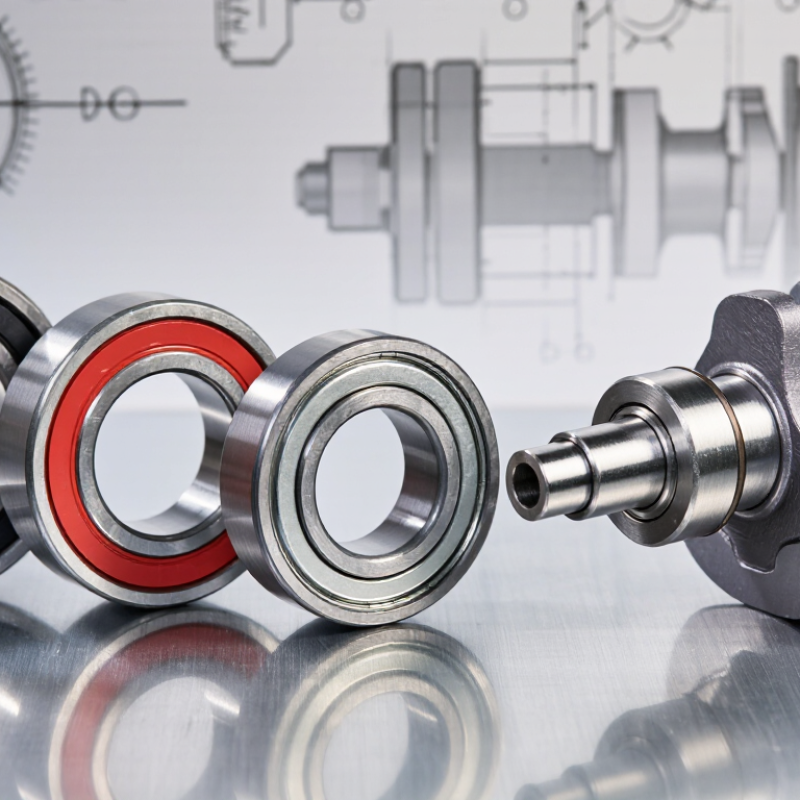
2026 Top Crankshaft Bearing Types for Global Buyers

Crankshaft Bearings Explained: Journal Support, Load Paths, and Oil Films

In 2026, global buyers are comparing crankshaft bearing types by more than material or price. Main bearings support the crankshaft journals inside the engine block. Connecting-rod bearings support the crank pins during combustion and acceleration. Together, they control radial movement and keep the crankshaft aligned. Small clearance matters.

A typical bearing may use aluminum-tin, copper-lead, or layered materials for different load conditions. The bearing does not normally carry the journal through direct contact. Pressurized oil forms a thin hydrodynamic film between both surfaces. This film separates metal, removes heat, and reduces friction.

The load path travels from the piston, through the connecting rod, into the crankshaft journal, and finally into the bearing shell and block. At low speed, however, the oil film becomes weaker. Start-up conditions can expose surface quality and clearance problems.

During practical inspection, technicians often check shell seating, oil-hole alignment, crankshaft roundness, and measured clearance. A clean, smooth journal is essential. Even a small burr can disturb oil flow.

Buyers should request material data, hardness results, dimensional tolerances, and batch traceability from qualified suppliers. A specification sheet can look perfect, yet installation errors still cause failure. I have seen incorrect bearing orientation create restricted lubrication within minutes. That detail is easy to miss.

Temperature, oil viscosity, operating speed, and engine load must also match the selected bearing type. Global applications may need different designs for heavy-duty, passenger, marine, or industrial engines.

Main Types in 2026: Plain, Flanged, Thrust, and Bimetal Designs

Crankshaft bearings in 2026 are still chosen by load, lubrication, space, and service conditions. The four common designs are plain, flanged, thrust, and bimetal bearings. Each solves a different mechanical problem. A low-cost choice can become expensive when clearance or alignment is wrong.

Plain bearings support radial loads around the crankshaft journal. They suit many engines with steady oil flow and accurate housing dimensions. Flanged bearings add locating faces, helping control crankshaft movement along its axis. They are useful where end play requires tighter control. Thrust bearings carry axial loads from clutches, transmissions, or connected machinery. Their faces need careful inspection because uneven wear may signal misalignment, not poor material alone.

Bimetal bearings combine a strong backing with a softer, wear-resistant lining. This structure can balance fatigue strength and tolerance for small particles. It is not a universal answer. Oil cleanliness, shaft finish, temperature, and load still matter. During selection, buyers should compare drawings, journal diameter, bearing width, oil-hole position, and specified clearance. Measurements should be verified with calibrated tools. Small errors matter.

A practical review should include operating hours and maintenance quality. Plain designs may be adequate for stable duty, while thrust or bimetal designs may better fit demanding conditions. Still, assumptions can fail. Catalogue descriptions rarely replace an application check. Supplier traceability, material reports, dimensional inspection, and sample testing improve purchasing confidence. The best decision is often less obvious than the cheapest quotation.

Material Data: Steel-Backed Bimetal and Tri-Metal Copper-Lead Liners

2026 Top Crankshaft Bearing Types for Global Buyers

Steel-backed bimetal bearings usually combine a rigid steel shell with an aluminum-based lining. This structure supports accurate housing contact and moderate engine loads. The steel backbone also improves dimensional stability during repeated heating. World Steel Association data shows global crude steel output reached about 1.88 billion tonnes in 2024. Supply is broad, but quality still varies between mills and forming processes.

Tri-metal copper-lead liners use steel, a copper-lead intermediate layer, and a thin conformable overlay. The copper layer offers strong load capacity and thermal conductivity. The overlay helps absorb small particles and shaft alignment errors. These benefits matter in high-load diesel and industrial engines. The USGS Mineral Commodity Summaries 2025 reports approximately 22 million tonnes of mined copper production in 2024. Copper availability appears strong, yet regional pricing and recycled content can change procurement decisions.

Material selection should follow load, oil chemistry, shaft hardness, and emission-system requirements. Lead-containing layers may also face tighter regional compliance controls. I would not trust a catalog label alone. Ask for cross-section data, bond-test results, hardness ranges, and dimensional inspection records. Published bearing guidance from SAE and ISO testing practices supports this evidence-based approach. One detail is often missed: a harder lining is not automatically better. It may resist wear, but it can punish a slightly contaminated oil system. That trade-off deserves review.

Performance Metrics: Typical 0.02–0.08 mm Oil Clearance Ranges

For global buyers, crankshaft bearing choice starts with oil clearance, not catalog labels. A practical range is 0.02–0.08 mm, but it is not a universal target. Clearance depends on journal diameter, engine load, oil viscosity, speed, and operating temperature. A thin racing-style bearing may need different control than a heavy-duty diesel shell. The same nominal size can behave differently after housing distortion.

Experienced inspectors measure the crankshaft with an outside micrometer and the housing bore with a calibrated bore gauge. They check several positions because taper and ovality can hide behind one reading. A 0.05 mm target may look correct on paper, yet a rough journal can destroy the oil film. During assembly, clean oil passages matter as much as bearing material. Tiny debris leaves visible scoring. For a field cross-check, controlled clearance compound can indicate contact, but it should not replace precision measurement.

Common choices include aluminum-based, copper-lead, and layered tri-metal constructions. Selection should match load capacity, fatigue resistance, embedability, and corrosion needs. Buyers should request tolerance data, hardness information, and inspection records, not only a size code. I once treated 0.03 mm as automatically safer than 0.07 mm; that assumption was too simple. Too little clearance can seize when parts expand. Too much can reduce pressure and increase impact noise. A better decision compares measured geometry with the exact service limits for the crankshaft and duty cycle.

Buyer Standards: ISO 3548 Tolerances, SAE J460, and Global Fitment

2026 Top Crankshaft Bearing Types for Global Buyers

Buyer Standards: ISO 3548 Tolerances, SAE J460, and Global Fitment

Global buyers are comparing more than bearing material and price. OICA reported over 75 million motor vehicles produced worldwide in 2024, creating wide fitment variation across engines, regions, and production years. For crankshaft bearings, ISO 3548 remains a practical reference for dimensional and geometrical tolerances. Buyers should verify shell thickness, housing diameter, oil-hole position, flange width, and bearing crush against approved drawings.

Small errors matter.

SAE J460 provides another useful checkpoint for engine-bearing requirements and dimensional control. It should support, not replace, the engine maker’s latest service data. A bearing may match the nominal crank diameter but fail after oversize grinding, housing distortion, or incorrect oil clearance. Experienced inspectors often measure crank journals at several points, then confirm clearance with calibrated tools. Records should include temperature, measurement force, and instrument accuracy.

Fitment is becoming less predictable. The IEA reported more than 17 million electric cars sold globally in 2024, while hybrid and combustion platforms remain active across many markets. This mixed fleet increases the need for accurate application data. Buyers should request cross-reference validation, material specifications, hardness results, and batch traceability. Imperial and metric dimensions can look deceptively similar. That mistake is common. Standards help, but field measurements and engineering review still decide whether a crankshaft bearing will perform reliably.

2026 Top Crankshaft Bearing Types for Global Buyers

Buyer standards: ISO 3548 tolerances, SAE J460, and global fitment. This scope chart shows which verification area each reference is primarily used for. A value of 1 indicates direct relevance; 0 indicates that the reference is not the primary source for that check.

Buyer guidance: Use ISO 3548 for applicable plain-bearing dimensional tolerance requirements, SAE J460 for relevant engine-bearing terminology and practice, and engine-specific drawings or catalogs to confirm crankshaft diameter, housing bore, bearing width, oil-hole position, thrust features, and oversize or undersize selection.

Brands

Proudly Trusted by Top Suppliers Worldwide

Let us know and we will automate, together to fit your industrial needs.

Clients

Proudly Trusted by Top Companies Worldwide

Do you need Help? Get in touch.

X

Please fill out the form below and we will get back to you as soon as possible.

    Subscribe our newsletter & get updates







