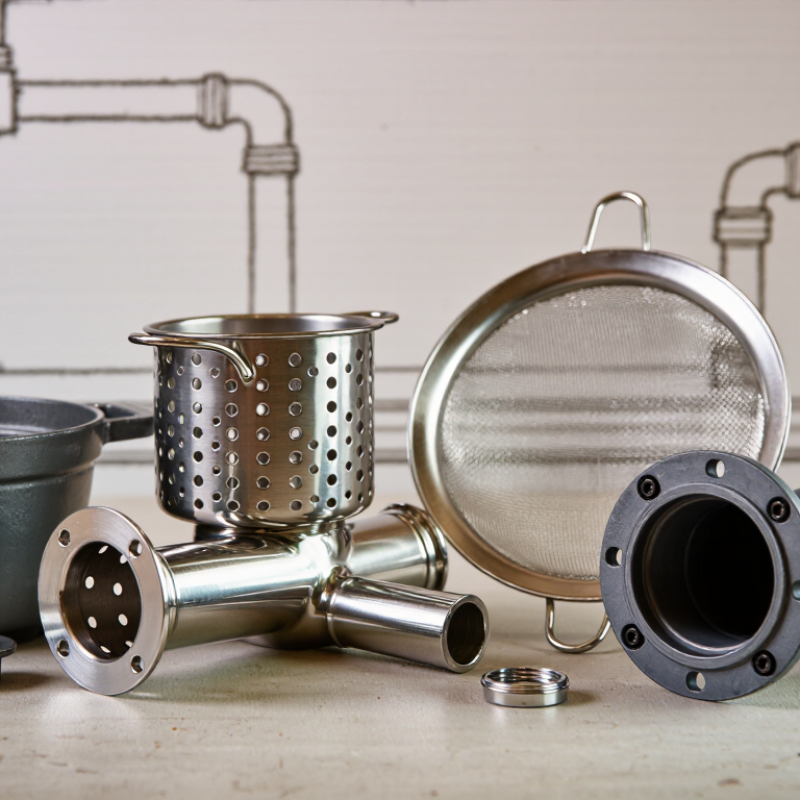
| Basket strainer | Cast, forged, or fabricated iron and steel body with a removable perforated plate or wire-mesh basket. Common openings range from approximately 0.5 mm to 6 mm, depending on the service. | Liquid pipelines, cooling water, process water, pumps, heat exchangers, and general industrial services. | Easy basket removal, low maintenance, reusable filter element, and good suitability for coarse-to-medium solids removal. | Requires isolation or a duplex arrangement for continuous service. Pressure drop rises as the basket loads with debris. | Body-wall thickness, basket fit, weld quality, gasket seating, drain arrangement, dimensional inspection, hydrostatic pressure test, and differential-pressure verification. | Material certificates, pressure-test records, inspection and test plan, replacement-basket traceability, documented cleaning procedure, and calibration records for gauges. | Pressure Equipment Directive 2014/68/EU may apply in the European Economic Area according to pressure, volume, fluid group, and equipment category. Confirm local piping and pressure-vessel rules. |
| Y-strainer | Inline body with an angled chamber containing a perforated or woven-mesh screen. Typical screen openings are approximately 0.25 mm to 3 mm for many industrial services. | Steam, water, compressed air, fuel, hydraulic circuits, and compact piping installations. | Compact design, broad connection options, relatively low purchase cost, and simple installation in horizontal or suitable vertical lines. | Small chamber volume can cause faster blockage. Cleaning usually requires line isolation unless an automatic blowdown arrangement is provided. | Flow-direction marking, screen retention, thread or flange accuracy, casting inspection, body pressure test, screen open-area check, and gasket compatibility. | Published pressure-temperature ratings, sample dimensional report, material grade confirmation, screen mesh or aperture report, and evidence of final visual inspection. | For European shipments, assess PED applicability and harmonized or designated standards used in the technical file. For electrical or automation accessories, assess separate EMC and low-voltage requirements where applicable. |
| Duplex basket strainer | Two basket chambers connected through a changeover valve or diverter arrangement. Baskets commonly use perforated plate, woven mesh, or multilayer screens. | Continuous-flow systems, lubrication circuits, fuel handling, cooling loops, and processes where shutdown for cleaning is unacceptable. | One side can remain in service while the other basket is cleaned, reducing process interruption and improving maintainability. | Higher cost, greater weight, more seals, and a risk of incorrect valve positioning if the changeover mechanism is poorly designed. | Interlock function, chamber isolation, valve seat leakage, changeover sequence, pressure test of each flow path, basket interchangeability, and safe vent and drain operation. | Functional test video or report, assembly drawings, spare-parts list, failure-mode review, operating instructions, and documented pressure-drop data at stated flow rates. | Pressure equipment documentation, machinery-safety assessment for actuated systems, transport packing validation, and destination-country language requirements should be reviewed before shipment. |
| Temporary cone or startup strainer | Conical perforated plate or wire mesh installed between flanges. It is normally supplied for temporary commissioning and equipment-protection service rather than permanent filtration. | New pipelines, pump suction protection, flushing operations, commissioning, and removal of weld slag or construction debris. | Low cost, quick installation, large debris-holding capacity, and simple removal after system cleaning. | Not generally intended for long-term service. Incorrect orientation or excessive loading can create high pressure loss and mechanical damage. | Cone angle, support-ring flatness, weld integrity, flange alignment, screen opening, flow-direction marking, and resistance to collapse at the specified differential pressure. | Drawing with installation orientation, material certificate, calculated open area, specified temporary-service duration, and clear removal instructions. | Confirm that the item is classified correctly for the destination market and that the connected piping system meets applicable pressure and installation requirements. |
| Perforated-plate strainer | Carbon steel, ductile iron, or stainless-steel housing fitted with a punched or drilled plate. Apertures are commonly specified by diameter, pitch, and open-area percentage. | Water treatment, cooling water, intake lines, irrigation, and services containing relatively coarse solids. | High mechanical strength, good resistance to coarse debris, straightforward cleaning, and stable aperture geometry. | Usually provides less fine filtration than woven mesh. Punched edges and coatings must be controlled to avoid burrs and corrosion sites. | Aperture diameter and pitch, burr height, plate thickness, coating adhesion, corrosion protection, weld inspection, and pressure-loss testing. | Aperture inspection report, coating or lining procedure, salt-spray or corrosion-test evidence where specified, and batch traceability from plate to finished assembly. | If supplied for drinking-water contact, verify the applicable national or regional positive-list and material-approval requirements; industrial-use compliance is not automatically sufficient. |
| Wedge-wire or slot strainer | Profile-wire screen welded to support rods, or a machined slotted element. Slot sizes can be specified in fine increments, often from roughly 0.05 mm upward depending on design. | Water wells, intake systems, food and chemical processing, wastewater, and applications requiring accurate particle separation. | Accurate slot control, strong open structure, good cleanability, and reduced tendency for particles to become deeply embedded compared with some woven screens. | Higher fabrication cost and the need for precise welding, support spacing, and particle-loading calculations. | Slot-size uniformity, weld penetration, support spacing, screen roundness, fatigue resistance, open-area calculation, and cleanability testing. | Microscope or calibrated optical inspection, weld-quality records, design calculations, pressure or collapse test, and documented tolerances for slot size and roundness. | Food, beverage, pharmaceutical, and drinking-water applications require product-contact materials and hygienic-design documentation appropriate to the destination jurisdiction. |
| Magnetic separator strainer | A liquid strainer combined with permanent magnetic bars or cores to capture ferrous particles. The nonmagnetic screen retains larger solids while the magnetic element captures metal fines. | Food ingredients, ceramics, plastics, paints, chemicals, oils, and process liquids where ferrous contamination is a concern. | Provides two separation mechanisms and can reduce metal contamination without adding a separate process stage. | Magnetic performance may decline with contamination, temperature, impact, or unsuitable design. It does not remove non-ferrous metals reliably. | Magnetic flux measurement at defined points, encapsulation integrity, corrosion resistance, screen fit, cleanability, maximum operating temperature, and pressure testing. | Flux-density map, temperature rating, magnet-grade and coating documentation, extraction-force test, food-contact declaration where relevant, and cleaning validation. | For food-contact use, review applicable food-contact framework, migration data, hygienic design, and allergen-cleaning controls. Check whether the destination requires metal-detection or foreign-body control documentation. |
| Self-cleaning or automatic backwash strainer | Robust body with screen, scraper, suction scanner, or backwash mechanism. Filtration openings commonly range from tens of micrometres to several millimetres, depending on process needs. | Large cooling-water systems, irrigation, desalination pretreatment, industrial water reuse, and continuous-flow utilities. | Reduces manual cleaning, supports continuous operation, and can maintain more stable pressure drop when correctly sized and controlled. | Higher capital cost, control-system dependence, backwash-water demand, and greater sensitivity to incorrect sizing or poor water-quality assumptions. | Screen strength, backwash sequence, actuator reliability, sensor calibration, drain capacity, fail-safe behavior, pressure-drop set points, and cycle endurance. | Control logic, wiring diagram, factory acceptance test, simulated blockage test, spare-parts strategy, maintenance schedule, and documented performance curve. | Electrical controls may require assessment under destination-market electrical, EMC, machinery, or functional-safety rules. Provide manuals, labels, and safety information in required languages. |