o
p
t
i
m
a
r
o
b
o
t
i
c
s

Make a Call


Make a Call
Blogs
2026 Best Laser Cladding Machines for Global Buyers
Choosing among the 2026 Best Laser Cladding Machines for Global Buyers requires more than comparing advertised power ratings. A reliable decision begins with the application: worn shafts, turbine blades, mining teeth, oilfield components, or corrosion-resistant surfaces. Each part demands different powder chemistry, laser wavelength, spot size, deposition rate, and dilution control. A machine that repairs a 300-millimeter shaft efficiently may perform poorly on a thin aerospace edge.
Professor John N. DuPont, a widely recognized welding and cladding researcher, has emphasized a practical principle: “The key to successful cladding is control of dilution and heat input.” That principle remains relevant in 2026. Buyers should examine melt-pool stability, heat-affected-zone width, powder utilization, layer adhesion, and repeatability under production conditions. Ask for metallurgical reports, not only polished photographs.
Real experience matters.
This guide evaluates machine architecture, fiber-laser output, coaxial and lateral powder delivery, automation, monitoring systems, and post-cladding machining needs. It also considers technical support, spare-parts access, operator training, warranty terms, and regional service coverage. These details can determine whether a promising machine becomes productive equipment or an expensive installation.
Some comparisons remain imperfect. Manufacturers may measure deposition rates under different powder sizes and test conditions. Published figures can therefore mislead. Independent trials are worth the time. Buyers should test their actual alloy, geometry, and repair thickness before signing a purchase agreement. The strongest choice is rarely the machine with the highest headline power. It is the system that delivers stable, traceable, and economically defensible Laser Cladding results over many production cycles.
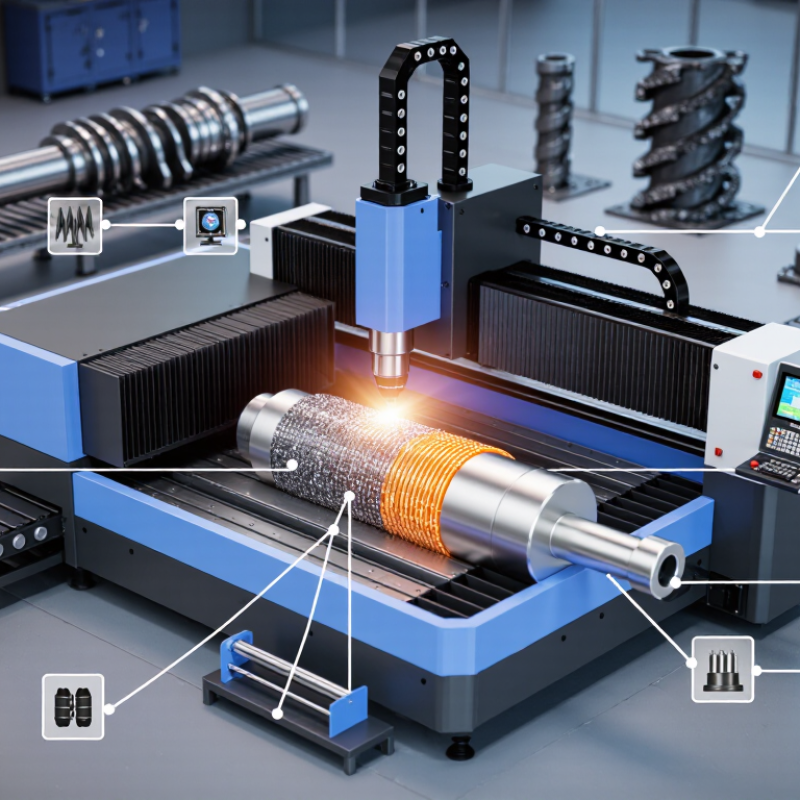
Table of Contents [Hide]
What Is a Laser Cladding Machine and How Does It Work?
2026 Best Laser Cladding Machines for Global Buyers
What Is a Laser Cladding Machine and How Does It Work?
A laser cladding machine repairs or protects metal surfaces with a precisely controlled laser beam. It places new material over a base component. The process creates a metallurgical bond, not merely a surface coating. Typical feedstock includes metal powder or wire. The selected material depends on wear, corrosion, temperature, and impact requirements.
During operation, the laser forms a small molten pool on the substrate. A nozzle delivers powder or wire into this pool. Shielding gas limits oxidation around the heated area. As the laser moves, the material cools and forms a dense deposited track. Successive tracks overlap to build the required thickness. Control matters.
Experienced technicians adjust laser power, travel speed, feed rate, and gas flow together. Excessive heat can increase dilution or distort a precision part. Insufficient energy may cause weak bonding or trapped pores. Robotic or CNC movement improves repeatability across complex surfaces. However, automation cannot replace correct parameter development.
For global buyers, working envelope, material compatibility, powder recovery, and service documentation deserve careful review. A first pass may look excellent, yet hidden porosity can remain. Inspection methods such as dimensional checks, hardness testing, and metallographic analysis reveal more. The process is powerful, but less forgiving than promotional descriptions suggest. Costs also depend on operator skill, consumables, maintenance, and local technical support.
Brands
Proudly Trusted by Top Suppliers Worldwide







Let us know and we will automate, together to fit your industrial needs.
 +91-97254 16844
Clients
Proudly Trusted by Top Companies Worldwide


Do you need Help? Get in touch.
X
Please fill out the form below and we will get back to you as soon as possible.