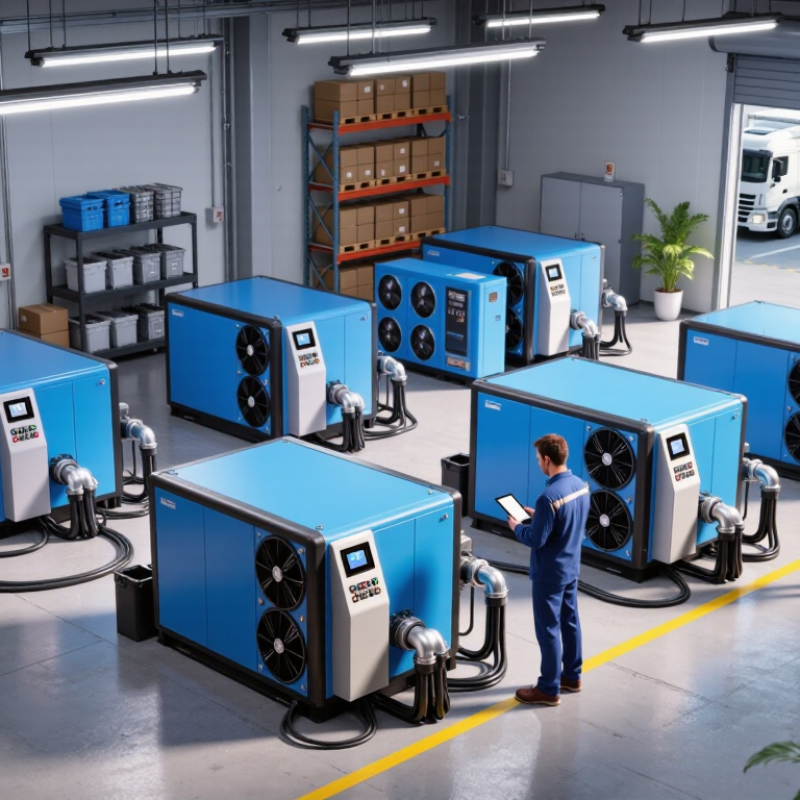
| A. Screw Air Compressor Market Scope |
| Product architecture | Oil-injected rotary screw compressors | Common industrial configuration for general plant air, manufacturing, workshops, and process support; usually paired with air treatment equipment. | Offers continuous-duty operation, stable airflow, and lower pulsation than reciprocating equipment. | Review the performance test report, duty-cycle rating, oil carryover data, and service intervals. |
| Product architecture | Oil-free rotary screw compressors | Used where compressed-air contamination must be tightly controlled, including selected food, pharmaceutical, electronics, and medical applications. | Reduces the risk of oil contamination in sensitive production processes. | Require ISO 8573-1 air-quality documentation and confirmation of the applicable Class 0 test basis. |
| Drive technology | Fixed-speed drive | Best suited to applications with relatively steady demand and high operating hours near rated capacity. | Typically has simpler controls and lower initial complexity, but may be less efficient at partial load. | Compare measured specific power at the expected operating profile rather than at full load only. |
| Drive technology | Variable-speed drive | Appropriate for demand that fluctuates during shifts, between production lines, or across operating seasons. | Can reduce unloaded running and improve energy performance under variable demand; actual savings depend on the load profile. | Request a part-load performance curve, minimum stable turndown, and drive operating limits. |
| Pressure segment | Low and standard industrial pressure | Approximately 7–8 bar(g) is common for general factory air, while higher setpoints may be selected for specialized equipment. | Selecting excessive pressure increases energy consumption and may reduce delivered flow. | Confirm minimum pressure required at the point of use and calculate pressure losses through dryers, filters, piping, and regulators. |
| Capacity segment | Small, medium, and large industrial systems | Capacity should be selected from measured demand, peak flow, leakage, future expansion, and required redundancy—not from connected equipment nameplates alone. | Correct sizing prevents short cycling, low-load inefficiency, production interruptions, and unnecessary capital cost. | Use a data logger or flow survey covering production peaks, weekends, idle periods, and shift changes. |
| Application sectors | Manufacturing, automotive, textiles, packaging, food processing, pharmaceuticals, electronics, and utilities | Required air quality, pressure stability, temperature control, noise limits, and redundancy vary substantially by sector. | A technically suitable compressor must also match the process risk and local regulatory environment. | Create an application specification covering air purity, dew point, operating hours, ambient conditions, and process criticality. |
| Geographic scope | Global industrial procurement | Key regional variables include electrical frequency, voltage, ambient temperature, altitude, local pressure units, import rules, and service availability. | A compliant machine may still be unsuitable if it cannot be installed, operated, or serviced locally. | Request region-specific electrical drawings, certificates, manuals, spare-parts plans, and commissioning support. |
| B. 2026 Technical and Commercial Buying Criteria |
| Air delivery measurement | Free Air Delivery and rated pressure | Compare delivered flow at the specified working pressure using a consistent test method, preferably ISO 1217 where applicable. | Nominal displacement or motor power alone does not establish usable output. | Require a performance sheet stating FAD, inlet conditions, discharge pressure, tolerances, and test standard. |
| Energy efficiency | Specific power | Evaluate input power per unit of delivered air, normally expressed as kW per m³/min or kW per m³/h at a stated pressure. | Electricity commonly represents the largest operating-cost component over the compressor life. | Compare full-load, part-load, and unloaded power using the same pressure and measurement basis. |
| Air quality | Oil concentration, particles, and water content | Specify the required ISO 8573-1 purity class and select filtration, drying, drainage, and monitoring accordingly. | Air quality directly affects product safety, equipment reliability, corrosion, and process yield. | Obtain laboratory test results and verify the complete system, not only the compressor package. |
| Dew point control | Refrigerated or desiccant air drying | Refrigerated dryers are commonly used for general plant air; desiccant dryers are selected when a substantially lower pressure dew point is required. | The correct dryer prevents condensation, freezing, corrosion, and process contamination. | Specify pressure dew point at the actual pressure and ambient conditions, including regeneration energy where relevant. |
| Operating environment | Ambient temperature, altitude, dust, humidity, and ventilation | Standard ratings may change at high ambient temperature or altitude; dusty environments require appropriate intake filtration and maintenance access. | Environmental derating can reduce capacity and shorten component life. | Request corrected performance data for the installation site and confirm allowable operating limits. |
| Reliability and redundancy | N+1 capacity, duty rotation, and backup strategy | Critical processes may require one additional compressor or an alternative backup source capable of maintaining minimum production air. | Redundancy reduces the impact of planned maintenance and unexpected failure. | Assess failure modes, mean time to repair, automatic sequencing, and emergency operating procedures. |
| Controls and connectivity | Sequencing, remote monitoring, alarms, and data logging | The control system should support pressure-band management, lead-lag rotation, operating-hour records, and fault notifications. | System-level control can prevent multiple machines from operating inefficiently at low demand. | Confirm communication protocols, cybersecurity responsibilities, data ownership, and integration requirements. |
| Noise and installation | Sound pressure, foundation, heat rejection, and access | Installation must provide adequate ventilation, lifting clearance, condensate management, and safe maintenance access. | Poor installation can cause overheating, excessive noise, vibration, and premature shutdowns. | Review layout drawings, sound data measurement conditions, heat-load calculations, and foundation requirements. |
| Maintenance strategy | Service intervals, consumables, and spare parts | Evaluate oil, filters, separators, belts or couplings, coolers, sensors, and recommended inspection intervals. | Availability and price of consumables can materially affect lifecycle cost and uptime. | Request a multi-year maintenance schedule, spare-parts list, lead times, and local technician coverage. |
| Compliance and documentation | Safety, electrical, pressure, and environmental requirements | Documentation may include conformity declarations, electrical schematics, pressure-vessel information, manuals, and applicable regional certificates. | Incomplete documentation can delay customs clearance, installation approval, commissioning, or insurance acceptance. | Make documentation deliverables a contractual requirement before shipment. |
| Total cost of ownership | Capital, energy, maintenance, downtime, and disposal cost | A lifecycle model should use local electricity tariffs, annual operating hours, expected load profile, service costs, and production-loss risk. | The lowest purchase price may not produce the lowest lifetime cost. | Request a transparent five- to ten-year cost model with clearly stated assumptions and sensitivity analysis. |
| Supplier qualification | Manufacturing quality, references, service network, and warranty | Evaluate quality systems, relevant installed references, response time, commissioning capability, warranty exclusions, and technical training. | Local technical support is essential for reducing downtime and maintaining performance after installation. | Use a weighted tender scorecard covering technical compliance, lifecycle cost, delivery, service, and documentation. |
| Procurement and delivery | Lead time, Incoterms, packaging, commissioning, and acceptance testing | The purchase contract should define delivery scope, factory testing, site acceptance criteria, training, packing for export, and responsibility for taxes and transport. | Clear commercial terms reduce schedule risk and disputes during handover. | Include a documented inspection and acceptance plan with measurable FAD, pressure, noise, and control requirements. |