o
p
t
i
m
a
r
o
b
o
t
i
c
s

Make a Call


Make a Call
Blogs
2026 Top Stamped Contact Spring Types for Global Buyers
In 2026, global buyers are evaluating Stamped Contact Spring designs with greater attention to reliability, miniaturization, and supply continuity. These components may look modest, yet they control contact pressure inside switches, battery assemblies, connectors, sensors, and compact electronic modules. Small parts. High stakes.
Industry forecasts support this purchasing shift. MarketsandMarkets’ recent connector market analysis identifies rising demand from automotive electronics, telecommunications, industrial controls, and consumer devices. Grand View Research also reports continued expansion in the global electrical and electronic connectors market, supported by vehicle electrification and higher device density. These trends increase pressure on spring suppliers to deliver consistent force, corrosion resistance, and stable electrical performance.
For buyers, the main question is not simply which spring costs less. It is whether the chosen type maintains contact after repeated compression, vibration, heat exposure, and surface contamination. Common options include flat stamped springs, cantilever contact springs, battery contact springs, grounding springs, and custom multi-point designs. Each geometry creates different force curves and installation requirements.
Material selection requires equal care. Stainless steel, copper alloys, and nickel-plated grades can behave differently under temperature cycling and current load. A supplier’s tooling experience also matters, especially when burr control and dimensional repeatability affect assembly yield. Fit matters.
This guide compares the leading Stamped Contact Spring types for global buyers in 2026. It uses practical selection criteria, manufacturing considerations, and published market research. Some supplier claims still deserve closer verification. Real performance depends on testing, not attractive specifications alone.
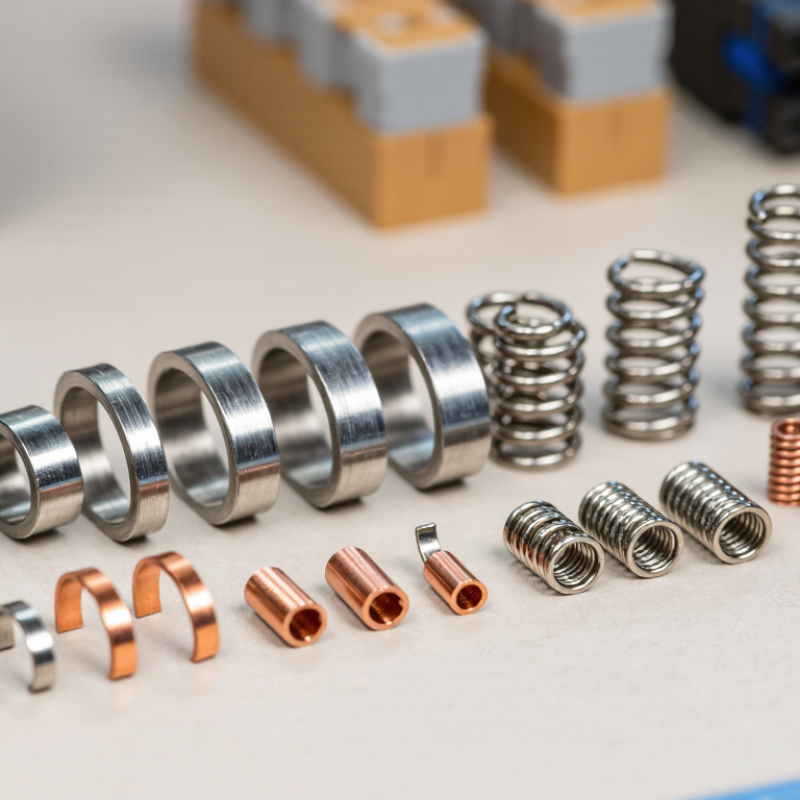
Table of Contents [Hide]
Stamped Contact Springs: Definition, Structure, and Operating Principles
Stamped contact springs are compact electrical components formed from flat metal strip. A press cuts and bends the material into a controlled spring profile. They provide pressure, electrical continuity, or both inside connectors, switches, battery contacts, and sensor assemblies.
Their structure usually includes a mounting base, flexible beam, contact crown, and terminal area. Small bends concentrate movement in the spring zone. The contact crown touches a mating surface, while the base holds alignment during assembly.
Copper alloys are common because they balance conductivity and resilience. Surface plating can improve corrosion resistance and reduce contact wear. Thickness, bend radius, and material temper strongly affect performance.
The operating principle is simple. When compressed, the spring stores elastic energy and pushes against the opposing contact. This force helps break through light surface films and maintain a stable current path during vibration.
Travel must remain within the elastic range. Excessive compression can cause permanent deformation. That mistake is easy to miss.
In practical design work, engineers check contact force, electrical resistance, insertion height, and cycle life. A spring may perform well in a sample but weaken after repeated loading. Manufacturing tolerance also matters. A few tenths of a millimeter can change the working force noticeably.
Testing should include dimensional inspection, compression cycling, temperature exposure, and vibration. Real assemblies often reveal problems that calculations overlook.
Brands
Proudly Trusted by Top Suppliers Worldwide







Let us know and we will automate, together to fit your industrial needs.
 +91-97254 16844
Clients
Proudly Trusted by Top Companies Worldwide


Do you need Help? Get in touch.
X
Please fill out the form below and we will get back to you as soon as possible.