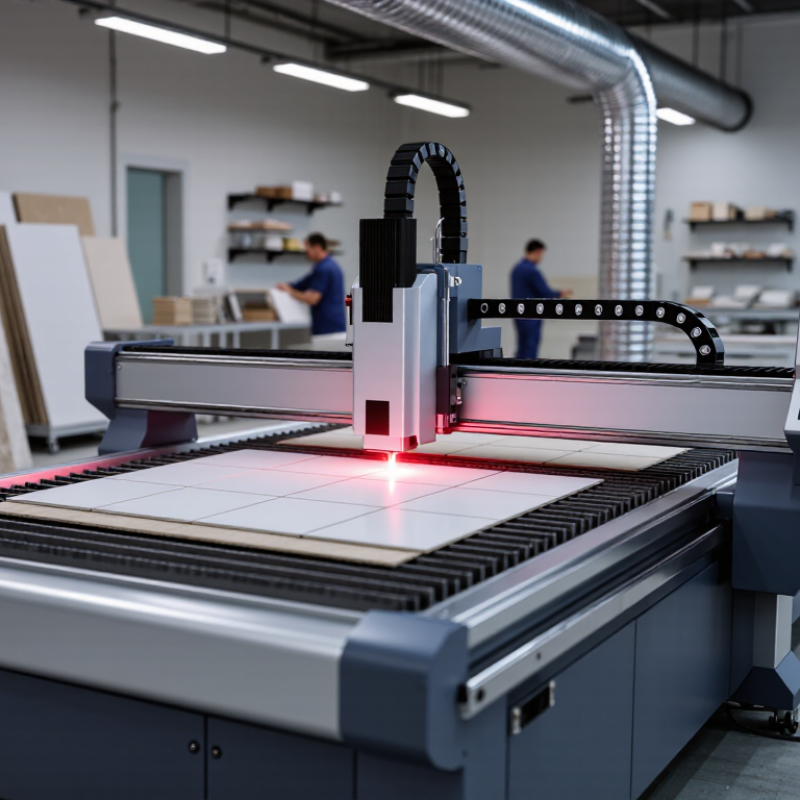
1. Compact Enclosed CO₂ Tile Laser ★★★★★ | Prototyping, small tile workshops, decorative inserts, sample production, and low-volume custom orders. | Sealed CO₂ laser tube, typically 80–100 W; air assist and water chiller normally included. | Approximately 600 × 400 mm to 900 × 600 mm. | Approximately US$4,000–US$10,000, excluding freight, import duties, installation, and local taxes. | Suitable for ceramic and porcelain samples, glazed surfaces, glass, and thin non-metallic sheets. Through-cutting thick tile may require multiple passes and can produce edge chipping or thermal stress. | Fully enclosed Class 1 design Door interlock Emergency stop Water-flow protection Fume extraction | Require a laser safety classification report, electrical test records, user manual, risk assessment, and evidence of conformity with applicable local rules. | Confirm remote commissioning, spare mirrors and lenses, tube replacement guidance, software support, and response times across the buyer’s time zone. | Best for low initial investment. Verify bed rigidity, cooling stability, extraction performance, and availability of local electrical service. |
2. Mid-Size CO₂ Flatbed Laser ★★★★★ | Regular production of decorative tile panels, logos, patterns, mosaic components, and medium-sized architectural pieces. | CO₂ laser, typically 130–150 W; closed-loop water chiller, air assist, and motorized focus commonly available. | Approximately 1,300 × 900 mm to 1,300 × 1,000 mm. | Approximately US$9,000–US$20,000. | Better suited to repeated work on ceramic, porcelain, glass, and stone-related non-metallic materials. Test samples are essential for tile thicknesses above approximately 6–10 mm. | Enclosed beam path Interlocked access doors Over-temperature alarm Water-level monitoring Exhaust filtration | Check CE or equivalent market documentation, IEC 60825-1 laser safety information, electrical schematics, and applicable machinery safety records. | Prefer suppliers offering installation videos, process parameter libraries, replacement optics, preventive-maintenance schedules, and operator training. | Balanced choice for many workshops. Compare usable bed size rather than advertised external dimensions and confirm the rated duty cycle. |
3. Industrial CO₂ Tile Cutting System ★★★★★ | Continuous production, tile decoration lines, high-volume custom orders, and integration with automated loading or unloading. | CO₂ laser, typically 200–300 W; industrial chiller, motorized optics, automatic height control, and stronger extraction system. | Approximately 1,300 × 2,500 mm to 2,000 × 3,000 mm. | Approximately US$20,000–US$50,000. | Designed for repeated work on ceramic and porcelain products, but final cut quality varies significantly with glaze, internal porosity, reinforcement, and thermal expansion. | Interlocked enclosure Beam-dump protection Dual emergency stops Smoke and fire monitoring Protected exhaust system | Require a complete technical file or equivalent documentation, conformity declaration, electrical safety test results, and laser safety labeling in the destination language. | Look for documented installation procedures, on-site or video acceptance testing, guaranteed spare-parts availability, and service-level terms for downtime-critical equipment. | Best for production-oriented buyers. Calculate power consumption, extraction requirements, compressed-air demand, and annual optics or tube replacement costs. |
4. Large-Format CO₂ Gantry Laser ★★★★☆ | Large architectural tiles, slab decoration, wall panels, signage, and oversized custom designs. | CO₂ laser, typically 300–600 W; large chiller, reinforced gantry, high-capacity extraction, and automatic focus options. | Approximately 2,000 × 3,000 mm to 2,500 × 4,000 mm. | Approximately US$35,000–US$90,000. | Suitable for large non-metallic workpieces where bed size is the main constraint. Heavy or thick tiles may require mechanical cutting, pre-scoring, or hybrid processing to avoid cracking. | Full perimeter guarding Multi-zone interlocks Fire detection High-volume extraction Access-control system | Confirm site-layout requirements, foundation or leveling specifications, electrical load data, exhaust approvals, and conformity documents for the destination country. | Prioritize local commissioning capability, technician travel terms, remote diagnostics, operator certification, and a recommended two-year spare-parts list. | High capital and installation cost. Choose this format only when large workpieces or high throughput justify the additional infrastructure. |
5. Galvo CO₂ Tile Engraving and Detail System ★★★★☆ | Fast surface marking, serial numbers, decorative textures, small logos, and detailed designs on finished tiles. | CO₂ galvo source, commonly 30–60 W; scanning head, f-theta lens, and optional rotary fixture. | Approximately 100 × 100 mm to 300 × 300 mm per scan field; larger designs require stitching. | Approximately US$8,000–US$25,000. | Strong for surface engraving and marking on glaze, ceramic, coated materials, and glass. Generally not the first choice for full-depth tile cutting. | Enclosed scan area Door interlock Beam shutter Fume extraction Reflective-surface risk controls | Verify laser class labeling, user-access controls, electrical conformity, software licensing terms, and documentation for reflected-beam hazards. | Confirm compatible design-file formats, calibration support, lens replacement guidance, and availability of scan-head components. | Best for speed and fine detail. Do not evaluate it as a substitute for a flatbed cutting machine unless the supplier demonstrates the required depth and edge quality. |
6. Low-Power UV Laser for Delicate Tile Decoration ★★★☆☆ | Fine marking, color-sensitive decoration, artwork, identification codes, and low-heat processing on selected surfaces. | UV laser, typically 10–20 W; air cooling or compact chiller depending on configuration. | Approximately 100 × 100 mm to 300 × 300 mm. | Approximately US$18,000–US$45,000. | Useful for delicate surface work on some glazed ceramics, glass, and coatings. Usually unsuitable for economical through-cutting of standard construction tiles. | Class 1 enclosure UV-rated viewing window Door interlock Ozone and fume extraction Emergency stop | Require UV laser hazard information, wavelength and power verification, electrical test results, conformity declaration, and destination-market labeling. | Request application testing, sample results, lens and source warranty terms, software training, and a clear procedure for calibration and replacement. | Higher price for specialized work. Select it when low heat input and surface quality matter more than cutting speed or material thickness. |
7. Hybrid Laser-and-CNC Tile Processing Cell ★★★★☆ | Mixed production involving laser marking or scoring plus mechanical routing, drilling, edge finishing, or conventional tile cutting. | CO₂ laser module commonly 80–150 W combined with a CNC spindle, diamond tool, water cooling, and dust or slurry management. | Approximately 1,300 × 2,500 mm to 2,000 × 3,000 mm. | Approximately US$30,000–US$80,000, depending on automation and tooling. | More practical when thick porcelain, stone, or brittle tile requires mechanical cutting while the laser handles marking, scoring, or detail work. | Interlocked enclosure Tool-guard protection Laser shutter Water-leak protection Dust/slurry extraction | Check conformity for both laser and CNC functions, electrical safety, guarding, emergency-stop circuits, water-management provisions, and local waste-disposal requirements. | Require integrated software support, tooling recommendations, preventive-maintenance training, spare-pump availability, and a documented acceptance test for both processes. | Best for broad material flexibility. Consider total operating cost, operator skill requirements, tooling wear, wastewater handling, and floor-space needs. |