o
p
t
i
m
a
r
o
b
o
t
i
c
s

Make a Call


Make a Call
Blogs
What Is a Backlit Letters Sign and How Does It Work?
A Backlit letters sign combines raised lettering with carefully placed illumination. It appears on storefronts, hotel façades, offices, restaurants, and retail interiors. During daylight, the letter shape and finish create the main visual impression. After sunset, hidden LEDs reveal the sign’s identity through a controlled glow.
Signage educator David B. Egan describes the broader purpose of effective signage with a simple phrase: “A sign is a silent salesperson.” A Backlit letters sign follows that principle without speaking. It attracts attention, communicates a brand name, and helps visitors recognize an entrance from the street. Quietly.
The construction is more practical than mysterious. Fabricated letters may use aluminum, stainless steel, acrylic, or combinations of these materials. LEDs sit inside or behind the letters, depending on whether the design uses face lighting, halo lighting, or both. A low-voltage power supply controls the illumination, while wiring and weather protection support dependable outdoor performance. The final effect depends on more than brightness. Letter depth, mounting distance, surface color, viewing angle, and surrounding light all matter.
A brighter sign is not always a better sign. Excessive glare can weaken readability and make a polished façade feel harsh. I once assumed that larger LEDs automatically produced a stronger result, but spacing and diffusion often matter more. This guide examines how a Backlit letters sign works, how professionals select its materials, and what installation details influence its appearance, energy use, and maintenance needs. Some projects still require adjustment after installation. Real façades rarely behave exactly like drawings.
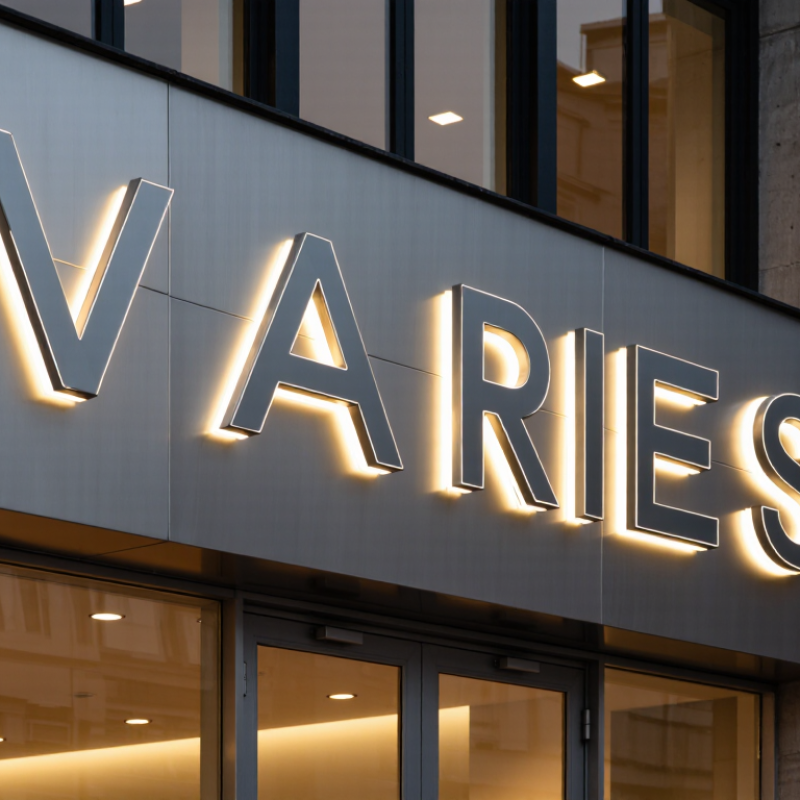
Table of Contents [Hide]
Definition and Anatomy: Faces, Returns, LEDs, and 50,000-Hour Lifespans
A backlit letters sign is a three-dimensional sign that glows from behind. It uses individually formed letters, numbers, or symbols. Each letter has a face, returns, and internal lighting. The face is the visible front surface. It may use acrylic, metal, or another translucent material. Returns are the sidewalls that give each character depth. Together, these parts create a shallow enclosure. The rear is often mounted against a wall or attached to a raceway.
LED modules sit inside the returns or behind the face. They spread light across the cavity, producing a soft halo around each letter. Correct spacing matters. LEDs placed too close can create bright spots, while wide gaps may cause dark areas. Ventilation also matters because trapped heat can shorten component life. A claimed 50,000-hour lifespan is a rating, not a promise. Heat, moisture, power quality, and installation methods can change actual performance. The number sounds exact, but real conditions are less predictable.
Tips: Ask for a lighting layout before fabrication. Check the face material in daylight and at night. Confirm that returns provide enough depth for even illumination. Inspect seals, wiring, and mounting points carefully. Small details matter. A sign can look excellent in a workshop yet appear uneven on a textured wall. Even experienced teams should review the design twice, because assumptions sometimes hide costly problems.
What Is a Backlit Letters Sign and How Does It Work? - Definition and Anatomy: Faces, Returns, LEDs, and 50,000-Hour Lifespans
| Data Dimension | Typical Specification or Fact | How It Affects the Sign |
|---|---|---|
| Definition | A dimensional sign with light-emitting components installed inside or behind raised letter forms. | Creates a halo or reverse-lit effect on the mounting surface rather than illuminating only the front face. |
| Letter Face | Commonly made from translucent acrylic, polycarbonate, or translucent coated metal; typical thickness is 3–6 mm. | Controls the visible surface, color, diffusion, and resistance to weather and impact. |
| Returns | The side walls of each letter, often formed from aluminum or metal sheet; typical depths range from 50–150 mm. | Provide dimensional depth, contain the LEDs, and influence the distance between the light source and the face. |
| Back or Mounting Plate | Usually aluminum, composite panel, or another rigid weather-resistant material. | Supports the letter structure and provides a surface for LED modules, wiring, and mounting hardware. |
| LED Light Source | Low-voltage LED modules or strips, commonly operating at 12 V or 24 V DC. | Produces the illumination with lower heat output and lower energy use than many traditional light sources. |
| LED Color Temperature | Warm white: approximately 2700–3500 K; neutral white: approximately 3500–4500 K; cool white: approximately 5000–6500 K. | Determines whether the halo appears warm, balanced, or bluish-white. |
| Light Distribution | Wide-angle LED modules are commonly spaced to distribute light across the interior surface. | Correct spacing reduces dark spots, bright points, and uneven halos. |
| Typical LED Spacing | Often approximately 75–150 mm apart, depending on module optics, letter depth, and required brightness. | Closer spacing generally improves uniformity but increases material use and electrical load. |
| Halo Gap | Letters are commonly mounted 25–75 mm away from the wall, depending on the desired glow. | A larger gap can create a broader, softer halo; a smaller gap produces a tighter and more defined outline. |
| Power Supply | An appropriately rated constant-voltage driver converts mains electricity to low-voltage DC. | Protects the LEDs from unsuitable voltage and must be installed with adequate ventilation and weather protection. |
| Energy Consumption | A typical small-to-medium backlit letter may use approximately 1–5 W, depending on size and brightness. | Total sign consumption depends on the number of letters, LED density, operating hours, and control settings. |
| Rated LED Life | Up to approximately 50,000 operating hours under specified temperature, voltage, and installation conditions. | At 10 hours per day, 50,000 hours equals about 13.7 years of operating time, although actual service life can vary. |
| Brightness Range | Common outdoor backlit signage may be designed around approximately 200–800 cd/m², depending on the application. | Higher brightness improves visibility in strong ambient light but may increase power use and glare. |
| Ingress Protection | Outdoor components are often selected to meet an enclosure or module rating such as IP65 or higher, where applicable. | Helps limit dust and water entry, but the complete installation still requires proper sealing and drainage. |
| Operating Temperature | Many LED systems are designed for approximately −20°C to +50°C, subject to the specific components used. | Temperature affects light output, driver performance, material expansion, and long-term reliability. |
| Typical Applications | Building façades, offices, hospitality venues, retail exteriors, campuses, and wayfinding installations. | Provides readable identification during the day while adding an architectural glow after dark. |
Note: Actual dimensions, electrical ratings, brightness, weather resistance, and service life depend on the sign design, components, installation quality, operating environment, and maintenance conditions.
Brands
Proudly Trusted by Top Suppliers Worldwide







Let us know and we will automate, together to fit your industrial needs.
 +91-97254 16844
Clients
Proudly Trusted by Top Companies Worldwide


Do you need Help? Get in touch.
X
Please fill out the form below and we will get back to you as soon as possible.