o
p
t
i
m
a
r
o
b
o
t
i
c
s

Make a Call


Make a Call
Blogs
What Is a Badminton Ballmaschine and How Does It Work?
A Badminton Ballmaschine is more than a box that launches shuttlecocks. It is a training partner with adjustable timing, speed, angle, and feeding frequency. By repeating specific shots, it helps players improve footwork, reaction speed, swing control, and recovery habits. The machine can feed high clears, flat drives, drops, or smashes across the court. Some models also change direction automatically, creating more realistic movement patterns.
Morten Frost, former world No. 1 badminton player and elite coach, once said, “Repetition builds confidence when every movement has purpose.” This idea explains why a Badminton Ballmaschine can support serious practice. It delivers consistent feeds, allowing players to study contact points and body balance without waiting for another person. A player can place the machine near the rear court, adjust the launch angle, and practise returning deep clears for several minutes. Small settings matter. A slightly faster feed can expose late preparation.
It is not magic.
The machine cannot replace tactical judgment, deception, or an experienced coach’s observation. It also cannot always reproduce an opponent’s unpredictable choices. I should admit that automated practice may become too comfortable when settings remain unchanged. Players need to vary placement, pace, and recovery demands. Used carefully, the equipment becomes a measurable training tool rather than a shortcut. This guide explains how a Badminton Ballmaschine works, what its main parts do, and how players can use it more intelligently.
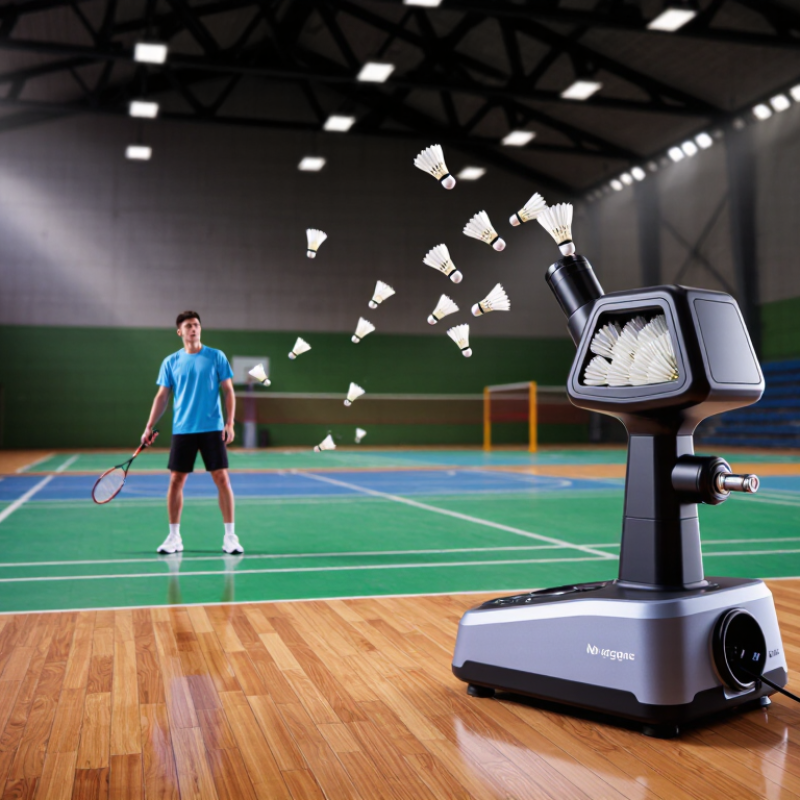
Table of Contents [Hide]
What Is a Badminton Ball Machine?
A badminton ball machine is more accurately called a shuttlecock machine. It feeds feather or synthetic shuttles across the court at controlled intervals. Rotating wheels create speed, while adjustable angles change height and direction. Some machines deliver straight clears, steep smashes, net shots, or alternating forehands and backhands.
The numbers matter. The Badminton World Federation’s Laws of Badminton specify a shuttlecock weight of 4.74 to 5.50 grams and a court length of 13.40 meters. A reliable machine should reproduce these distances consistently. Its feed rate may be set from slow practice rhythms to rapid defensive drills. In coaching sessions, I often begin with one shuttle every three seconds. Faster settings can expose poor footwork quickly.
It is not a substitute for a skilled coach. Not yet. A machine cannot read an opponent’s body position or create genuine match pressure. The SFIA 2024 Topline Participation Report continues to track badminton as a major recreational racquet activity in the United States, showing why accessible practice tools remain relevant. However, participation data does not prove that automated training improves every player. That assumption needs testing. Players should check shuttle alignment, wheel tension, battery condition, and court clearance before training. A small angle error can send dozens of shuttles into the net.
What Is a Badminton Ballmaschine and How Does It Work? - What Is a Badminton Ball Machine?
| Data Dimension | Factual Description | Practical Training Value |
|---|---|---|
| Definition | A badminton ball machine, sometimes called a shuttlecock launcher or “Ballmaschine,” is an automated device that feeds shuttlecocks to a player for repetitive practice. | Allows players to practice without a coach or training partner continuously feeding shuttles. |
| Main Components | Typical units include a shuttlecock hopper, feed mechanism, launch wheels or rollers, aiming mechanism, control panel, frame, and power system. | Each component contributes to consistent shuttle feeding, direction control, and repeatable drills. |
| How It Works | Shuttlecocks are placed in the hopper. A feeder separates them one at a time, and rotating wheels or a mechanical launcher propel each shuttle toward the court. | The player can repeat the same stroke pattern while adjusting footwork, timing, and recovery position. |
| Shuttlecock Compatibility | Machines may be designed for feather shuttlecocks, synthetic shuttlecocks, or both. Compatibility depends on the feeder and launch system. | Using the correct shuttle type helps reduce feeding errors and protects the shuttlecocks from unnecessary damage. |
| Feed Frequency | The interval between launches is adjustable on many machines. Common training settings range from a few seconds between shuttles to rapid continuous feeds, depending on the design. | Slow feeds support beginners and technique work, while faster feeds challenge reaction speed and endurance. |
| Launch Direction | The launch angle can usually be aimed toward different court areas, such as the front court, midcourt, rear court, forehand side, or backhand side. | Supports focused practice for net shots, lifts, clears, drives, defensive returns, and movement between court zones. |
| Speed and Distance | Output speed and travel distance vary according to wheel speed, launch angle, shuttle type, and machine settings. They should be adjusted to match the intended stroke and court area. | Correct settings create realistic trajectories without forcing the player to compensate for unsuitable speed or depth. |
| Oscillation | Some machines can move the launch direction from side to side or across a selected angle. Others require manual repositioning. | Horizontal variation helps develop lateral footwork, split-step timing, and recovery after each shot. |
| Training Drills | Common drills include straight clears, alternating forehand and backhand feeds, net-to-rear-court movement, defensive drives, and random-direction routines. | Different patterns train stroke consistency, movement efficiency, reaction ability, and aerobic conditioning. |
| Power Options | Depending on the design, a machine may use mains electricity, a rechargeable battery, or both. Battery operating time varies with feed rate and motor load. | Portable power is useful for courts without convenient electrical outlets, while mains power supports longer sessions. |
| Capacity | Hopper capacity differs by model and shuttle size. A larger hopper allows longer practice periods before reloading. | Higher capacity is convenient for multi-drill sessions, while a smaller hopper may make the unit lighter and easier to transport. |
| Control Methods | Controls may be located on the machine or provided through a wired or wireless remote. Adjustable functions commonly include speed, interval, direction, and oscillation. | Remote adjustments let players change drills without repeatedly walking back to the machine. |
| Key Benefits | A ball machine provides repeatable feeds, independent practice, adjustable difficulty, and measurable repetition. | It is especially useful for reinforcing technique and movement patterns, although it cannot fully reproduce the decisions and deception of a human opponent. |
| Safety Considerations | Players should keep a safe distance during setup, avoid placing hands near moving parts, use suitable eye protection when appropriate, and stop the machine before clearing a jam. | Following safe operating procedures reduces the risk of impact injuries and mechanical accidents. |
| Maintenance | Routine care includes removing damaged shuttle fragments, keeping feed paths clean, checking wheels and fasteners, charging batteries correctly, and storing the machine in a dry place. | Regular maintenance helps preserve feeding consistency and extends the service life of the equipment. |
Brands
Proudly Trusted by Top Suppliers Worldwide





Let us know and we will automate, together to fit your industrial needs.
 +91-97254 16844
Clients
Proudly Trusted by Top Companies Worldwide


Do you need Help? Get in touch.
X
Please fill out the form below and we will get back to you as soon as possible.