o
p
t
i
m
a
r
o
b
o
t
i
c
s

Make a Call


Make a Call
Blogs
Best Ceramic Irregular Nozzle Manufacturer in China?
Choosing the best Ceramic Irregular Nozzle Manufacturer in China requires more than comparing prices or polished product photos. Irregular ceramic nozzles often support spraying, coating, atomizing, cooling, and other demanding industrial processes. Their performance depends on geometry, ceramic composition, surface finish, and dimensional consistency.
A reliable supplier should explain these details clearly. Ask about alumina or zirconia grades, forming methods, firing temperatures, and machining tolerances. Request inspection records for opening size, wall thickness, concentricity, and surface defects. A small edge chip can disturb spray patterns, increase wear, or shorten service life. Practical experience matters here.
Look for a manufacturer with documented process control, sample-testing capability, and responsive technical support. They should discuss your pressure, flow rate, temperature, media, and installation conditions before recommending a design. Generic advice may sound efficient, but it can create expensive problems later. No supplier is perfect.
That point deserves attention. Even an experienced factory may need several design adjustments for a truly irregular nozzle. Ask how prototypes are tested and how changes are recorded. Clear drawings, traceable batches, and consistent communication help reduce uncertainty. Certifications can support trust, but they should not replace direct quality evidence.
This guide examines the factors behind a dependable Ceramic Irregular Nozzle Manufacturer. It focuses on manufacturing capability, material selection, inspection practices, customization, delivery reliability, and long-term technical support. The goal is not to name a supplier without verification. It is to help buyers make a careful, evidence-based decision. Performance should come first.
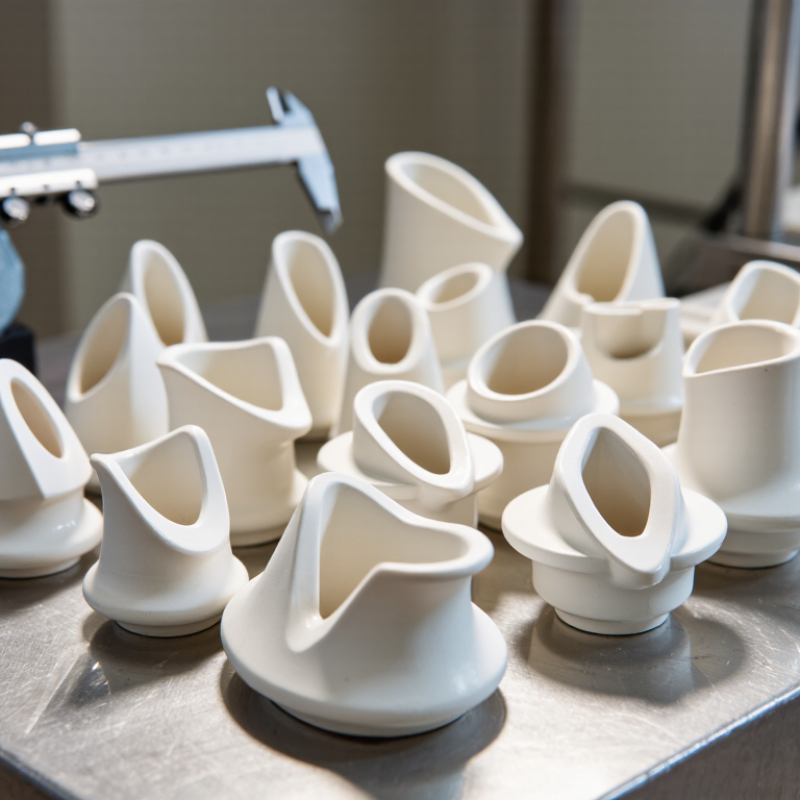
Table of Contents [Hide]
Ceramic Irregular Nozzles: Definition, Structure, and Main Applications
Best Ceramic Irregular Nozzle Manufacturer in China?
Ceramic Irregular Nozzles: Definition, Structure, and Main Applications
A ceramic irregular nozzle is a precision flow component with a non-circular outlet. Its opening may be oval, slotted, tapered, or asymmetrical. This geometry changes the spray pattern, impact area, and material distribution. Unlike standard round nozzles, irregular designs support controlled coverage in difficult processing zones. They are commonly made from alumina, zirconia, or silicon carbide. Material selection depends on temperature, abrasion, chemical exposure, and pressure.
The structure usually includes a mounting body, internal flow passage, transition chamber, and shaped outlet. The internal surface should remain smooth and accurately finished. Small defects can disturb flow and create uneven wear. A reliable manufacturer should control powder purity, molding pressure, sintering temperature, and dimensional shrinkage. Inspection may include microscopy, flow testing, hardness checks, and outlet measurement. Practical experience matters here. Drawings alone cannot reveal every production risk.
These nozzles serve spray drying, ceramic processing, thermal treatment, surface coating, and abrasive material handling. They can form a wide fan, narrow curtain, or directional jet. In spray drying equipment, the outlet influences droplet distribution and powder consistency. In coating systems, it helps cover flat or irregular surfaces with less overspray. Performance still depends on pressure, feed viscosity, particle size, and installation alignment. No design is perfect. Field testing may expose weaknesses that laboratory data misses. A careful supplier should welcome that feedback and adjust the structure when evidence supports a change.
| Data Dimension | Typical Data or Specification | Technical Description and Application Relevance |
|---|---|---|
| Definition | Engineered ceramic nozzle with a non-circular, asymmetric, angled, slot-type, or customized outlet | An irregular ceramic nozzle is designed to modify the direction, width, velocity, or distribution of a fluid, gas, abrasive, or molten material stream. Its outlet geometry differs from a standard round or straight-bore nozzle. |
| Primary Materials | Alumina, silicon carbide, zirconia, and selected nitride ceramics | Alumina is widely used for electrical insulation and general wear resistance. Silicon carbide is suitable for severe abrasion and thermal shock. Zirconia provides higher fracture toughness than many conventional oxide ceramics but is generally selected for more specialized applications. |
| Alumina Content | Common grades: approximately Al2O3 90%–99.8% | Higher-purity alumina generally offers improved chemical stability, hardness, electrical insulation, and high-temperature performance. The suitable grade depends on the process medium, temperature, impact loading, and cost requirements. |
| Typical Structure | Inlet, transition section, internal flow channel, irregular outlet, and mounting or sealing area | The internal channel controls flow behavior, while the transition section reduces abrupt turbulence and stress concentration. The mounting area may include a flange, thread, groove, shoulder, or press-fit surface. |
| Outlet Geometry | Slot, fan, oval, rectangular, multi-port, offset, angled, or custom contour | Outlet geometry is selected according to the required spray pattern, coverage width, impingement angle, particle distribution, or directional control. Complex profiles are commonly produced by precision forming, machining, or grinding. |
| Common Outlet Size Range | Approximately 0.5–10 mm equivalent opening, subject to design | The actual opening may not be circular, so flow area and hydraulic diameter are more meaningful than nominal diameter alone. Final sizing should be based on pressure, flow rate, viscosity, particle loading, and required coverage. |
| Dimensional Tolerance | Typically about ±0.02–±0.10 mm for precision features | Achievable tolerance depends on ceramic grade, feature size, production method, geometry, and inspection requirements. Critical outlets should be specified with a drawing-based tolerance rather than a general material tolerance. |
| Hardness | Alumina: commonly about 1,500–2,000 HV; silicon carbide: commonly about 2,000–3,000 HV | High hardness helps resist erosion from abrasive particles and wear from repeated flow. Hardness alone does not determine service life; fracture toughness, particle impact angle, temperature, and mounting quality are also important. |
| Working Temperature | Material-dependent; alumina and silicon carbide can support high-temperature service when properly designed | Actual operating temperature is limited by thermal gradients, pressure, seals, joints, contamination, and mechanical loading. A complete thermal and mechanical review is required for continuous high-temperature applications. |
| Chemical Resistance | Generally strong resistance to oxidation and many acidic or alkaline process environments | Resistance varies with ceramic composition, concentration, temperature, and exposure time. Compatibility should be verified for hydrofluoric acid, concentrated alkalis, molten chemicals, and other aggressive media. |
| Flow Characteristics | Controlled by outlet area, channel profile, pressure differential, viscosity, and fluid density | Irregular outlets can create flat-fan, directional, wide-angle, or multi-stream patterns. Computational fluid dynamics, flow-bench testing, or prototype testing may be used when distribution uniformity is critical. |
| Pressure Capability | Application-specific; determined by geometry, wall thickness, ceramic grade, and mounting design | Ceramic materials withstand compression well but are sensitive to tensile stress, impact, sharp corners, and uneven clamping. Pressure ratings should be validated using the complete nozzle assembly rather than the ceramic part alone. |
| Wear Resistance | High for abrasive powders, slurries, and particle-laden gas streams when properly selected | Ceramic nozzles are often used where polymer or metal outlets wear rapidly. Wear rate depends on particle hardness, concentration, velocity, impact angle, moisture, and the presence of chemical corrosion. |
| Electrical Properties | Alumina provides high electrical insulation; silicon carbide is comparatively conductive | Alumina is suitable for insulating fixtures, plasma-related components, and electrically isolated process areas. Silicon carbide may be selected for thermal and wear performance when electrical insulation is not the primary requirement. |
| Manufacturing Methods | Dry pressing, isostatic pressing, injection molding, extrusion, green machining, sintering, and diamond grinding | The best process depends on production volume, dimensional complexity, material, and required precision. Very small or intricate outlets commonly require post-sintering diamond machining or specialized finishing. |
| Surface Finish | Typically specified by application; smoother internal surfaces reduce flow disturbance and particle retention | Surface requirements should distinguish between internal flow surfaces, sealing surfaces, and external mounting surfaces. Excessive finishing may increase cost without improving performance in non-critical areas. |
| Main Application: Abrasive Blasting | Abrasive media acceleration and controlled directional discharge | Ceramic nozzles can be used for light- to medium-duty abrasive blasting where wear resistance and cost balance are important. More severe duty may require silicon carbide or other highly wear-resistant nozzle materials. |
| Main Application: Thermal Spraying | Powder, gas, or flame-flow control in coating processes | Irregular or angled outlets can help shape the spray plume or access difficult geometries. Thermal shock resistance, dimensional stability, and compatibility with the spray chemistry are key selection factors. |
| Main Application: Powder Processing | Powder conveying, dosing, atomization, and controlled discharge | Ceramic surfaces can reduce contamination and resist wear from hard powders. The design should consider powder cohesion, particle size distribution, flowability, and the risk of clogging at narrow or complex outlets. |
| Main Application: Chemical Processing | Gas distribution, liquid spraying, washing, quenching, and reaction equipment | Ceramic nozzles are useful where corrosion resistance and temperature stability are required. Chemical compatibility must be checked under the actual concentration, temperature, pressure, and flow conditions. |
| Main Application: Metallurgy and Furnaces | Cooling, burner-related flow control, protective gas delivery, and molten-material handling | High-temperature applications require careful control of thermal gradients and mounting stress. The nozzle design should also account for slag, scale, thermal cycling, and possible mechanical impact. |
| Main Application: Semiconductor and Electronics Equipment | High-purity gas or liquid distribution and electrically insulated process fixtures | High-purity alumina may be selected for its insulation, low outgassing potential after appropriate processing, and chemical stability. Cleanliness, particle control, and surface finish are normally more important than low initial cost. |
| Advantages | Wear resistance, high-temperature capability, chemical stability, and electrical insulation | Ceramic irregular nozzles can maintain their outlet profile for longer periods in demanding environments. Their main limitations are brittleness, sensitivity to impact, and the need for carefully designed mounting and handling. |
| Key Selection Criteria | Medium, flow rate, pressure, temperature, particle content, outlet pattern, tolerance, and mounting method | A reliable specification should include a technical drawing, material grade, density, porosity, hardness, dimensional tolerances, surface finish, inspection method, and test conditions for flow and leakage. |
| Quality Inspection | Dimensional inspection, visual inspection, density or porosity testing, flow testing, and leakage testing | For critical applications, additional checks may include microscopic examination, coordinate measurement, pressure testing, thermal-cycle testing, and verification of the spray or flow pattern under operating conditions. |
Brands
Proudly Trusted by Top Suppliers Worldwide







Let us know and we will automate, together to fit your industrial needs.
 +91-97254 16844
Clients
Proudly Trusted by Top Companies Worldwide


Do you need Help? Get in touch.
X
Please fill out the form below and we will get back to you as soon as possible.