o
p
t
i
m
a
r
o
b
o
t
i
c
s

Make a Call


Make a Call
Blogs
10 Best Toothbrush Mold Manufacturers for Global Buyers
Choosing among the 10 best toothbrush mold manufacturers takes more than comparing prices or polished catalog photos. A toothbrush mold must produce consistent parts, protect fine details, and support practical production cycles. Small features matter: bristle-hole positions, handle texture, parting lines, and the fit of moving components. A sample may look excellent. The harder test is whether later batches match it.
For technical context, Dr. David Kazmer is a plastics engineering scholar whose work covers injection molding and manufacturing. No verified, toothbrush-mold-specific quotation from him is provided here, so this guide does not invent one. Instead, a useful editorial principle is: “Repeatable quality matters more than a perfect first sample.” Treat it as a buyer’s checklist, not a quotation from Dr. Kazmer. Ask manufacturers how they control dimensions, inspect mold components, and address wear. Request evidence, not just assurances.
Details reveal the difference. Look for clear drawings, documented trial results, and realistic schedules for revisions and maintenance. Check whether the supplier understands your resin, cavity requirements, and expected production volume. A low quote can hide gaps in communication or after-sales support. It can also be a fair offer. Verify before deciding.
No supplier is ideal for every project. This ranking helps global buyers compare capabilities, communication, and support, while recognizing that the best choice depends on the product and production plan. A little skepticism helps.
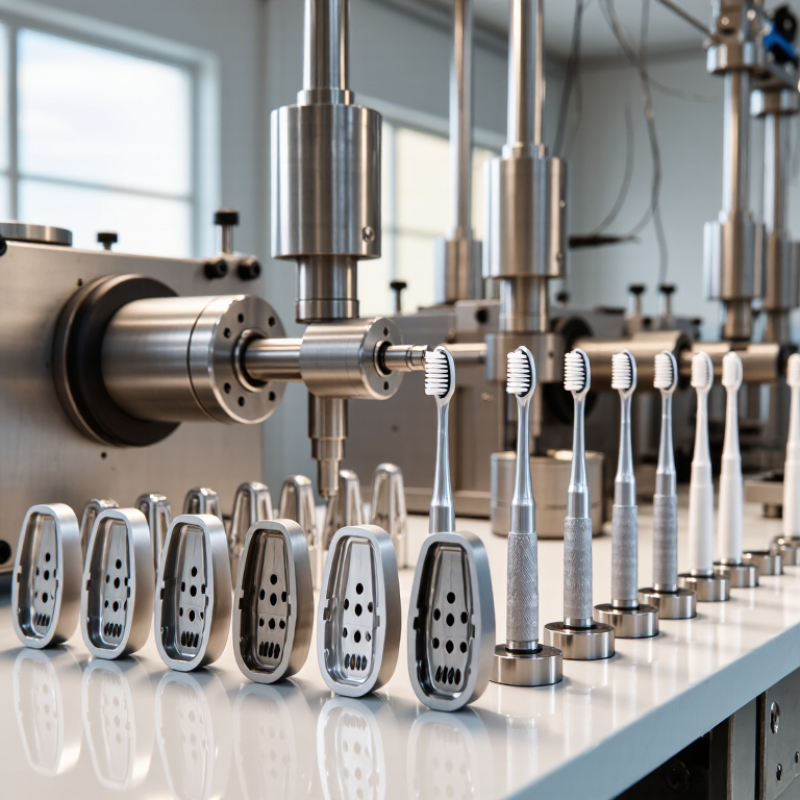
Table of Contents [Hide]
Understanding Toothbrush Molds and Their Role in Manufacturing
A toothbrush mold shapes the handle, neck, and head base during injection molding. It does not install the bristles; tufting happens in a later production step. Inside the mold, precisely cut cavities define the handle’s curves, grip texture, and dimensions. Small details matter. A shallow groove can affect comfort, while a rough parting line may leave a visible seam. Even minor dimensional errors can complicate assembly or packaging.
Mold design influences both product consistency and production efficiency. Cooling channels help control heat, while ejector pins release the molded handle without damaging it. Multi-cavity molds can produce several handles per cycle, but each cavity needs consistent filling and cooling. Manufacturers typically review drawings, material behavior, and sample parts before full production. A useful inspection checks dimensions, surface finish, and fit with the tufting process. A warped handle may point to material or process settings, not the mold alone. That distinction is easy to overlook.
Tips: Ask how sample parts are measured, not just whether they look acceptable. Check grip details under ordinary lighting, and inspect the parting line by touch. Confirm that the chosen material suits the mold design. Small trial runs can reveal issues early, though they rarely predict every production condition.
Brands
Proudly Trusted by Top Suppliers Worldwide







Let us know and we will automate, together to fit your industrial needs.
 +91-97254 16844
Clients
Proudly Trusted by Top Companies Worldwide


Do you need Help? Get in touch.
X
Please fill out the form below and we will get back to you as soon as possible.