o
p
t
i
m
a
r
o
b
o
t
i
c
s

Make a Call


Make a Call
Blogs
What Is a Centrifugal Fan and How Does It Work?
A Centrifugal Fan is a practical machine for moving air through buildings, factories, and process equipment. Unlike an axial fan, it turns airflow through a right-angle path. Air enters near the impeller’s center, then leaves through the casing under higher pressure. Picture air pulled into a rotating wheel and guided toward a discharge outlet. That simple path explains its usefulness in ventilation, dust collection, cooling, and combustion systems.
The U.S. Department of Energy’s Improving Fan System Performance: A Sourcebook for Industry identifies fans as major industrial electricity users. It also emphasizes system design, control, and maintenance rather than fan selection alone. The International Energy Agency’s Energy Efficiency 2023 report states that buildings consume about 30% of global final energy. Efficient air movement therefore matters beyond the equipment room. AMCA Publication 210 and ANSI/AMCA Standard 210 provide recognized methods for measuring fan airflow, pressure, and performance. These standards help engineers compare tested results with operating requirements.
Real installations are rarely perfect. Duct leakage, clogged filters, oversized motors, and poorly adjusted dampers can reduce efficiency. Sometimes, a quieter fan performs better than a stronger one. The numbers can surprise you. A centrifugal fan may deliver excellent pressure, yet waste energy when operating far from its design point. This guide explains the impeller, housing, pressure conversion, fan curves, and common control methods. It also considers practical selection issues, including noise, maintenance access, motor efficiency, and variable-speed operation. Some simplified explanations cannot represent every installation. That limitation deserves attention. Performance depends on the whole system, not the fan alone.
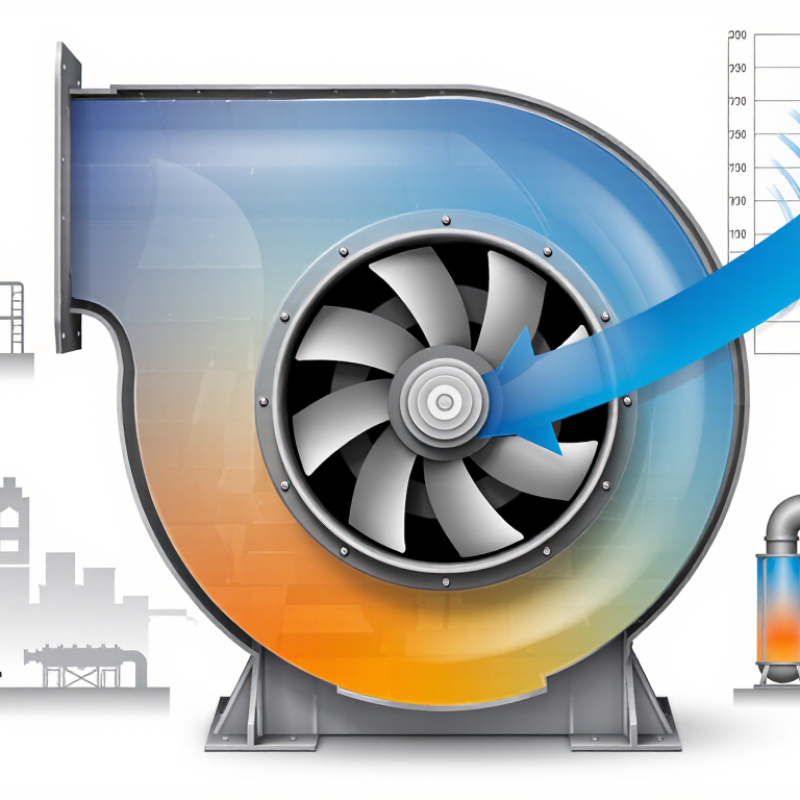
Table of Contents [Hide]
What Is a Centrifugal Fan?
A centrifugal fan is a mechanical device that moves air or gas by changing its direction and increasing its pressure. Unlike an axial fan, it draws air into the center of a rotating wheel and pushes it outward through a housing. This radial movement gives the fan its common alternative name, radial fan. The wheel usually contains curved blades, a hub, and a shaft connected to a motor. The surrounding casing guides airflow toward the outlet.
During operation, the motor turns the wheel at a controlled speed. Air enters through the inlet near the shaft, where the rotating blades capture it. Centrifugal force and blade geometry drive the air toward the outer edge. As air leaves the wheel, part of its velocity changes into static pressure inside the casing. The outlet then directs pressurized air into ductwork, filters, heaters, or process equipment. It can handle resistance better than many simple propeller fans.
Performance depends on wheel size, speed, blade shape, air density, and system resistance. A technician should check the fan curve, airflow requirement, pressure loss, temperature, and noise level before selection. Poorly matched equipment may waste energy or deliver less air than expected. I have found that installation details matter more than specifications alone; a sharp duct bend near the outlet can disturb flow and create vibration. The term “centrifugal force” is useful in practice, although engineers often explain pressure rise through rotating-flow principles. That distinction is easy to overlook.
Brands
Proudly Trusted by Top Suppliers Worldwide







Let us know and we will automate, together to fit your industrial needs.
 +91-97254 16844
Clients
Proudly Trusted by Top Companies Worldwide


Do you need Help? Get in touch.
X
Please fill out the form below and we will get back to you as soon as possible.