o
p
t
i
m
a
r
o
b
o
t
i
c
s

Make a Call


Make a Call
Blogs
China Best Graphite Clay Crucible Supplier?
Choosing the China Best Graphite Clay Crucible Supplier requires more than comparing prices. A reliable supplier should prove material consistency, production capability, and quality control. The right Graphite Clay Crucible must withstand repeated heating, resist thermal shock, and support clean metal melting. These details matter in foundries, laboratories, and small casting workshops.
Practical evaluation should begin with the crucible’s graphite content, clay composition, density, and maximum working temperature. Ask for technical data, inspection records, and sample testing before placing a large order. A professional manufacturer should explain how it controls forming, drying, firing, and surface finishing. Photos are useful, but they cannot replace physical inspection. That lesson is easy to overlook.
Supplier experience also deserves close attention. A factory serving different industries may understand varied furnace designs and operating conditions. Check its production equipment, export history, packaging methods, and response speed. Ask whether the supplier can provide consistent dimensions across repeated batches. Even a strong factory may show occasional defects, so transparent after-sales support is essential.
Look for evidence.
The best choice is not always the lowest quotation. A cheaper crucible may crack sooner, increase replacement costs, or contaminate the melt. However, no supplier should be called “best” without matching your specific process. Compare test results, communication, certifications, and delivery reliability together. This approach helps buyers identify a dependable China-based Graphite Clay Crucible partner while leaving room for careful review and honest improvement.
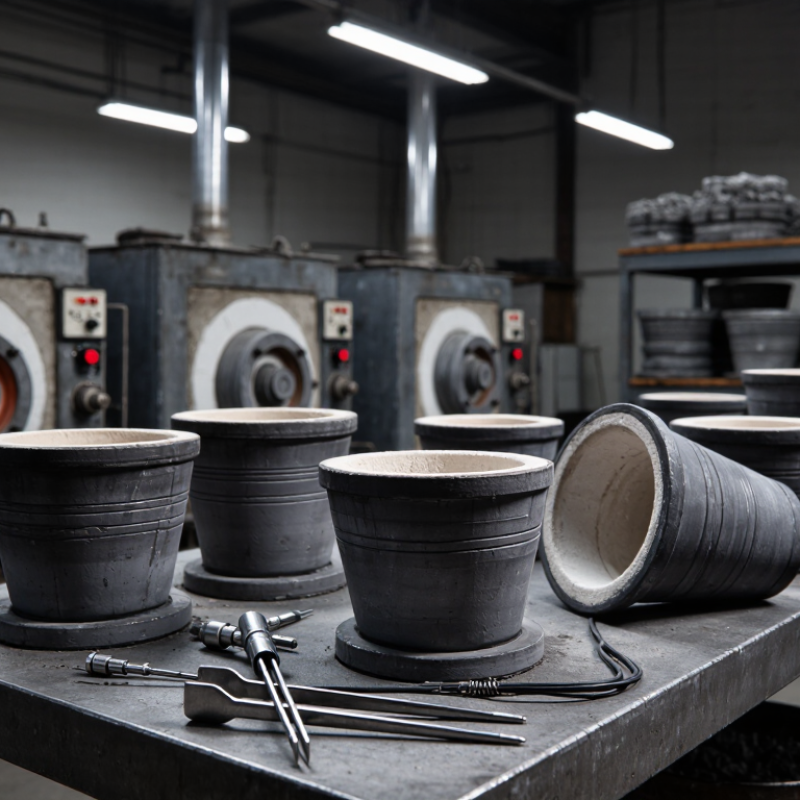
Table of Contents [Hide]
What Is a Graphite Clay Crucible?
A graphite clay crucible is a heat-resistant vessel made from natural graphite and refractory clay. It holds molten metal inside a furnace during melting and casting. Graphite transfers heat efficiently, while clay helps the crucible keep its shape at high temperatures. This combination also provides useful resistance to thermal shock and chemical attack.
In practical furnace work, these crucibles often handle aluminum, copper, brass, and other nonferrous metals. Their dark surface can reduce sticking, but it does not prevent every reaction. The correct crucible depends on melting temperature, metal chemistry, furnace atmosphere, and heating speed. A crucible designed for aluminum may perform poorly with another alloy.
It is not indestructible. Moisture, sudden heating, or a hidden crack can cause failure. Operators should store crucibles in a dry area and inspect them before use. Gentle preheating removes moisture and reduces thermal stress. Handle it carefully. Overfilling is another common mistake, because molten metal expands and may spill over the rim. Even experienced users can misjudge service life when slag builds up or repeated heating weakens the wall. That detail is easy to overlook.
China Best Graphite Clay Crucible Supplier? - What Is a Graphite Clay Crucible?
| Data Dimension | Typical Information | Practical Importance | Selection Notes |
|---|---|---|---|
| Product definition | A refractory melting vessel made primarily from graphite and clay, used to contain and heat metals or other high-temperature materials. | Combines graphite’s thermal conductivity with clay’s refractory bonding and shaping capability. | Confirm that the crucible is intended for the target metal, furnace type, and heating atmosphere. |
| Main raw materials | Natural or processed graphite, refractory clay, and small amounts of additives or binders depending on the manufacturing process. | Material selection affects thermal shock resistance, chemical compatibility, strength, and service life. | Ask for a technical datasheet rather than judging quality by appearance alone. |
| Common graphite content | Often approximately 30%–60% by mass in traditional graphite-clay formulations; the actual level varies by design and application. | Higher graphite content can improve thermal conductivity and resistance to rapid temperature changes, but formulation balance remains essential. | Treat the percentage as a specification to verify, not as a universal industry standard. |
| Typical maximum service temperature | Many graphite-clay crucibles are used in applications up to roughly 1,200°C–1,600°C, depending on construction, atmosphere, and heating method. | The allowable operating temperature determines whether the crucible can safely melt the intended material. | Do not use the advertised maximum as a continuous operating target; follow the supplier’s rated working temperature. |
| Suitable metals | Common applications include melting aluminum, copper, brass, bronze, cast iron, and selected precious-metal alloys. | Different molten metals can cause different levels of chemical attack, oxidation, or contamination. | Check compatibility before melting reactive alloys, salt-containing charges, or materials that may attack carbon. |
| Thermal conductivity | Generally higher than that of many conventional oxide-based ceramic crucibles because graphite conducts heat efficiently. | Promotes comparatively fast and more uniform heat transfer during melting. | Actual performance depends on graphite grade, porosity, wall thickness, and furnace conditions. |
| Thermal shock resistance | Typically good when the crucible is correctly formulated, dried, preheated, and operated within its rating. | Helps reduce cracking caused by rapid heating, cooling, or uneven temperature distribution. | Avoid cold charging into a red-hot crucible and avoid placing a hot crucible on a cold or wet surface. |
| Atmosphere sensitivity | Graphite oxidizes in air at elevated temperatures; oxidation becomes a major service-life concern during prolonged hot operation. | Oxidation can thin the crucible wall, weaken the structure, and shorten usable life. | Use suitable furnace control, protective coatings, or a non-oxidizing atmosphere when required. |
| Typical density range | Common commercial graphite-clay crucibles often fall broadly within about 1.8–2.4 g/cm³, depending on porosity and formulation. | Density influences mechanical strength, heat transfer, oxidation behavior, and resistance to molten-metal penetration. | Compare density only when test methods and product compositions are comparable. |
| Porosity and permeability | Controlled open porosity is normal, while excessive porosity may increase metal penetration and oxidation. | Affects contamination risk, resistance to thermal shock, and the number of usable heating cycles. | Look for consistent walls, a sound rim, and a documented quality-control process. |
| Available shapes | Common forms include cylindrical, round-bottom, pouring, bale-out, and furnace-specific shapes. | Shape affects stability, filling efficiency, pouring control, and heat distribution. | Match the base and external dimensions to the furnace support and heating zone. |
| Capacity range | Commercial sizes range from small laboratory or workshop crucibles to large industrial vessels holding several hundred kilograms, depending on the metal density and design. | Capacity determines batch size, furnace productivity, and safe pouring weight. | Specify both nominal capacity and the target metal; capacity differs by material density. |
| Heating methods | Used in gas-fired, oil-fired, electric-resistance, induction, and other compatible furnace systems. | The heat source changes the temperature profile, atmosphere, and mechanical load on the crucible. | Confirm whether the selected crucible is designed for direct flame, induction, or enclosed electric heating. |
| Preheating requirement | A gradual drying and preheating cycle is normally required before the first molten-metal charge. | Removes moisture and reduces the risk of thermal shock or steam-related failure. | Follow the product-specific heating schedule and never use a damp or visibly damaged crucible. |
| Quality and safety checks | Inspect for cracks, chips, distortion, soft spots, excessive oxidation, and unusual metal penetration before every use. | Routine inspection helps prevent leakage, sudden breakage, molten-metal spills, and unplanned downtime. | Use appropriate protective equipment, lifting tools, furnace guards, and documented operating procedures. |
Note: Performance values are typical industry ranges. Exact specifications vary according to composition, manufacturing method, crucible geometry, furnace type, operating atmosphere, and molten material.
Brands
Proudly Trusted by Top Suppliers Worldwide







Let us know and we will automate, together to fit your industrial needs.
 +91-97254 16844
Clients
Proudly Trusted by Top Companies Worldwide


Do you need Help? Get in touch.
X
Please fill out the form below and we will get back to you as soon as possible.