o
p
t
i
m
a
r
o
b
o
t
i
c
s

Make a Call


Make a Call
Blogs
China Top SMC Slice Material Press Manufacturer?
China’s SMC press industry is expanding with automotive electrification, lightweight transport, and demand for corrosion-resistant components. A Smc Slice Material Press converts pre-cut sheet molding compound into consistent panels, housings, and structural parts. Its value depends on more than rated tonnage.
Grand View Research estimated the global composites market at approximately USD 112.7 billion in 2023. Its report also projected strong growth through 2030, supported by transportation and construction applications. MarketsandMarkets has similarly identified compression molding as a key process for high-volume composite production. These figures describe broader markets, not China’s exact press rankings. That distinction matters.
As composites specialist Dr. Sanjay K. Mazumdar has stated, “A press is only as good as its process control.” This practical observation explains why buyers should examine platen parallelism, heating uniformity, hydraulic response, mold protection, and data logging. A machine may show impressive pressure on paper. It can still produce uneven thickness or resin-rich edges.
The strongest Chinese manufacturer is therefore not automatically the largest supplier. Buyers should request sample parts, cycle-time records, energy data, and references from comparable SMC applications. Factory audits remain useful. So does skepticism.
A reliable comparison should also examine after-sales engineering, spare-part availability, controller stability, and operator training. Small details become visible on the shop floor: temperature drift, slow mold opening, or inconsistent slice placement. The market is promising, but published claims can be incomplete. This guide evaluates China’s leading Smc Slice Material Press manufacturers through measurable performance, application experience, and documented customer support.
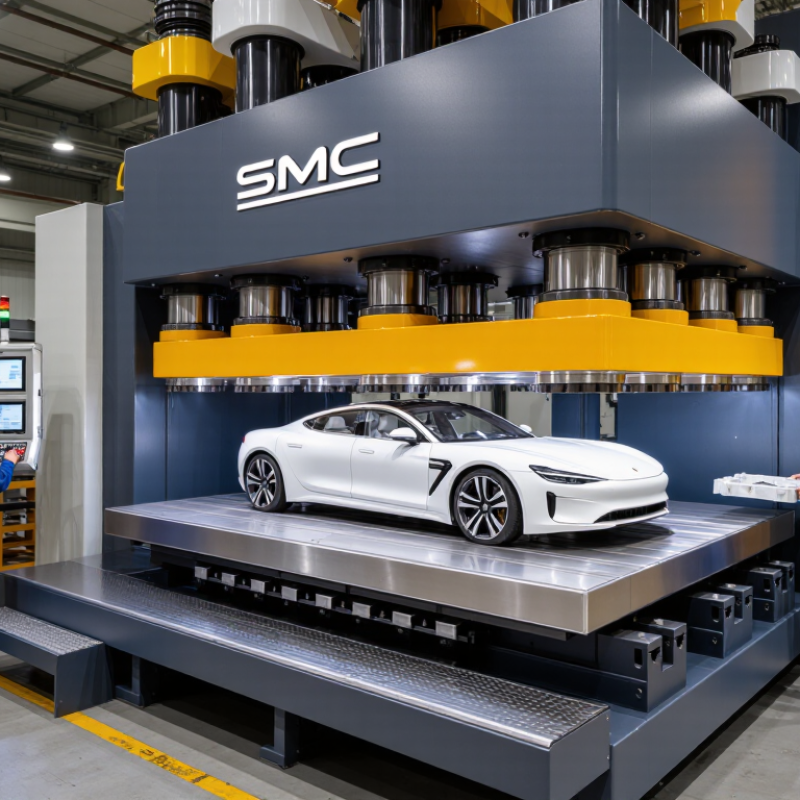
Table of Contents [Hide]
What Is an SMC Slice Material Press?
An SMC slice material press is industrial equipment used to shape measured pieces of Sheet Molding Compound into finished components. SMC combines resin, chopped glass fibers, mineral fillers, pigments, and curing agents. The press places this prepared charge inside a heated mold. Pressure then spreads the material through the cavity and forms the required geometry.
A reliable machine needs more than high closing force. Its hydraulic system should control pressure smoothly, while the heating plates should maintain even temperatures across the mold surface. Uneven heat can create weak areas, surface marks, or incomplete curing. Operators also check charge weight, placement, mold temperature, pressing time, and cooling conditions. Small changes matter. A few misplaced slices may cause flow lines or resin-rich edges.
For buyers comparing a China top SMC slice material press manufacturer, practical verification is essential. Ask for mold trials, pressure records, temperature uniformity data, and samples from comparable parts. Safety guarding, emergency stops, controlled access, and clear maintenance procedures should be visible during inspection. A large press is not automatically a better press. The correct capacity depends on part size, material volume, mold design, and production rhythm. In real factories, setup errors remain a frequent problem. Even advanced equipment can produce inconsistent parts when operators lack training or the process window is too narrow. Performance should be judged through repeatable results, not impressive specifications alone.
Brands
Proudly Trusted by Top Suppliers Worldwide







Let us know and we will automate, together to fit your industrial needs.
 +91-97254 16844
Clients
Proudly Trusted by Top Companies Worldwide


Do you need Help? Get in touch.
X
Please fill out the form below and we will get back to you as soon as possible.