o
p
t
i
m
a
r
o
b
o
t
i
c
s

Make a Call


Make a Call
Blogs
China Top Handheld Portable UV Lamp Manufacturers
China’s handheld UV lamp sector attracts buyers seeking compact tools for targeted disinfection and inspection. A Handheld Portable Uv Lamp may look simple, but wavelength, output, exposure time, and beam coverage shape its real-world performance. A bright blue glow alone proves little.
Grand View Research estimated the global UV disinfection equipment market at USD 4.8 billion in 2023, with projected annual growth of 13.1% from 2024 to 2030. This broad category includes far more than handheld products. It should not be treated as a sales forecast for portable lamps. Small differences matter. For buyers comparing China Top Handheld Portable UV Lamp Manufacturers, useful checks include measured irradiance, battery runtime, material quality, and clear operating instructions. Ask how performance is tested, not just what the product claims.
A cautious perspective comes from Dr. David J. Weber, an infection-prevention specialist whose published work with William A. Rutala discusses ultraviolet disinfection as an adjunct to established cleaning practices. Their research supports a practical takeaway: UV devices should complement, not replace, routine cleaning. That distinction deserves attention. Manufacturers can differ in testing transparency, documentation, and consistency between samples. Even a polished product sheet may leave key questions unanswered. A credible supplier should explain the lamp’s intended use, provide test details, and state its limits plainly. This overview examines makers through those practical signals, rather than relying on rankings or broad market promises.
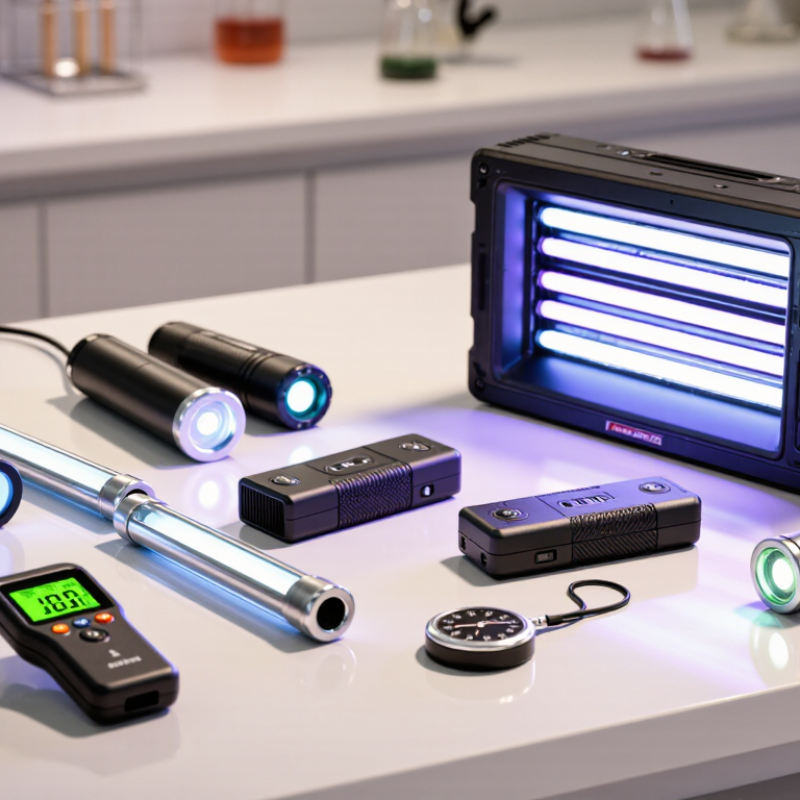
Table of Contents [Hide]
What Are Handheld Portable UV Lamps?
Handheld portable UV lamps are compact electrical devices that emit ultraviolet light, often UV-C, onto a targeted surface. They are designed for spot treatment of exposed, nonporous items such as a tabletop or door handle. Their small size is convenient. But it does not make disinfection automatic.
Performance depends on wavelength, exposure time, distance, and beam angle. Shadows matter: UV light cannot reliably reach beneath a curved object or through dust and fabric. A 2021 study in Scientific Reports by Biasin and colleagues reported over 99% SARS-CoV-2 inactivation at a UV-C dose of 3.7 mJ/cm² under laboratory conditions. That result describes a controlled test, not every handheld device or real-world surface. A lamp’s advertised output alone cannot confirm the dose received by an object.
Use the device only as its manufacturer directs, and never aim UV-C at people or animals; direct exposure can injure eyes and skin. Keep the target still, clear visible debris, and allow the full stated exposure time. A small caveat: “portable” can sound reassuring, yet uneven coverage is easy to miss. These lamps can support surface hygiene, but they do not replace ordinary cleaning.
China Top Handheld Portable UV Lamp Manufacturers - What Are Handheld Portable UV Lamps?
Handheld portable UV lamps are compact, movable devices that emit ultraviolet radiation for tasks such as fluorescence inspection, curing, or controlled germicidal applications. The correct wavelength and safety controls depend on the intended use; UV lamps are not interchangeable.
| Lamp category | Typical wavelength | Common applications | Light source and practical notes | Key details to check when sourcing | Important safety considerations |
|---|---|---|---|---|---|
| UV-A inspection lamp | Commonly 365 nm or 395 nm | Fluorescent leak detection, inspection of security features, and viewing fluorescent materials. | Usually uses UV-A LEDs. A 365 nm lamp often produces less visible violet light than a 395 nm lamp, which can make some fluorescence easier to distinguish. | Confirm the peak wavelength, irradiance at a stated distance, beam pattern, and whether a visible-light filter is included. | UV-A is less hazardous than UV-B or UV-C, but direct viewing and prolonged skin exposure should still be avoided. Use suitable eye protection. |
| UV-A curing lamp | Often 365–405 nm, depending on the material being cured | Small-scale curing of compatible UV-curable inks, coatings, adhesives, or resins. | Typically LED-based in compact units. Curing performance depends on the material’s absorption spectrum, irradiance, exposure time, and distance. | Request spectral and irradiance data, recommended working distance, illuminated area, and compatibility information for the target material. | Follow the material supplier’s curing and protective-equipment instructions. Shield eyes and skin from direct exposure. |
| Germicidal UV-C lamp | About 254 nm for common low-pressure mercury sources | Germicidal irradiation in purpose-designed, controlled systems; handheld formats require particular caution. | Low-pressure mercury lamps commonly emit near 254 nm. UV-C effectiveness depends on dose, exposure geometry, shadowing, and the target organism. | Verify wavelength, measured irradiance and measurement distance, exposure-time guidance, shielding, and safety interlocks. | UV-C can injure eyes and skin. Do not expose people or animals to direct UV-C; use only with appropriate containment and safety controls. |
| UV-C LED lamp | Commonly within 265–280 nm | Specialized disinfection or research applications where a compact UV-C source is required. | Uses UV-C LEDs. Output and efficiency vary by wavelength, device design, temperature, and operating conditions; LED emission is not automatically equivalent to a validated disinfection dose. | Ask for the spectral peak, irradiance map, operating-temperature limits, LED lifetime test conditions, and validated dose information for the intended use. | UV-C exposure is hazardous. Provide effective shielding, interlocks, warning labels, and operating procedures; never rely on appearance to judge whether a lamp is safe. |
| Portable power and housing | Depends on the UV source fitted | Field inspection, maintenance work, laboratory tasks, and other applications requiring a movable light source. | Portable models may use a rechargeable battery or an external power supply. Runtime depends on battery capacity, UV output, operating mode, and temperature. | Check battery capacity and runtime test conditions, charging method, housing material, thermal management, switch design, and any ingress-protection rating claimed. | Battery and housing features do not reduce UV exposure risk. Confirm that the device has appropriate controls for its UV wavelength and intended environment. |
Purchasing note: Compare products using documented wavelength and irradiance measurements, with the measurement distance clearly stated. Ask suppliers for test reports and safety documentation relevant to the specific model and application. A handheld UV lamp should not be described as a disinfectant solution unless its effectiveness has been validated for the stated conditions.
Brands
Proudly Trusted by Top Suppliers Worldwide







Let us know and we will automate, together to fit your industrial needs.
 +91-97254 16844
Clients
Proudly Trusted by Top Companies Worldwide


Do you need Help? Get in touch.
X
Please fill out the form below and we will get back to you as soon as possible.