o
p
t
i
m
a
r
o
b
o
t
i
c
s

Make a Call


Make a Call
Blogs
Why Choose a Feed Pellet Mill for Your Business?
Feed production is a large, competitive business, and small process improvements can matter. Alltech’s 2024 Agri-Food Outlook estimated global feed production at 1.29 billion metric tons in 2023, drawing on information from 142 countries. It is an industry estimate, not a complete census. Still, it shows the scale of demand behind decisions about efficient, consistent manufacturing.
A Feed Pellet Mill can turn conditioned mash into compact pellets that are easier to store, transport, and handle. For operators, that may mean less ingredient separation during handling and more uniform portions at the feeder. The results depend on the full process, not the machine alone. Grind size, moisture, steam conditioning, die specifications, and roller settings all influence pellet quality and energy use. A poorly matched die can raise power consumption or produce fragile pellets. That matters.
Choosing a mill is therefore a business decision, not simply an equipment purchase. Buyers should compare capacity against realistic daily demand, review maintenance access, and ask how output changes across feed formulas. Request measurable performance data, such as throughput, energy use per ton, and pellet durability under stated conditions. Check the assumptions behind every figure. Results from one plant may not transfer neatly to another. A mill can improve production, but it cannot fix every formulation or management problem. That part deserves honest attention.
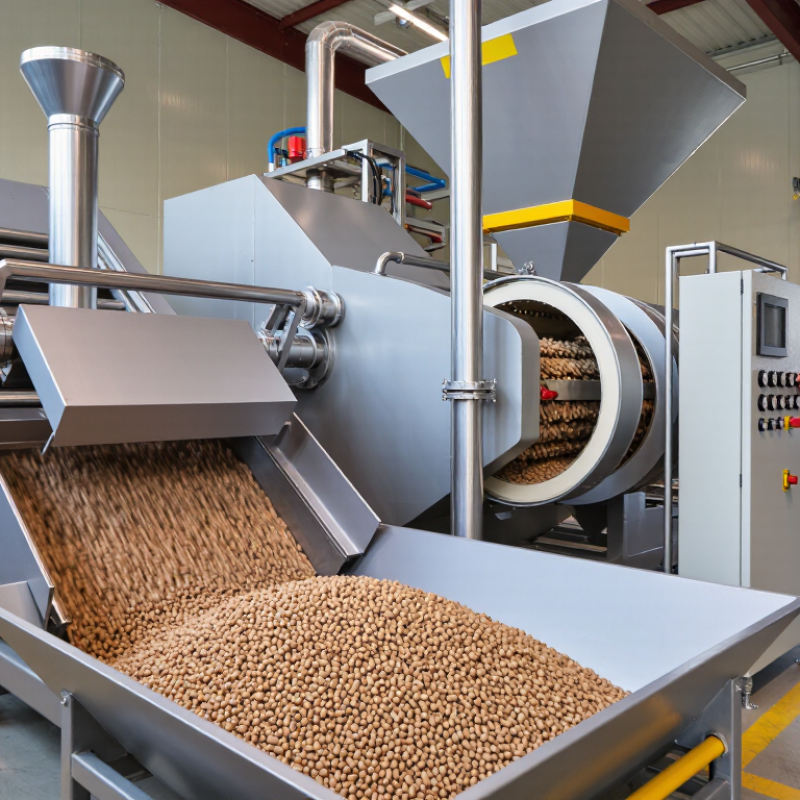
Table of Contents [Hide]
What a Feed Pellet Mill Is and How It Works
A feed pellet mill converts prepared mash into compact, uniform feed pellets. A typical line includes grinding, batching, mixing, conditioning, pressing, cooling, and screening. During conditioning, steam and moisture soften the mash, helping it bind as it passes through a die. Rollers press the material through small openings, and rotating knives cut the emerging strands to length. The pellets then cool and dry before storage or delivery. Small details matter.
Alltech’s 2024 Agri-Food Outlook estimated that global feed production reached 1.29 billion metric tons in 2023, based on its survey across 142 countries. That figure covers manufactured feed overall, not pellet production alone, but it shows the scale of the industry a mill may serve.
In practice, operators adjust moisture, temperature, die size, and throughput to suit the recipe and equipment. A pellet that looks firm can still crumble during handling. Too much heat may also affect heat-sensitive ingredients. These trade-offs are easy to underestimate.
Reliable operation therefore depends on routine checks, recorded process settings, and testing finished pellets—not appearance alone.
Brands
Proudly Trusted by Top Suppliers Worldwide







Let us know and we will automate, together to fit your industrial needs.
 +91-97254 16844
Clients
Proudly Trusted by Top Companies Worldwide


Do you need Help? Get in touch.
X
Please fill out the form below and we will get back to you as soon as possible.