o
p
t
i
m
a
r
o
b
o
t
i
c
s

Make a Call


Make a Call
Blogs
How to Choose a Plastic Cup Lids Making Machine in 2026?
Choosing a Plastic Cup Lids Making Machine in 2026 requires more than comparing prices. The right equipment must match your lid design, material, production volume, and quality targets. A clear, flat sample lid can reveal important details, including sealing performance, rim accuracy, stacking stability, and surface finish. These small details often influence customer complaints and material waste.
In practical factory evaluations, buyers should inspect forming speed, mold-change time, heating control, and automatic trimming accuracy. A machine may advertise high output, yet real production can slow during setup, cleaning, or material changes. Ask for a live demonstration using your intended plastic sheet. Measure the cycle time yourself. Check whether the finished lids fit actual cups, not only display samples.
Safety and compliance also deserve careful attention. Review electrical protection, guarding, emergency stops, ventilation, and documentation with qualified technicians. Confirm that the machine supports approved food-contact materials for your target market. After-sales training matters too. Spare-part availability can determine whether a minor sensor fault becomes a costly delay. However, no supplier can guarantee perfect performance for every factory. I have seen attractive specifications hide difficult maintenance routines. That is why a careful evaluation should include operator feedback, sample testing, energy use, and long-term service records. The best choice is not always the fastest machine. It is the one that delivers stable quality, manageable operating costs, and dependable support as your business grows.
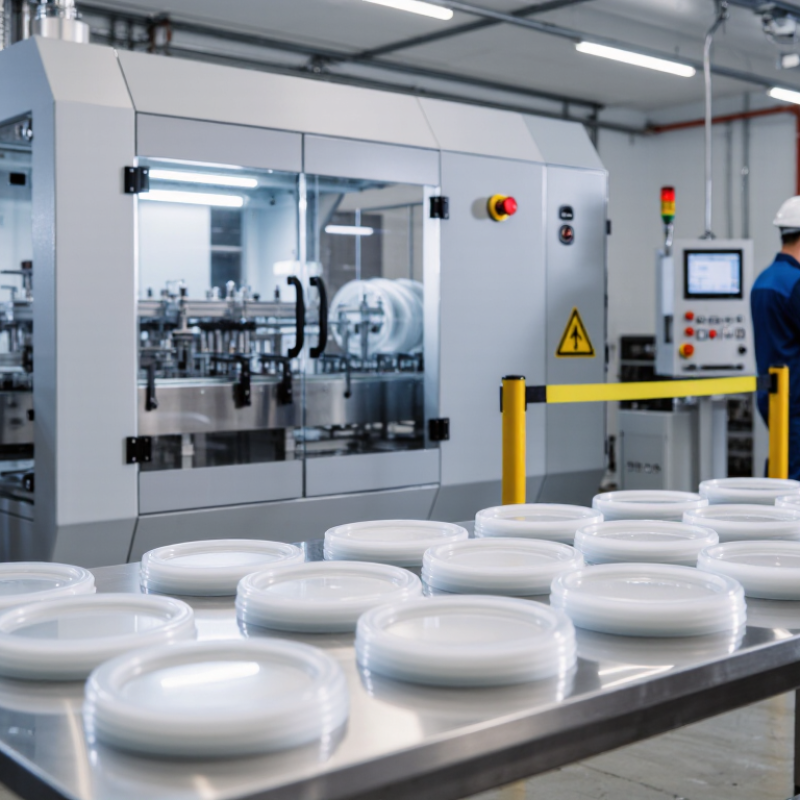
Table of Contents [Hide]
Plastic Cup Lid Types and 2026 Demand: PP, PET, and PLA Market Data
In 2026, plastic cup lid demand is separating by material, application, and regional recycling capacity. PP remains the volume leader because it is light, tough, and suitable for high-speed forming. It performs well with snap-fit lids and hot-fill applications. PET demand is rising where clear presentation and stronger barrier performance matter. PLA remains smaller, but interest is growing in controlled composting systems and sustainability-focused food service.
Market data should be read carefully. Regional forecasts vary because collection systems, resin prices, and food-service habits change quickly. A machine for PP usually needs stable sheet heating, accurate plug assistance, and fast trimming. PET often requires tighter temperature control to protect transparency and avoid whitening. PLA can demand gentler forming conditions and careful moisture management. Small differences matter.
I would compare cycle time, mold-change speed, energy use, and scrap rates before selecting equipment. A machine rated only by maximum output may disappoint during thin-wall production. Ask for trial forming with your actual lid diameter, sheet thickness, and stacking design. Inspect edge quality under normal lighting. Count deformed lids after several hours, not only after a short demonstration. Forecasts are useful, but they are not guarantees. A flexible machine may cost more initially, yet rigid equipment can become expensive when demand shifts between PP, PET, and PLA.
How to Choose a Plastic Cup Lids Making Machine in 2026? - Plastic Cup Lid Types and 2026 Demand: PP, PET, and PLA Market Data
| Evaluation Dimension | PP Cup Lids | PET Cup Lids | PLA Cup Lids | 2026 Machine-Selection Implication |
|---|---|---|---|---|
| Common resin identification code | #5 PP | #1 PET | Often #7 or a compostable-specific label; coding varies by jurisdiction | Select a forming and marking system that can display the required material identification clearly. |
| Typical density | Approximately 0.90–0.91 g/cm³ | Approximately 1.33–1.40 g/cm³ | Approximately 1.24–1.27 g/cm³ | Density affects sheet weight, material consumption, nesting, and scrap calculations. |
| Approximate melting or processing range | Melting point typically about 160–165°C | Melting point typically about 250–260°C | Melting range commonly about 150–180°C, depending on grade | The heater zones, mold temperature control, and cooling capacity must be matched to the selected resin. |
| Appearance and transparency | Translucent to semi-transparent; good surface toughness | Naturally clear with high gloss when properly processed | Can be clear and glossy; clarity depends strongly on crystallization and cooling | Choose a thermoforming or injection system with stable temperature uniformity for clear lids. |
| Moisture sensitivity before processing | Low compared with PET and PLA; normal storage control is still required | High; drying is required to limit hydrolytic degradation | High; drying is generally required before processing | For PET or PLA, specify a dehumidifying dryer, controlled hopper residence time, and moisture monitoring. |
| Typical lid formats | Flat lids, dome lids, straw-slot lids, sip-through lids, and snap-fit lids | Clear flat lids, dome lids, anti-fog lids, and precision snap-fit lids | Flat or dome lids for cold beverages and applications designed for industrial composting systems | Confirm mold changeover time, cavity configuration, venting, trimming, and stacking requirements. |
| Recommended forming technologies | Injection molding, injection compression molding, or thermoforming | Thermoforming from PET sheet or injection molding for selected designs | Thermoforming or injection molding with carefully controlled drying and cooling | For high-volume thin lids, compare injection compression with roll-fed thermoforming using cycle time and scrap rate. |
| Best-fit production profile | High-volume, lightweight lids requiring flexibility and impact resistance | High-clarity lids where appearance and dimensional precision are priorities | Applications seeking bio-based feedstock and an appropriate certified compostability route | The machine should be evaluated against annual output, lid weight, cavity count, and allowable scrap percentage. |
| Key quality-control risks | Warping, inadequate snap fit, uneven wall thickness, and stress whitening | Brittleness from moisture degradation, haze, web thinning, and dimensional shrinkage | Moisture degradation, brittleness, deformation at elevated temperature, and inconsistent clarity | Prioritize closed-loop temperature control, automatic thickness inspection, and reliable mold cooling. |
| End-of-life consideration | Mechanical recycling is technically established, but collection and sorting availability varies | Widely recognized in recycling systems, although small lids may be lost during sorting | Requires suitable industrial composting infrastructure; it should not be assumed to biodegrade in natural environments | Avoid mixed-material designs where possible and verify local recycling or composting acceptance before investment. |
| 2026 demand signal | Strong fit for lightweight packaging and high-throughput food-service applications | Strong fit for clear beverage packaging and applications emphasizing visual presentation | Demand is policy- and infrastructure-dependent; growth is strongest where certified composting systems exist | Use a modular machine platform if the product portfolio may shift between PP, PET, and PLA during 2026. |
| 2026 regulatory and market context | Recyclability, lightweighting, and recycled-content requirements are important purchasing factors | Recyclability and compatibility with established PET sorting streams remain important | Compostability claims require applicable certification and suitable waste-management infrastructure | The European Union Packaging and Packaging Waste Regulation generally begins applying from 12 August 2026, increasing the importance of recyclability, material reduction, and packaging compliance planning. |
Reference data and methodology
Material-property ranges are general industry ranges and vary by grade, additives, orientation, and processing conditions. Global plastics production was approximately 430.9 million metric tonnes in 2023, according to Plastics Europe. Packaging accounted for approximately 40% of plastics use in Europe in 2022, according to Plastics Europe. The European Union Packaging and Packaging Waste Regulation (EU) 2025/40 entered into force in 2025 and generally applies from 12 August 2026. Recycling codes are based on ASTM D7611/D7611M and may be administered differently in individual markets.
Brands
Proudly Trusted by Top Suppliers Worldwide







Let us know and we will automate, together to fit your industrial needs.
 +91-97254 16844
Clients
Proudly Trusted by Top Companies Worldwide


Do you need Help? Get in touch.
X
Please fill out the form below and we will get back to you as soon as possible.