o
p
t
i
m
a
r
o
b
o
t
i
c
s

Make a Call


Make a Call
Blogs
How to Choose the Best Chocopie Cake Production Line?
Choosing the right Chocopie Cake Production Line requires more than comparing machine prices. It demands a clear view of capacity, product quality, hygiene, labor, and future expansion. A line that produces 10,000 pieces per hour may look attractive, yet it can become inefficient when orders fall or product sizes change.
Market evidence supports careful planning. Grand View Research reported that the global bakery products market was valued at approximately USD 594.3 billion in 2023. It also expects continued growth through 2030. This expansion increases pressure on manufacturers to improve consistency and operating efficiency. Meanwhile, PMMI’s packaging industry reports repeatedly identify automation, flexible production, and sustainable packaging as major investment priorities. These trends directly influence cake forming, baking, cooling, coating, filling, and packaging equipment.
Details matter.
A reliable Chocopie Cake Production Line should match the recipe’s moisture level, filling viscosity, coating temperature, and required output. For example, poor cooling control can create condensation beneath the chocolate layer. That small defect may later cause cracking, sticking, or shortened shelf life. Experienced suppliers should provide factory testing, production samples, sanitation procedures, spare-parts support, and measurable energy data. Their claims should be checked, not simply accepted.
No single line fits every factory. This is where many buyers misjudge the decision. A cheaper system may require more manual handling, while an advanced system may remain underused. The best choice balances present demand with realistic growth. This guide explains how to compare equipment layouts, automation levels, technical specifications, supplier credibility, and total ownership costs before signing a purchase agreement.
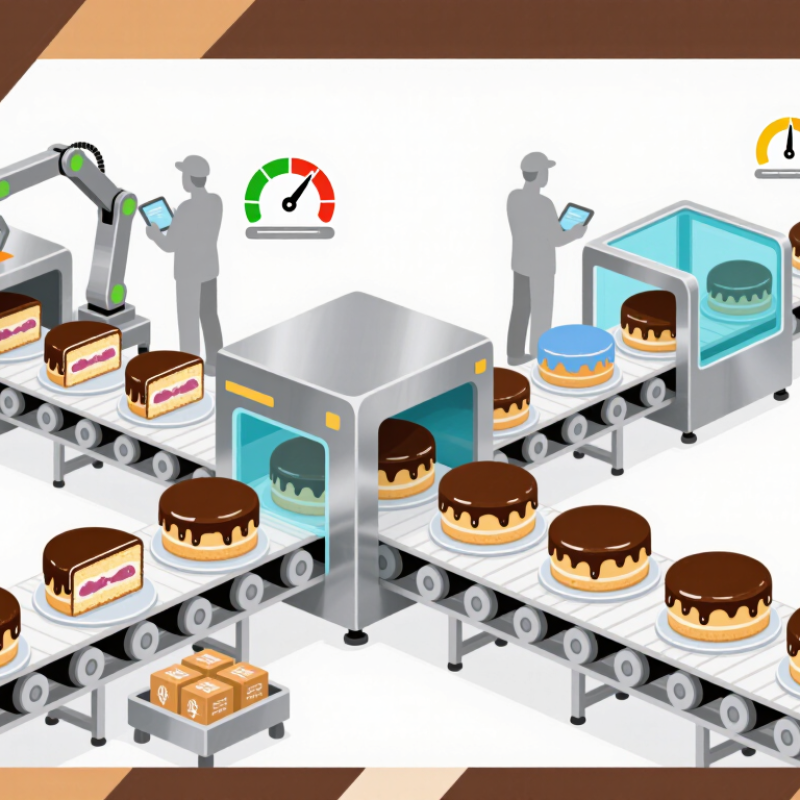
Table of Contents [Hide]
Understanding Chocopie Cake Production Requirements
Choosing a chocopie cake production line starts with the product, not the machine list. A typical cake requires mixing, depositing, baking, cooling, filling, sandwiching, chocolate coating, final cooling, inspection, and wrapping. Each stage changes the next one. For example, a soft filling can deform warm cakes, while excessive cooling may reduce coating adhesion. The line must control batter weight, baking temperature, filling volume, coating thickness, and cooling time.
Food loss deserves serious attention. The FAO’s 2019 report estimates that 14% of food is lost globally between harvest and retail. In a chocopie facility, small process errors multiply quickly. A 2-gram filling variation across 20,000 pieces wastes about 40 kilograms of material. Operators should therefore request trial data for weight accuracy, product rejection, and changeover time.
PMMI industry reports also identify labor availability and automation as major packaging concerns. Servo-driven depositing, automatic alignment, and vision inspection can reduce repetitive adjustments, but they cannot repair poor recipes.
Do not trust impressive speed alone. A line rated at 600 pieces per minute may run slower with sticky filling, uneven cake sizes, or frequent cleaning. Hygienic design, accessible belts, allergen controls, and reliable temperature records matter more than a perfect brochure. I would test the full recipe under realistic humidity and shift conditions. That test may expose an inconvenient truth: the cheapest line is sometimes the most expensive choice after waste, downtime, and manual rework are counted.
Brands
Proudly Trusted by Top Suppliers Worldwide






Let us know and we will automate, together to fit your industrial needs.
 +91-97254 16844
Clients
Proudly Trusted by Top Companies Worldwide


Do you need Help? Get in touch.
X
Please fill out the form below and we will get back to you as soon as possible.