o
p
t
i
m
a
r
o
b
o
t
i
c
s

Make a Call


Make a Call
Blogs
How to Choose an EPS Casting Pattern Mould?
Choosing an Eps Casting Pattern Mould is a technical decision, not merely a price comparison. The mould shapes foam beads, controls expansion, and influences every later casting stage. A small mismatch at the parting line can create flashing, uneven walls, or costly trimming. The right choice begins with the component’s geometry, production volume, required tolerance, and alloy temperature.
John Campbell, a widely recognized authority on casting technology, states, “The quality of a casting is determined by the quality of the liquid metal entering the mould.” His principle also applies to lost-foam production. A reliable Eps Casting Pattern Mould should support stable bead filling, consistent steam heating, adequate venting, and easy pattern release. Aluminium tooling may suit many production runs, while reinforced resin tooling can offer a practical option for prototypes or limited quantities. The decision depends on cycle demands.
Look closely at the details. Check cooling channels, ejector access, coating compatibility, and dimensional records. Ask whether the supplier has produced similar shapes, such as deep ribs, narrow cores, or uneven wall sections. Request trial samples.
Do not trust polished promises alone.
A mould may look precise yet perform poorly after repeated heating cycles. Suppliers should explain their inspection methods and correction process. Some choices remain uncertain, especially when the design contains thin sections or complex internal cavities. That uncertainty deserves testing, not optimism. A careful selection process combines engineering data, operator experience, and honest review of early defects. It may take longer initially, but it reduces avoidable rework and improves casting consistency.
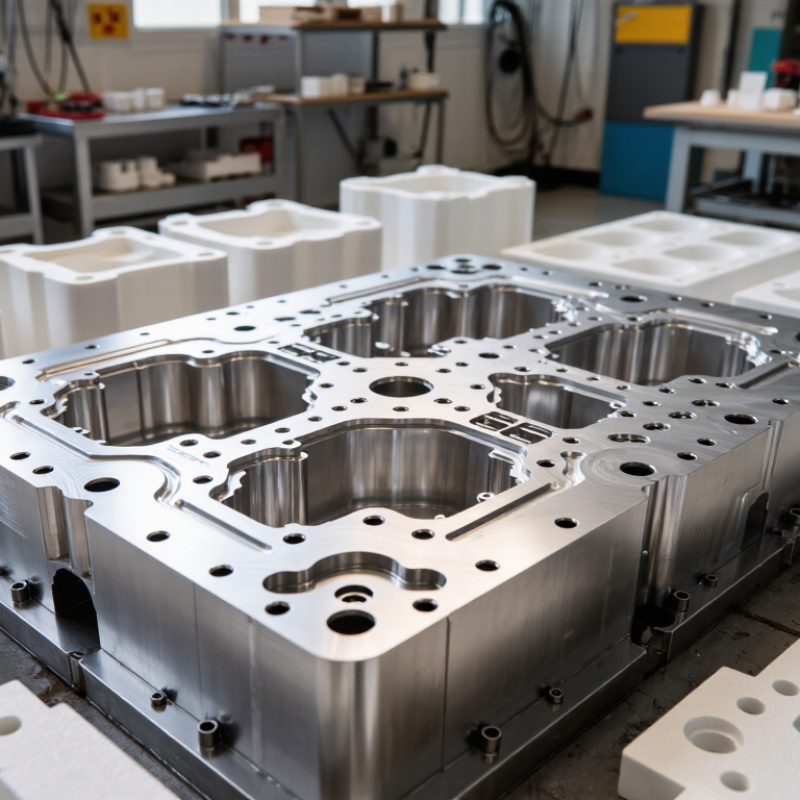
Table of Contents [Hide]
Define the casting target: alloy, part size, and 20–30 kg/m³ EPS density
How to Choose an EPS Casting Pattern Mould?
Define the casting target before designing the EPS pattern mould. Identify the alloy, part size, wall thickness, and expected production volume. Aluminium, iron, and steel require different thermal considerations.
Their pouring temperatures can range from about 660°C to above 1,500°C. The mould must therefore support suitable filling, venting, and dimensional control. American Foundry Society process guidance also stresses that alloy selection influences gating, shrinkage, and surface quality.
Part size matters more than many designers expect. A large pattern can distort during handling, coating, or drying. Thin ribs may collapse. Heavy sections may need stronger supports or segmented mould construction.
For most lost-foam applications, an EPS density of 20–30 kg/m³ provides a practical starting range. Lower density improves foam decomposition but may reduce handling strength. Higher density feels safer, yet it can increase gas generation and casting defects.
Measure density under a recognized method, such as ISO 845:2018, rather than trusting supplier labels. Check actual mass and volume from trial samples. This step is often skipped. It should not be.
The right mould also maintains consistent bead fusion, accurate shrinkage allowance, and clean pattern release. Data from the European Foundry Association’s industry reports shows that process efficiency and defect reduction remain major foundry priorities.
Still, density alone cannot solve poor venting or unsuitable alloy temperatures. Testing one small section first is wiser than committing to a full-size mould.
Brands
Proudly Trusted by Top Suppliers Worldwide







Let us know and we will automate, together to fit your industrial needs.
 +91-97254 16844
Clients
Proudly Trusted by Top Companies Worldwide


Do you need Help? Get in touch.
X
Please fill out the form below and we will get back to you as soon as possible.