o
p
t
i
m
a
r
o
b
o
t
i
c
s

Make a Call


Make a Call
Blogs
What Are Cobot Solutions and How Do They Work?
Cobot solutions combine a collaborative robot arm with the tools, software, and safeguards needed for a specific task. A typical setup might use a compact arm, a gripper, and a camera to pick parts from a tray and place them beside a worker. Sensors and programmed limits help the system respond to contact or changes in its workspace. The exact design depends on the task, the objects handled, and how people move nearby. Not plug-and-play.
The wider robotics industry offers useful context, though its figures do not isolate cobots. The International Federation of Robotics reported 541,302 industrial robot installations worldwide in 2023, with operational stock reaching 4,281,585, in World Robotics 2024. These totals show how broadly automation is being adopted; they should not be read as cobot counts. In practice, cobot solutions can support repetitive jobs such as machine tending, screwdriving, or packaging, while people handle setup, inspection, or exceptions. But “collaborative” does not automatically mean safe for every shared workspace. ISO/TS 15066:2016 provides guidance for collaborative robot applications, and each deployment still needs a task-specific risk assessment. That distinction matters. A gripper, sharp fixture, heavy workpiece, or unexpected reach can change the risk. Understanding what the system senses, how it stops, and where its limits lie is part of choosing a suitable solution. The technology is capable, but not magic. A careful introduction should explain both its practical benefits and the trade-offs integrators and operators must consider.
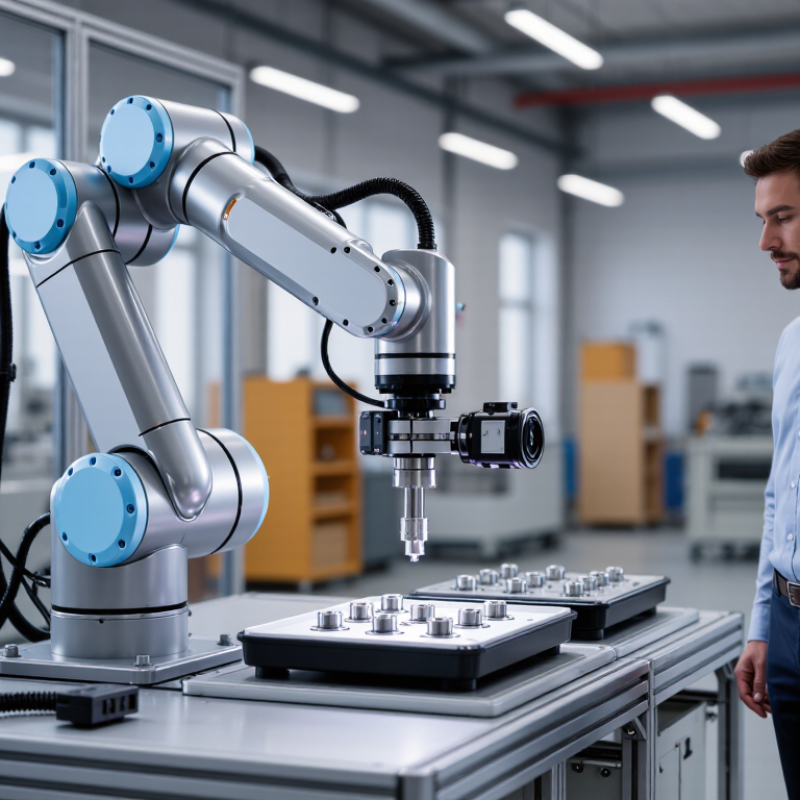
Table of Contents
[Hide]
What Defines a Cobot Solution?
A cobot solution is more than a robot arm placed beside a person. It combines a collaborative robot, end-of-arm tooling, sensors, software, and a defined work process. Together, these elements help a robot perform repeatable tasks while people handle judgment, variation, or delicate adjustments. The International Federation of Robotics’ World Robotics 2024 report puts collaborative robots at about 10.5% of industrial robot installations in 2023. Adoption is growing, but a cobot label alone does not make a workstation safe or productive.
What defines a cobot solution is how the whole cell is designed and tested. Engineers assess the task, tool, workpiece, and possible contact points, then set operating speeds and safety measures accordingly. For example, a cobot may place small parts into a tray while an operator checks alignment. The best setup keeps the tray within easy reach and avoids awkward wrist turns. That sounds tidy. Reality is messier: cycle times, product changes, and human habits can alter the workflow. A pilot run can reveal issues that a simulation misses.
Tips: Start with one repetitive task and measure its cycle time, reach, and error rate before installation. Test the actual tool and workpiece, not just the robot. Record near-misses and operator feedback during trials. If people must constantly pause, reach around the arm, or correct placements, revisit the layout; collaboration should improve the task, not simply add equipment.
What Are Cobot Solutions and How Do They Work? — What Defines a Cobot Solution?
| Dimension | What It Means | How It Works in Practice |
|---|---|---|
| Definition | A cobot solution is a collaborative robot application: a robot, its tools, control software, safeguards, and work process configured to perform a task around people. | The solution is designed around the complete task and workplace, rather than treating the robot arm as a standalone product. |
| Robot arm | A programmable robotic arm that moves through defined positions and paths to handle parts or tools. | Its joints are controlled to repeat operations such as placing components, tending a machine, or following a process path. |
| End effector | The tool attached to the robot, such as a gripper, vacuum cup, screwdriver, or inspection sensor. | The tool is selected for the object and task. Its shape, force, sharp edges, and operating method affect application safety and performance. |
| Sensors and inputs | Devices and signals that provide information about the robot, workpiece, equipment, or surrounding area. | Depending on the application, inputs may include cameras, force sensors, proximity sensors, buttons, or machine status signals. They help the system respond to changing conditions. |
| Safety measures | Controls and protective measures selected to reduce risks from the entire application. | A risk assessment considers the robot, tool, workpiece, speed, force, layout, and human tasks. Depending on the findings, measures can include limiting motion, separation, guarding, or monitored collaborative operation. |
| Programming and control | Software that defines motion, task sequences, input responses, and communication with other equipment. | Programs can use taught positions, reusable routines, and signals from sensors or machines. The chosen method depends on the task and the system configuration. |
| Typical workflow | A repeatable sequence that turns a work instruction into robot and operator actions. | A cycle might involve a person loading a part, the robot performing a defined operation, and the person checking or transferring the result. The exact sequence varies by application. |
| Human collaboration | People and robots contribute to the same production process, either at the same time or in coordinated stages. | Operators may supply judgment, setup, or quality checks while the robot handles repetitive or position-controlled actions. Collaboration does not necessarily mean constant physical contact or unrestricted access. |
| Deployment and integration | The process of fitting the cobot application into an existing workstation or production line. | Deployment involves assessing the workspace, mounting the robot, connecting tools and signals, defining operator access, testing the cycle, and validating protective measures before use. |
| Common applications | Tasks with repeatable steps that can be handled by a programmable robot and suitable tooling. | Examples include machine tending, pick-and-place, packaging, screwdriving, and some inspection or assembly tasks. Suitability depends on the parts, process, required quality, and risk assessment. |
| Important limitations | A collaborative robot is not automatically safe for every task or environment. | Hazards can come from the tool, workpiece, sharp edges, pinch points, or process equipment. Application-specific assessment, configuration, and validation are necessary; cobots may also be unsuitable for tasks requiring very high speed, payload, or reach. |
Related Posts
-
Top Collaborative Robot Arm Models Transforming Industries Today?
-

How to Choose Collaborative Robots in 2026?
-
Best Cobot Solutions for Enhanced Efficiency in Manufacturing Processes
-
Top Advantages of Cobot Automation in 2025 for Smart Manufacturing
-
Why Are Cobot Universal Robots Revolutionizing the Future of Automation
-
10 Best Benefits of Cobot Automation for Modern Manufacturing
Brands
Proudly Trusted by Top Suppliers Worldwide






Let us know and we will automate, together to fit your industrial needs.
 +91-97254 16844
Clients
Proudly Trusted by Top Companies Worldwide


Do you need Help? Get in touch.
X
Please fill out the form below and we will get back to you as soon as possible.