o
p
t
i
m
a
r
o
b
o
t
i
c
s

Make a Call


Make a Call
Blogs
What Is Crystal Cat Litter and How Does It Work?
Crystal Cat Litter is made from porous silica gel crystals, not traditional clay. These tiny beads absorb liquid through microscopic openings. Urine spreads across the crystals, while much of its moisture evaporates into the surrounding air. Solid waste remains visible and should be removed daily. The litter usually does not form firm clumps. Instead, the crystals gradually become yellow, damp, or less effective. That change gives owners a useful maintenance signal. A fresh tray feels dry underfoot. An old one may feel heavy and smell sharp.
Dr. Jane Brunt, a veterinarian and cat-care expert, emphasizes a practical principle: “Cats are creatures of habit, and litter box changes should be gradual.” That advice matters when introducing Crystal Cat Litter. Pouring it into a familiar, clean tray can reduce hesitation. Some cats accept the texture immediately. Others dislike the hard, crunchy feeling. Their reaction deserves attention, not dismissal. A gradual mixture may help, although it can make odor control harder during the transition. Keep the tray in a quiet, accessible place, and follow the product’s cleaning instructions. Avoid assuming that stronger odor always means poor litter. It may indicate insufficient depth, infrequent waste removal, or a health concern. Persistent urination changes require veterinary advice. Crystal litter can be convenient, lightweight, and highly absorbent. It is not perfect for every cat. Dust levels, fragrance, tracking, and paw sensitivity still matter. The best choice is the one that keeps the cat comfortable and the box consistently clean. That sounds simple, but daily observation remains essential.
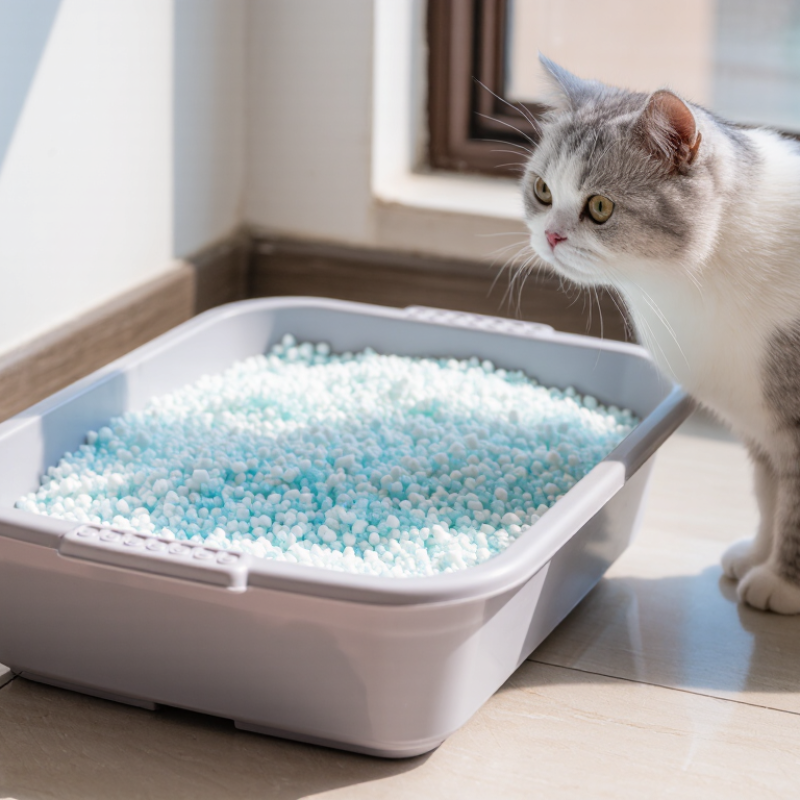
Table of Contents [Hide]
What Crystal Cat Litter Is: Amorphous Silica Gel and Its Porous Structure
Crystal cat litter is usually made from amorphous silica gel, not traditional mineral crystals. “Amorphous” means its silicon dioxide structure lacks a regular, repeating crystal pattern. Instead, the material forms an irregular network with countless microscopic pores. These pores create a surprisingly large surface area inside each lightweight granule.
That structure matters. When urine contacts the litter, moisture moves across the granule and becomes held within its pores. The process is mainly adsorption, rather than simple absorption like water entering a sponge. Odor molecules can also become trapped, although performance depends on ventilation, box cleanliness, and litter depth.
In daily use, the surface may look dry while the lower layer feels heavier and slightly damp. Removing solid waste regularly helps preserve the available pore space. Stirring the litter can distribute moisture, but excessive stirring may release dust.
I once assumed “crystal” meant a hard, glass-like substance; that description is misleading. The granules are porous, brittle, and intentionally engineered for moisture management.
A practical check is to watch for persistent odor, wet patches, or granules that no longer flow freely. Those signs suggest the pores are nearing saturation. Silica gel can reduce cleaning frequency, but it does not replace routine box washing.
Cats also differ: some dislike the texture or faint sound under their paws. Dust exposure should be minimized, especially around sensitive people or animals. Always follow the product’s handling guidance, and prevent ingestion.
Brands
Proudly Trusted by Top Suppliers Worldwide







Let us know and we will automate, together to fit your industrial needs.
 +91-97254 16844
Clients
Proudly Trusted by Top Companies Worldwide


Do you need Help? Get in touch.
X
Please fill out the form below and we will get back to you as soon as possible.