o
p
t
i
m
a
r
o
b
o
t
i
c
s

Make a Call


Make a Call
Blogs
How to Pull Out an Ironing Board Drawer in 2026?
A Pull Out Ironing Board Drawer saves space, but it should never be treated like an ordinary cabinet drawer. Its runners carry uneven weight, its folding frame needs clearance, and its hinges can catch fabric or fingers. Before pulling, remove nearby objects, open the drawer slowly, and support the board with one hand.
The Houzz 2024 U.S. Kitchen Trends Study reports that 76% of renovating homeowners upgraded their cabinets. That figure reflects a growing demand for practical storage, including concealed laundry and ironing solutions. The National Kitchen and Bath Association’s design research also highlights storage efficiency, ergonomic access, and multifunctional cabinetry as continuing priorities. These reports support a simple principle: convenience must work with safe movement.
Cabinetmaking educator Gary Katz repeatedly promotes the workshop rule, “Measure twice, cut once.” It applies here, even when you are only operating a finished drawer. Check whether the runners are fully extended. Look for a release lever, locking stop, or soft-close resistance. Never force the drawer past its designed travel. A slight wobble may indicate loose hardware, uneven loading, or a damaged runner.
This guide explains how to Pull Out Ironing Board Drawer safely in 2026, using clear checks and practical details. You may find that your cabinet uses a proprietary mechanism. That is the imperfect part. Without the manufacturer’s instructions, certainty is limited. Still, careful observation usually reveals the release points, clearance limits, and correct folding sequence. A phone flashlight helps. So does patience.
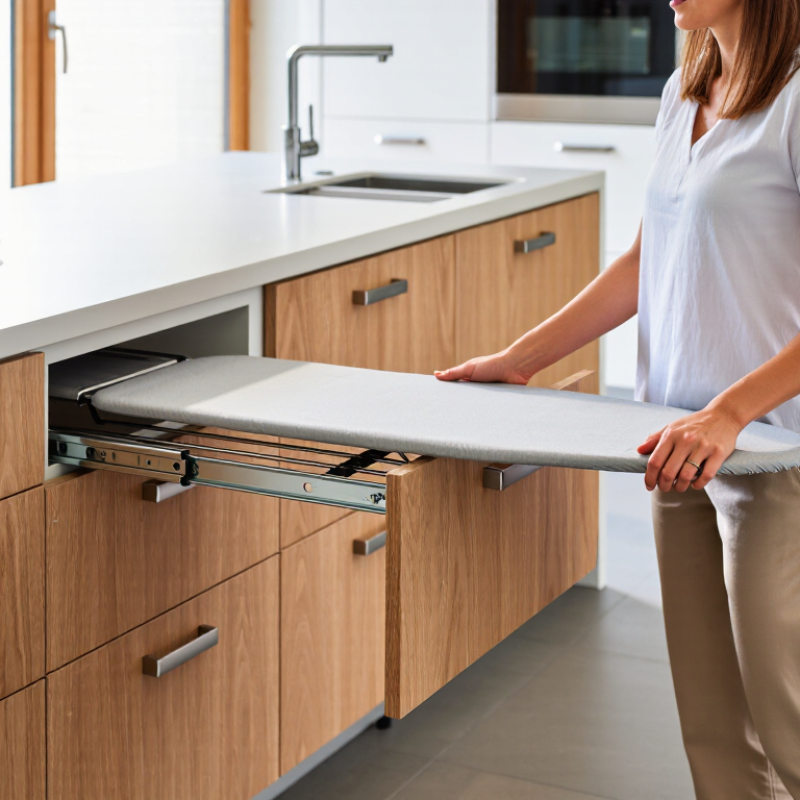
Table of Contents [Hide]
Identify the Drawer Style and Check for Safety Locks
How to Pull Out an Ironing Board Drawer in 2026?
Identify the drawer style before pulling. Some ironing boards use a shallow front drawer. Others hide behind a cabinet panel or slide from the side. A full-extension drawer usually has visible metal runners. A concealed model may move only after its front panel is pressed. Do not yank the handle. The board may be attached to folding hinges, and sudden movement can pinch your fingers.
Check for safety locks around the drawer edges and underneath the front panel. Look for a small release tab, locking lever, or child-safety catch. Remove clothing and nearby objects before testing the mechanism. Hold the drawer with both hands, then pull slowly until you feel resistance. If the lock clicks, press the release gently while maintaining light pressure. Never force a stuck drawer with a knife or heavy tool. From practical repair work, most damage comes from pulling before locating the latch. I have made that mistake myself.
Tips: Use a flashlight inside the cabinet. Keep fingers beside the handle, not below the board. If the runners look bent, stop and photograph their position. Check the user instructions when available. A drawer that feels unusually heavy may contain a loose hinge or uneven load. Do not continue until the cause is clear.
Brands
Proudly Trusted by Top Suppliers Worldwide







Let us know and we will automate, together to fit your industrial needs.
 +91-97254 16844
Clients
Proudly Trusted by Top Companies Worldwide


Do you need Help? Get in touch.
X
Please fill out the form below and we will get back to you as soon as possible.