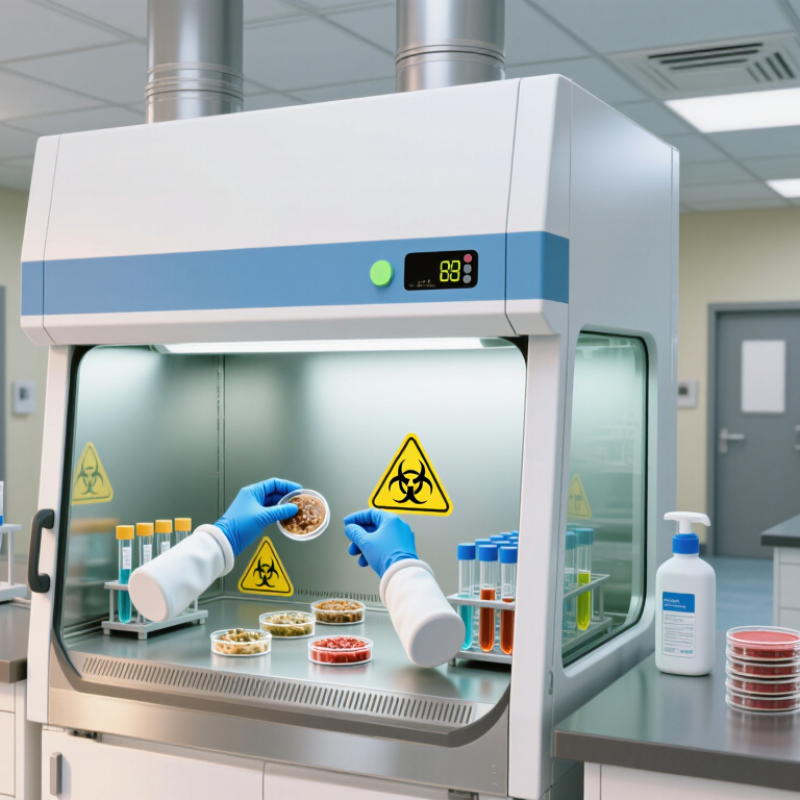
| Primary protection | Personnel, environment, and product protection when correctly installed and operated. | Personnel, environment, and product protection for work involving volatile toxic chemicals or radionuclides, when connected to a suitable exhaust system. | Personnel and environmental protection; it does not provide reliable product protection. | Product protection only; it does not protect the operator or room from hazardous biological aerosols. |
| Typical microbiology applications | Routine culture work, non-volatile biological agents, clinical and research microbiology, and moderate-risk biological procedures. | Work combining biological agents with significant quantities of volatile toxic chemicals or radionuclides. | Procedures where operator and environmental protection are required but sterile product protection is not. | Non-hazardous reagent preparation, PCR setup, and contamination-sensitive work involving materials that do not require containment. |
| Airflow configuration | Inward airflow at the front opening; HEPA-filtered downflow; approximately 70% of air recirculates and 30% is exhausted through a HEPA filter in the standard configuration. | Total-exhaust design; cabinet air is not recirculated back into the laboratory and must be discharged through a properly designed exhaust system. | Air is drawn inward through the front opening and exhausted through HEPA filtration; the work zone is not supplied with sterile vertical downflow. | HEPA-filtered air flows toward the work surface and into the room; airflow is not intended for containment. |
| Relevant certification framework | NSF/ANSI 49 is widely used in North America; EN 12469 is commonly used in Europe and other markets. Select the standard required by local regulations and institutional policy. | The same cabinet performance standards may apply, but the exhaust installation must also meet applicable mechanical, electrical, fire, and occupational-safety requirements. | Certification is generally evaluated against the applicable biosafety-cabinet standard, such as NSF/ANSI 49 or EN 12469, depending on location. | It should not be substituted for a certified biosafety cabinet. Product-cleanliness performance and electrical safety should be verified separately. |
| Minimum certification checks before use | Downflow and inflow velocity, HEPA-filter integrity, smoke-pattern testing, cabinet leakage, airflow alarms, electrical safety, and installation-site assessment. | All Type A2 checks plus exhaust-volume verification, building exhaust interlock, duct integrity, discharge location, and confirmation that the exhaust system is suitable for the cabinet. | Inflow velocity, HEPA-filter integrity, smoke-pattern testing, cabinet leakage, airflow alarms where fitted, and electrical safety. | Airflow velocity and uniformity, HEPA-filter integrity, cleanliness controls, and electrical safety; biological containment testing is not applicable in the same way. |
| Recertification frequency | At least annually in many institutional programs, and after relocation, repair, filter replacement, or any event that may affect performance. Local rules and the governing standard take precedence. | At least annually in many institutional programs, with additional testing after exhaust-system changes, relocation, repair, or filter replacement. | Typically annually and after relocation, repair, or filter replacement, subject to the applicable standard and site policy. | Frequency depends on the quality system and contamination risk; it should not be treated as a substitute for biosafety-cabinet certification. |
| HEPA filtration | HEPA filters are commonly specified at a minimum efficiency of 99.97% for 0.3-micrometre particles under the applicable test method. | Uses HEPA filtration for cabinet air; the exhaust arrangement and chemical compatibility must be evaluated because HEPA filters do not remove most chemical vapors. | HEPA-filtered exhaust protects the room and environment from biological aerosols; product protection is not provided. | HEPA-filtered supply air helps protect the work from airborne particles but does not provide personnel or environmental containment. |
| Maintenance workload | Moderate: surface cleaning, prefilter inspection where fitted, airflow-alarm checks, annual certification, and eventual HEPA replacement. | High: all routine cabinet maintenance plus exhaust-fan, ductwork, interlock, building-airflow, and chemical-safety inspections. | Moderate: cleaning, airflow verification, filter inspection, annual certification, and eventual HEPA replacement. | Low to moderate: cleaning, airflow checks, filter inspection, and replacement based on pressure drop and performance. |
| Filter replacement timing | There is no universal calendar interval. Replace when integrity testing fails, pressure drop becomes unacceptable, airflow cannot be maintained, or contamination requires replacement. | The same performance-based approach applies, with additional evaluation of exhaust-system condition and chemical exposure. | Replace based on failed integrity testing, excessive pressure drop, inadequate airflow, or contamination—not solely on age. | Replace when airflow, pressure drop, or filter-integrity results indicate reduced performance. |
| Installation complexity | Medium. Requires suitable room airflow, clearance, electrical service, and certification after installation. A canopy connection may be used only when permitted by the design and standard. | Very high. Requires dedicated, reliable exhaust capacity, correct duct design, alarms or interlocks, make-up air, and coordination with building services. | Medium. Requires appropriate room placement, electrical service, exhaust arrangement, and post-installation certification. | Low to medium, but placement must avoid drafts, doors, high-traffic areas, and other disturbances that can disrupt clean airflow. |
| Typical energy profile | Usually lower than a total-exhaust cabinet because much of the air is recirculated, although the blower may operate continuously. | Highest among the listed options in many installations because the cabinet and building exhaust system operate continuously and require conditioned replacement air. | Generally moderate; energy demand depends on blower power, operating hours, room conditions, and exhaust configuration. | Generally lower than total-exhaust biosafety cabinets, but actual consumption depends on fan type, cabinet size, and operating schedule. |
| Illustrative annual electricity cost | For a 1.0 kW average load operated 8 hours per day for 250 days at $0.15/kWh: approximately $300 per year, excluding room HVAC impact. | Cabinet electricity alone can be similar to or higher than the example above; additional building exhaust and conditioned make-up air may materially increase total cost. | For a 0.8 kW average load under the same assumptions: approximately $240 per year, excluding room HVAC impact. | For a 0.6 kW average load under the same assumptions: approximately $180 per year, excluding room HVAC impact. |
| Long-term operating-cost drivers | Annual certification, service labor, replacement filters, blower components, cleaning, downtime, and electrical consumption. | All Type A2 costs plus exhaust-fan maintenance, duct inspections, make-up air, HVAC load, control-system testing, and potentially higher installation costs. | Certification, filter replacement, service labor, electrical consumption, and possible room exhaust costs. | Filter replacement, fan energy, cleaning, performance checks, and the cost of managing contamination if the cabinet is incorrectly used for hazardous work. |
| Best choice when | The laboratory needs balanced personnel, environmental, and product protection for routine microbiology without significant volatile chemical use. | The risk assessment confirms that biological work must be combined with volatile toxic chemicals or radionuclides and the facility can support dedicated exhaust. | Operator and environmental protection are required, but sterile handling of the product is not a primary requirement. | The work is non-hazardous and the main objective is to reduce contamination of samples, reagents, or amplification reactions. |
| Main selection warning | Do not use a Type A2 cabinet for significant volatile chemical work unless the installation is specifically designed, approved, and operated for that purpose. | Do not select a Type B2 cabinet without confirming building exhaust capacity, emergency operation, make-up air, and total lifecycle cost. | Do not use a Class I cabinet when sterile product protection is required. | Never use a clean bench as a biosafety cabinet for infectious, toxic, or otherwise hazardous biological materials. |