o
p
t
i
m
a
r
o
b
o
t
i
c
s

Make a Call


Make a Call
Blogs
Top Turbo Intercooler Manufacturers Worldwide
Choosing among the top Turbo Intercooler manufacturers worldwide requires more than comparing core size or advertised horsepower. A reliable intercooler must control charge-air temperature, preserve airflow, and survive vibration, pressure, moisture, and repeated heat cycles. It sits behind the grille, yet its work is intense. Hot compressed air leaves the turbocharger and enters the intercooler, where carefully designed fins and passages remove heat before combustion begins.
Corky Bell, a respected forced-induction author, explains, “An intercooler is a heat exchanger for compressed intake air.” That simple description carries practical weight. A larger unit is not automatically better. Excessive volume can increase pressure drop and delay boost response. Poor fin design can restrict airflow. Weak welds may fail when the engine repeatedly sees high boost. The details matter.
This guide examines leading Turbo Intercooler manufacturers through engineering quality, testing methods, material selection, production consistency, and real-world fitment. It considers bar-and-plate and tube-and-fin designs, end-tank structure, core efficiency, and thermal recovery after demanding use. Factory data is useful, but not perfect. Independent testing can reveal differences that marketing pages overlook. Even then, results depend on vehicle layout, ambient temperature, boost pressure, and calibration.
Some conclusions may remain debatable. That is acceptable. Honest comparison should leave room for revision. The strongest manufacturers combine measurable performance with dependable quality control, clear technical documentation, and support after installation. For buyers, the goal is not the largest intercooler. It is the right balance of cooling, response, durability, and verified engineering.
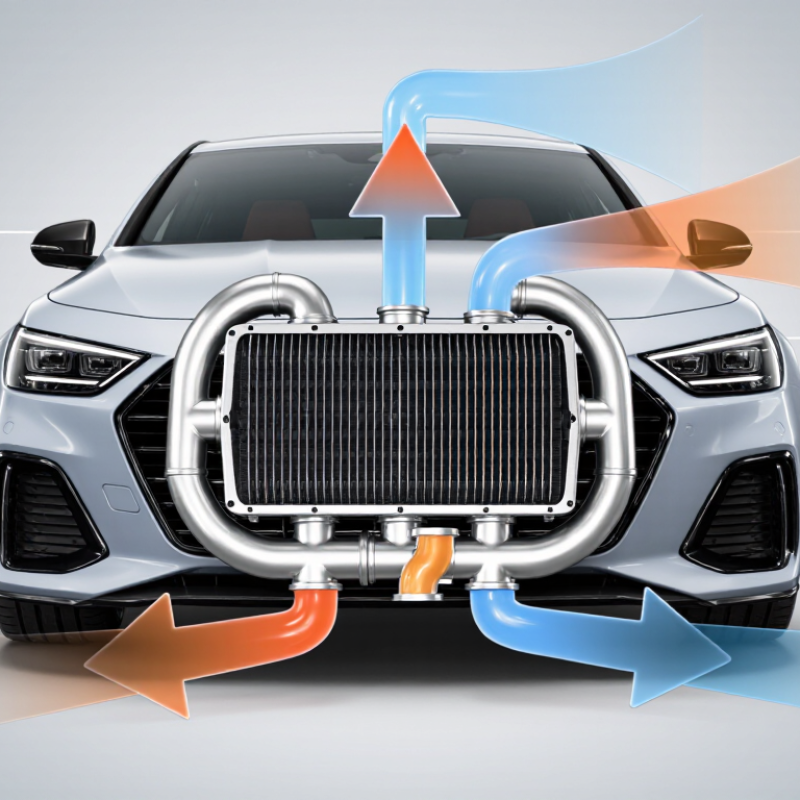
Table of Contents [Hide]
Turbo Intercoolers: Purpose, Structure, and Operating Principles
Top Turbo Intercooler Manufacturers Worldwide
Turbo Intercoolers: Purpose, Structure, and Operating Principles
A turbocharger compresses air before it enters the engine. Compression raises air temperature and reduces oxygen density. The intercooler removes much of this heat. SAE International test literature commonly records charge-air reductions of 40–80°C under heavy boost. Cooler air supports more stable combustion and helps control knock risk.
Most intercoolers use an aluminium core, internal passages, external fins, inlet tanks, and outlet tanks. Air-to-air designs transfer heat through ambient airflow. Air-to-liquid designs use a coolant circuit and usually respond faster during short acceleration events. The operating principle is simple: hot compressed air crosses thin walls, while a cooler medium carries heat away. The design still involves trade-offs. Larger cores improve cooling, but excessive volume can increase pressure drop and response delay. Real-world results are less tidy.
Tips: Check temperature before changing hardware. The U.S. Department of Energy’s vehicle technology research emphasizes thermal management as a key efficiency factor. In practice, compare compressor-outlet and manifold temperatures, not only advertised core size. A pressure drop near 0.1–0.2 bar may already affect response on some systems. Seal quality matters too. A small leak can erase expensive cooling gains. Manufacturers should also validate airflow, coolant capacity, vibration resistance, and heat-soak performance under repeated acceleration. Data from a single laboratory pull is not enough. Temperature sensors can also be poorly placed, which makes conclusions look better than reality.
Brands
Proudly Trusted by Top Suppliers Worldwide







Let us know and we will automate, together to fit your industrial needs.
 +91-97254 16844
Clients
Proudly Trusted by Top Companies Worldwide


Do you need Help? Get in touch.
X
Please fill out the form below and we will get back to you as soon as possible.