o p t i m a r o b o t i c s

Blogs

What Is a Robot Machine and How Does It Work?

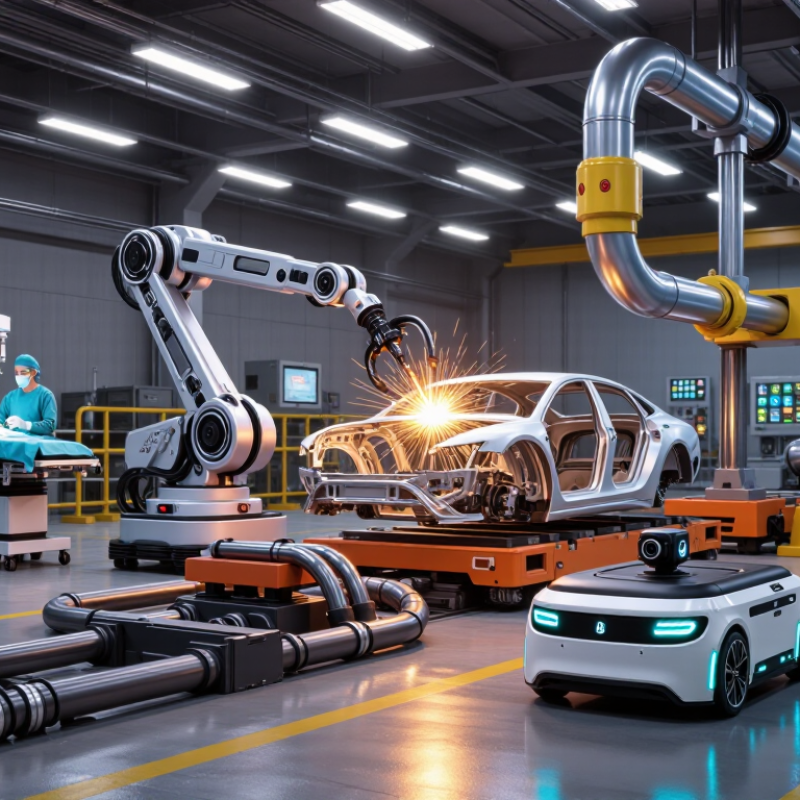
A robot machine is more than a metal body with motors and sensors. It is a system that observes its surroundings, processes information, and performs programmed actions. Some machines weld car frames, while others carry packages, inspect pipelines, or assist surgeons. Their forms differ, but their basic purpose remains similar: turning digital instructions into controlled physical movement.

Joseph Engelberger, widely regarded as a pioneer of industrial robotics, once said, “I can’t define a robot, but I know one when I see one.” His words remain useful because robot machine designs vary greatly. A factory arm may repeat the same motion for twelve hours, while a mobile robot must avoid shelves, workers, and unexpected obstacles. Cameras, lidar, encoders, controllers, and software work together in these situations. The process is precise, but never perfectly simple.

A robot machine usually follows a loop: sensing, deciding, moving, and checking results. Its controller compares the planned action with real feedback. If a gripper slips, the system may adjust its force. If a sensor becomes dirty, performance can decline. Small details matter.

This article explains what a robot machine is, how its main components interact, and why safety controls are essential. It also examines practical limits, including maintenance costs, sensor errors, and difficult environments. Some explanations may simplify complex engineering. That limitation deserves attention. Understanding robots requires curiosity, careful testing, and respect for the people who design, operate, and maintain them.
What Is a Robot Machine and How Does It Work?

What Is a Robot Machine? Definition and Core Characteristics

What Is a Robot Machine and How Does It Work?

What Is a Robot Machine? Definition and Core Characteristics

A robot machine is a programmable mechanical system that senses conditions, processes information, and performs physical actions. It may move materials, inspect surfaces, or assist with carefully controlled tasks. Unlike a simple machine, it can follow changing instructions through software. A typical robot includes sensors, a controller, actuators, and a power source. These parts work together in a repeated control cycle.

Sensors might detect distance, pressure, temperature, or the position of an object. The controller interprets this information and selects an action. Motors, pneumatic systems, or other actuators then create movement. For example, a robot arm can locate a metal part, grip it, and place it into a fixture. Its accuracy depends on calibration, programming, mechanical design, and operating conditions.

Repeatability is a core characteristic. The machine should perform the same motion with limited variation. Adaptability also matters, especially when objects shift slightly or lighting changes. Safety systems can slow movement, limit force, or stop operation near a person. However, a robot is not automatically intelligent. Many systems only follow predefined rules. The boundary between a robot and an automated machine can remain unclear. That distinction deserves careful reflection, particularly when judging autonomy, reliability, and human responsibility.

Main Components That Enable a Robot Machine to Function

What Is a Robot Machine and How Does It Work?

Main Components That Enable a Robot Machine to Function

A robot machine is a programmable system that senses conditions and performs physical actions. Its body includes a rigid frame, joints, motors, and an end effector. The frame provides stability during movement. Motors create rotation or linear motion at each joint. A gripper, cutter, or tool performs the assigned task. Without suitable tools, movement alone has little value.

Sensors help the machine understand its surroundings and internal condition. Position sensors track joint angles, while force sensors detect contact with an object. A controller receives this information and compares it with programmed instructions. Software then converts decisions into precise motor commands. Feedback allows the robot to correct small errors during operation. That correction is never perfect.

A power unit supplies electricity to motors, sensors, and control circuits. Cables carry signals and energy through moving sections of the machine. Safety circuits can stop motion when a door opens or unusual resistance appears. Communication modules connect the controller with approved equipment and monitoring systems. During hands-on testing, engineers often notice vibration, heat, or slight timing delays. These details can change the final result. A clean-looking design may still perform poorly under load. Engineers should measure speed, force, temperature, and repeatability instead of trusting appearance. Sometimes, a simpler mechanism works better.

How Robot Machines Sense Their Environment

What Is a Robot Machine and How Does It Work?

How Robot Machines Sense Their Environment

A robot machine senses its surroundings through cameras, microphones, distance sensors, and touch-sensitive parts. Each device collects a different kind of information. A camera may identify a doorway, while a depth sensor measures the space between the robot and a nearby chair.

Inside the robot, software combines these signals into an environmental map. It may detect a person moving across a hallway or recognize a sharp edge near its wheels. Distance sensors often send invisible pulses and measure their return time. Touch sensors provide another layer of protection when the robot contacts an object unexpectedly. Small details matter.

In practical testing, sensor placement strongly affects performance. A dusty lens can weaken visual accuracy. Bright sunlight may confuse optical systems, while a wet floor can change reflected signals. For this reason, reliable robots compare data from several sensors instead of trusting one source. Engineers also calibrate sensors regularly and test machines in crowded, uneven, and poorly lit spaces.

Still, sensing is not understanding. A robot can detect a soft bag but misjudge its stability. It may see a shadow as an obstacle. These failures require careful review, better training data, and safer movement limits. Human supervision remains valuable in uncertain environments, especially when the robot must interpret unusual sounds, objects, or movement patterns.

What Is a Robot Machine and How Does It Work? — How Robot Machines Sense Their Environment

Robots combine multiple sensing technologies to measure distance, light, motion, contact, sound, temperature, and orientation before making control decisions.

Common Robot Sensors and Their Environmental Sensing Functions
Sensor Type Physical Principle Typical Effective Range Main Output How a Robot Uses It Key Strengths Important Limitations
Camera Converts visible light into digital images using an image sensor. Approximately 0.1 m to 100 m or more, depending on optics, lighting, and scene detail. Color or grayscale images; video frames. Object recognition, visual inspection, lane following, visual localization, and reading signs or markings. Provides rich information about shape, color, texture, and visual context. Performance can decline with darkness, glare, shadows, fog, motion blur, or visually similar objects. Depth is not directly measured by a single standard camera.
Stereo Camera Estimates depth by comparing the same scene from two separated viewpoints. Typically about 0.2 m to 30 m, with accuracy influenced by camera spacing and image resolution. Paired images and a depth map. Obstacle detection, three-dimensional mapping, grasp planning, and terrain analysis. Provides color information and passive depth without emitting energy. Depth estimation becomes less reliable on textureless, reflective, transparent, or poorly lit surfaces.
Time-of-Flight Sensor Measures the travel time of emitted light, commonly infrared light, reflected from an object. Often about 0.1 m to 10 m for compact depth sensors. Per-pixel distance or depth values. Close-range obstacle avoidance, hand tracking, workspace monitoring, and volume measurement. Delivers direct depth information and works quickly across many scenes. Strong sunlight, reflective materials, transparent objects, and multipath reflections can reduce accuracy.
LiDAR Measures the return time of laser pulses reflected from surrounding surfaces. Approximately 0.1 m to 200 m, depending on sensor class and target reflectivity. Three-dimensional point clouds or range scans. Mapping, localization, obstacle detection, navigation, and measuring the geometry of indoor or outdoor spaces. Provides accurate geometric distance data and performs well in many lighting conditions. Can have difficulty with highly transparent, very dark, or highly reflective surfaces; moving objects may create incomplete scans.
Ultrasonic Sensor Uses the time of flight of high-frequency sound waves reflected by nearby objects. Commonly about 0.02 m to 5 m. Approximate distance to a detected surface. Short-range collision prevention, liquid-level measurement, and detecting objects near the robot. Low cost, simple operation, and useful performance in darkness. Soft, angled, narrow, or sound-absorbing surfaces may produce weak or misleading echoes. The beam is relatively wide.
Infrared Proximity Sensor Detects reflected or interrupted infrared radiation. Typically about 0.01 m to 0.8 m for reflective proximity devices. Presence detection or an estimated short distance. Edge detection, wall following, object presence detection, and small-scale obstacle avoidance. Compact, fast, and suitable for short-range measurements. Sunlight, object color, surface reflectivity, and object angle can strongly affect the reading.
Tactile or Contact Sensor Detects mechanical contact, force, pressure, or deformation. Contact-based; effective only when the sensing surface touches or is pressed by an object. Contact state, pressure, force, or force distribution. Collision detection, gripping feedback, object handling, touch interaction, and safe physical contact. Directly confirms physical contact and can support controlled manipulation. It cannot detect an approaching object before contact unless paired with another sensor.
Force-Torque Sensor Measures forces and rotational moments using elastic deformation and strain measurement. Contact-based; measurement capacity depends on the sensor design. Forces along three axes and torques around three axes. Assembly, polishing, insertion tasks, compliant gripping, and detecting contact direction. Enables precise control of interaction forces between a robot and its environment. Requires calibration and mechanical integration; overloads or vibration can affect measurements.
Inertial Measurement Unit Combines accelerometers and gyroscopes; many units also include a magnetometer. Measures motion and orientation rather than a fixed spatial distance. Linear acceleration, angular velocity, and estimated orientation. Balance control, motion tracking, stabilization, dead reckoning, and detecting sudden movement. Small, fast, and effective when external visual or range data are temporarily unavailable. Integration errors cause drift over time; vibration and magnetic interference can reduce accuracy.
Wheel Encoder Counts wheel rotation using optical, magnetic, or similar position-detection methods. Measures wheel rotation and estimated travel distance, not direct environmental distance. Wheel angle, rotational speed, and estimated displacement. Odometry, speed control, trajectory tracking, and estimating the robot's position. Provides high-rate motion feedback and is useful for precise motor control. Wheel slip, uneven floors, and incorrect wheel-size assumptions cause accumulated position errors.
Microphone Array Converts sound pressure into electrical signals; multiple microphones can estimate direction. Highly dependent on sound level, room acoustics, and background noise; commonly used within several meters indoors. Audio waveform, sound level, or estimated sound direction. Voice interaction, alarm detection, sound-source localization, and monitoring acoustic events. Allows robots to respond to spoken commands and events that may not be visible. Noise, echoes, reverberation, and competing speakers can reduce recognition and direction accuracy.
Temperature Sensor Measures temperature through changes in electrical resistance, voltage, or infrared radiation. Depends on the sensor; contact and non-contact types cover different temperature ranges. Ambient, surface, or component temperature. Monitoring motors and batteries, detecting overheating, handling temperature-sensitive goods, and environmental assessment. Supports equipment protection and process quality control. Contact sensors respond relatively slowly, while non-contact readings can be affected by emissivity and distance.

Note: The ranges shown are representative engineering ranges rather than guaranteed specifications. Actual performance depends on sensor design, calibration, target properties, environmental conditions, mounting position, and data-processing software.

How Robots Process Information and Make Decisions

What Is a Robot Machine and How Does It Work?

A robot machine turns physical signals into actions through a repeated information cycle. Cameras capture shapes, microphones detect sound, and force sensors measure contact. Software then cleans these signals and compares them with programmed rules or trained models. A warehouse robot may see a box, estimate its position, and calculate a safe gripping angle within milliseconds.

The International Federation of Robotics reported 541,302 industrial robot installations worldwide in 2023. Its World Robotics 2024 report also recorded about 4.28 million industrial robots in operation. These machines do not simply “think.” They process probabilities, limits, and sensor feedback. A control system may slow a joint when force rises unexpectedly. A vision model may reject a package when its label appears blurred.

Small errors matter.

The AI Index Report 2024 noted that inference costs for GPT-3.5-level performance fell more than 280-fold between November 2022 and October 2023. Lower computing costs can support faster visual analysis near the machine. Yet speed does not guarantee good decisions. Glare can resemble a safety marker. A loose cable can look like an obstacle. Engineers therefore combine models with emergency stops, physical boundaries, and human review. I would not call this perfect autonomy. A robot can respond consistently, but it may still misunderstand an unusual scene. That gap deserves testing, not confidence.

Common Types and Applications of Robot Machines

What Is a Robot Machine and How Does It Work?

A robot machine combines sensors, software, motors, and mechanical parts to perform programmed tasks. It receives information from its surroundings, processes instructions, and produces physical movement. In practical testing, even a small sensor error can change a robot’s position by several centimeters. That matters near people, tools, or fragile materials.

Common types include articulated robots, mobile robots, collaborative robots, and autonomous guided vehicles. Articulated robots use rotating joints for welding, painting, assembly, and packaging. Mobile robots carry materials across warehouses, hospitals, and large workshops. Collaborative robots support workers with repetitive lifting, inspection, and screw-fastening tasks. They usually operate at controlled speeds and rely on force or distance sensors.

Robot machines also appear in agriculture, medical training, underwater research, and household cleaning. A field robot may identify dry soil and release water only where needed. An inspection robot can enter narrow pipes and record images for later analysis. These applications improve consistency, but they are not effortless. Dust, poor lighting, uneven floors, and unexpected objects can confuse sensors. Human supervision remains important, especially during setup and maintenance. Not every task deserves automation. A robot may repeat a simple motion perfectly, yet struggle when the product changes slightly. Careful risk testing, regular calibration, and clear operating limits make the technology more reliable.

Brands

Proudly Trusted by Top Suppliers Worldwide

Let us know and we will automate, together to fit your industrial needs.

Clients

Proudly Trusted by Top Companies Worldwide

Do you need Help? Get in touch.

X

Please fill out the form below and we will get back to you as soon as possible.

    Subscribe our newsletter & get updates