o
p
t
i
m
a
r
o
b
o
t
i
c
s

Make a Call


Make a Call
Blogs
Why Choose SUS304L Stainless Plates for Global Buyers?
Why Choose Sus304l Stainless Plates for Global Buyers?
Global buyers need more than a bright surface and a competitive quotation. They need predictable chemistry, stable fabrication, and documents that survive technical review. SUS304L Stainless Plates remain popular because their low carbon content supports cleaner welded joints and reduces the risk of intergranular corrosion after welding. The grade also offers practical resistance to moisture, food-processing environments, architectural exposure, and many moderate chemical services.
World Stainless reported approximately 58.4 million tonnes of stainless crude steel production in 2023. That scale reflects continuing demand, but it also reveals a crowded supply chain. Not every plate offers identical performance. Buyers should verify ASTM A240 or EN 10088-2 compliance, heat numbers, test certificates, thickness tolerance, surface finish, and ultrasonic testing requirements.
Small details matter.
John E. Bringas, editor of Handbook of Stainless Steels, states, “Stainless steels are iron-base alloys containing a minimum of 10.5% chromium.” This definition sounds basic, yet it explains the importance of controlled composition. Chromium supports passivation, while nickel helps maintain the austenitic structure expected from 304L.
The Nickel Institute’s technical guidance also emphasizes that corrosion resistance depends on the environment, fabrication quality, and maintenance. That point deserves attention. SUS304L is not universally corrosion-proof. Chloride-rich seawater, stagnant crevices, and aggressive acids may require 316L or a more specialized alloy.
For international projects, dependable sourcing matters as much as grade selection. Compare mill origin, inspection practices, packaging, and traceability. A lower price may conceal greater finishing or replacement costs. That is easy to underestimate.
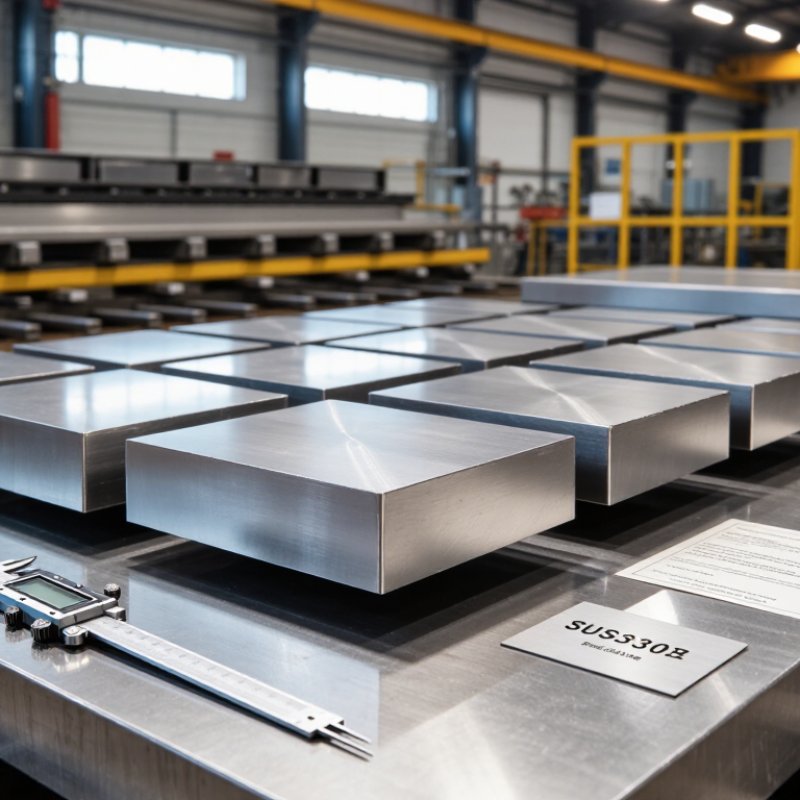
Table of Contents [Hide]
SUS304L Stainless Plates: Composition and Key Material Properties
SUS304L stainless plates are commonly aligned with UNS S30403 and EN 1.4307.
Their low carbon content is the defining feature. ASTM A240/A240M limits carbon to 0.030%. Chromium typically ranges from 18% to 20%, while nickel ranges from 8% to 12%. Manganese is limited to 2.00%, and silicon to 0.75%. These elements support a stable austenitic structure and reliable forming performance.
ASTM A240/A240M lists minimum tensile strength near 485 MPa, yield strength near 170 MPa, and elongation of 40% for annealed plate.
Density is about 7.9 g/cm³.
The low carbon level reduces chromium-carbide precipitation during welding. It does not make the plate immune to corrosion. Chlorides, surface contamination, and poor drainage can still cause pitting. That detail is often underestimated.
Tips:
Ask for heat numbers, chemical test results, and mechanical test reports. Check whether the certificate references ASTM A240/A240M or EN 10088-2. Plate thickness also affects flatness and forming behavior. A familiar grade is not always a perfect match. Compare the actual service temperature, weld design, and chloride exposure before purchasing.
Brands
Proudly Trusted by Top Suppliers Worldwide






Let us know and we will automate, together to fit your industrial needs.
 +91-97254 16844
Clients
Proudly Trusted by Top Companies Worldwide


Do you need Help? Get in touch.
X
Please fill out the form below and we will get back to you as soon as possible.