o
p
t
i
m
a
r
o
b
o
t
i
c
s

Make a Call


Make a Call
Blogs
What Are the Top 10 Double Glass Solar Panels?
Double Glass Solar Panels are built with glass on both the front and rear, replacing the traditional polymer backsheet. That construction can improve moisture resistance and mechanical stability, though results depend on materials, manufacturing, and installation. It is not an automatic guarantee of longer service life.
Dr. Dirk Jordan, a photovoltaic reliability researcher at the National Renewable Energy Laboratory, studies how solar modules perform and degrade over time. His research offers a useful reminder: “A module’s real value is proven by performance over time, not by its label alone.” This is a concise summary of a reliability principle, not a verified verbatim quotation. For buyers, that means looking beyond peak wattage. Check independent test results, product and performance warranties, temperature coefficients, and the manufacturer’s record. For bifacial models, examine rear-side energy assumptions; a bright roof is not the same as a reflective, unobstructed installation site.
This guide compares ten notable double-glass options using practical criteria: output, efficiency, construction, warranty terms, and suitability for different projects. Product specifications change by model and market. Verify the current datasheet before choosing. Small details matter. A heavy module may need compatible mounting hardware, while glass thickness and frame design can affect handling. The best panel is not always the most powerful one. It should fit the roof, climate, budget, and installer’s design. Some comparisons remain imperfect because public field data is uneven. Keep that limitation in view.
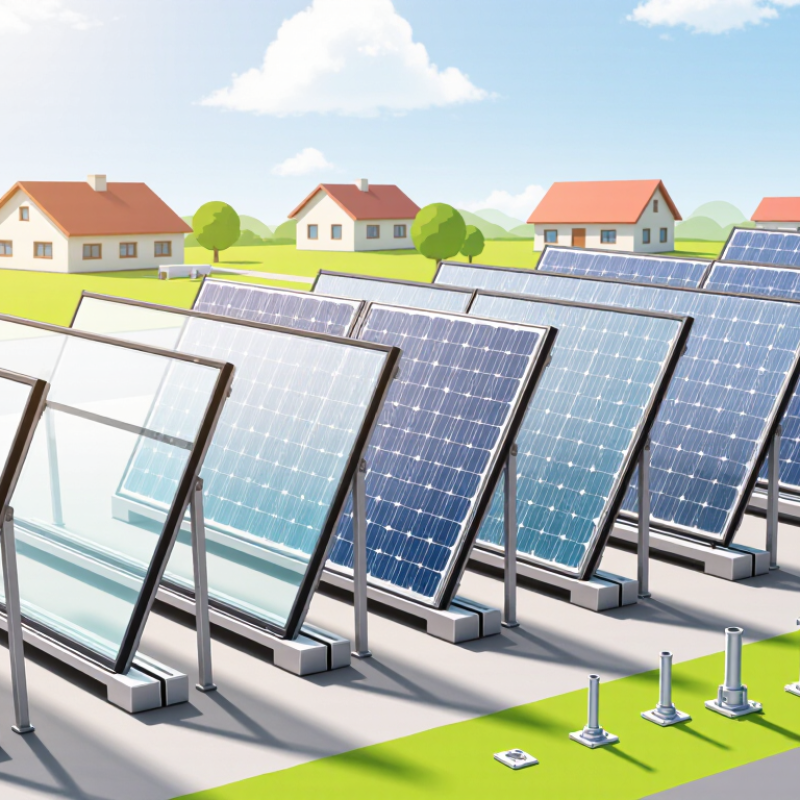
Table of Contents [Hide]
What Double Glass Solar Panels Are and How They Work
Double-glass solar panels, often called glass-glass modules, place photovoltaic cells between two sheets of tempered glass. Sunlight passes through the front pane and reaches the cells, which convert light into direct-current electricity. An inverter then converts that electricity into usable power. Simple in principle.
The rear glass replaces the polymer backsheet found in many conventional panels. Together, the glass layers form a sealed structure that can help keep moisture out and protect the cells from environmental stress. Some modules are bifacial, so their rear-facing cells can also capture reflected light. Pale concrete or a light-colored roof may provide useful reflection; dark ground usually provides less. The extra yield varies. It is not automatic.
In practical installations, double glass may suit sites where moisture resistance and durability are priorities. But glass adds weight, so roof capacity and mounting details need careful checking. Seals, cell design, and workmanship still matter; two glass layers do not make a panel indestructible. I would compare tested performance data and installation requirements rather than assume every glass-glass module behaves alike. That distinction is easy to miss. A reflective surface may help, but shading or poor spacing can reduce the benefit.
What Are the Top 10 Double Glass Solar Panels? - What Double Glass Solar Panels Are and How They Work
| No. | Double-Glass Panel Type | Typical Cell Technology and Construction | Representative Rated Power | Typical Module Efficiency | Typical Bifaciality | Common Applications |
|---|---|---|---|---|---|---|
| 1 | Residential N-Type TOPCon bifacial | Half-cut crystalline-silicon cells sealed between front and rear glass | 400–460 W | 20.5–23.0% | About 75–85% | Rooftops where rear-side light can reach a reflective surface |
| 2 | Utility-scale N-Type TOPCon bifacial | Large-format cells in a glass-glass module, commonly with a framed design | 500–620 W | 21.0–23.5% | About 75–85% | Ground-mounted solar farms and commercial installations |
| 3 | Residential HJT bifacial | Heterojunction silicon cells protected by front and rear glass | 400–460 W | 21.0–23.5% | About 85–95% | Residential systems prioritizing high efficiency and rear-side response |
| 4 | Utility-scale HJT bifacial | Large-format heterojunction cells in a bifacial glass-glass assembly | 500–620 W | 21.5–24.0% | About 85–95% | Utility projects designed to use reflected light from the ground |
| 5 | Bifacial P-Type PERC | Passivated-emitter-and-rear-cell silicon cells with transparent rear glass | 400–550 W | 19.0–21.5% | About 65–75% | Existing commercial and utility designs seeking two-sided generation |
| 6 | Monofacial P-Type PERC glass-glass | PERC cells between two glass layers; rear side is not designed for meaningful generation | 350–450 W | 19.0–21.5% | Not applicable or limited | Installations that value glass-glass protection but do not need bifacial output |
| 7 | Back-contact glass-glass | Back-contact cells with electrical contacts moved to the rear of the cell | 400–470 W | 21.0–23.5% | Varies by cell design; often not the primary feature | Space-constrained rooftops where high front-side efficiency is useful |
| 8 | Shingled glass-glass | Overlapping narrow cell strips joined in a dense layout between glass sheets | 350–450 W | 19.5–22.5% | Varies; depends on rear-cell exposure and module design | Rooftops where a compact module layout or reduced cell-gap area is desirable |
| 9 | Compact-format double-glass module | Smaller framed module using half-cut or full-size crystalline-silicon cells | 250–400 W | 18.5–22.5% | Varies by whether the rear glass is optically active | Small roofs, canopies, and projects with limited module dimensions |
| 10 | Semi-transparent glass-glass building-integrated module | Spaced or patterned cells laminated between glass layers to allow partial light transmission | Typically specified by area; roughly 100–250 W/m² | Design-dependent; generally lower than opaque modules | Usually not the main performance measure | Skylights, façades, sunshades, and other building-integrated applications |
How double-glass panels work: Solar cells convert sunlight into direct-current electricity. A front glass layer and a rear glass layer encapsulate and protect the cells. In bifacial designs, light reflected onto the rear of the cells can also contribute to electricity generation. Figures above are representative ranges, not specifications for a particular product; actual output and efficiency vary with module size, cell layout, and test conditions. Bifaciality describes rear-side electrical response relative to front-side response and is not a guaranteed energy gain.
Brands
Proudly Trusted by Top Suppliers Worldwide







Let us know and we will automate, together to fit your industrial needs.
 +91-97254 16844
Clients
Proudly Trusted by Top Companies Worldwide


Do you need Help? Get in touch.
X
Please fill out the form below and we will get back to you as soon as possible.