o
p
t
i
m
a
r
o
b
o
t
i
c
s

Make a Call


Make a Call
Blogs
Top 10 Types of Pharmaceutical Grade Activated Carbon?
Pharmaceutical Grade Activated Carbon supports purification, decolorization, and impurity control across modern drug manufacturing. Its dark powder may look simple, but every pore matters. Pore size, ash content, moisture, surface chemistry, and extractable impurities can influence process performance.
Grand View Research estimates the global activated carbon market in the multibillion-dollar range, with continued growth driven by water treatment, food processing, and pharmaceutical applications. MarketsandMarkets also forecasts sustained expansion, although reported values differ by scope and methodology. That difference deserves attention. Market figures are useful, but they cannot replace batch-specific qualification.
Ralph T. Yang, a recognized adsorption authority, describes adsorption simply: “Adsorption is a surface phenomenon.” This principle explains why Pharmaceutical Grade Activated Carbon requires more than high surface area. Manufacturers must examine raw materials, activation methods, particle distribution, microbial control, and trace metals. USP–NF expectations, applicable GMP guidance, and supplier certificates add further control points.
The following guide examines the top 10 types of Pharmaceutical Grade Activated Carbon, including powder, granular, extruded, acid-washed, steam-activated, and chemically activated grades. Each type offers a different balance of adsorption speed, filtration behavior, purity, and handling convenience. Powdered grades can act quickly but create filtration challenges. Granular grades may simplify recovery but require longer contact time.
No single type fits every formulation. That is the uncomfortable part. Selection often depends on real process trials, not catalog claims. A careful comparison should therefore connect carbon structure with the exact impurity profile, manufacturing stage, and regulatory documentation required.
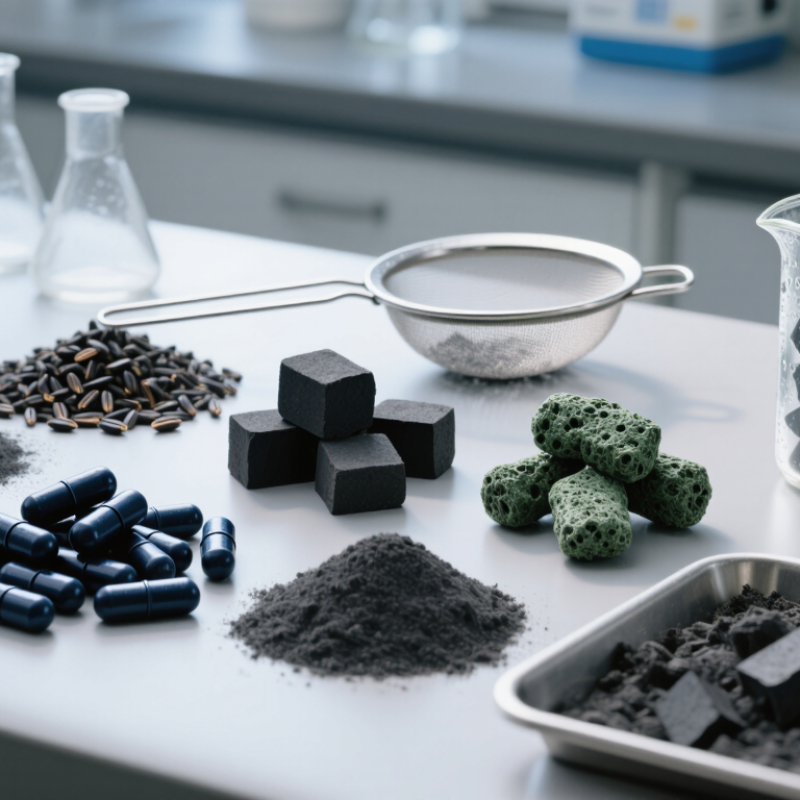
Table of Contents [Hide]
Pharmaceutical-Grade Activated Carbon: Definition and Quality Standards
Pharmaceutical-grade activated carbon is purified carbon produced under controlled conditions for medical, pharmaceutical, or process applications. Its grade depends on more than adsorption performance. Raw material, activation method, cleaning steps, packaging, and traceability all affect suitability. Common forms include powder, granules, and pellets, while coconut, wood, and mineral sources create different pore structures.
Quality standards should match the intended use and applicable pharmacopeial or regulatory requirements. Typical tests examine identity, moisture, ash, pH, particle size, bulk density, and adsorption capacity. Iodine number and methylene blue adsorption can describe pore performance, but neither test tells the whole story. Heavy metals, microbial limits, and endotoxin controls may also matter, especially when the carbon contacts pharmaceutical materials. Results should come from validated methods, qualified laboratories, and controlled sampling.
A reliable supplier should provide batch records, a certificate of analysis, and clear change-control procedures. Manufacturing under pharmaceutical quality systems improves consistency, but it does not remove every risk. A clean-looking powder can still contain unwanted residues. A strong specification can also miss an application-specific problem. I would review compatibility, extractables, storage humidity, and container integrity before approval. That extra review may feel slow. It is often where practical quality begins.
Brands
Proudly Trusted by Top Suppliers Worldwide







Let us know and we will automate, together to fit your industrial needs.
 +91-97254 16844
Clients
Proudly Trusted by Top Companies Worldwide


Do you need Help? Get in touch.
X
Please fill out the form below and we will get back to you as soon as possible.