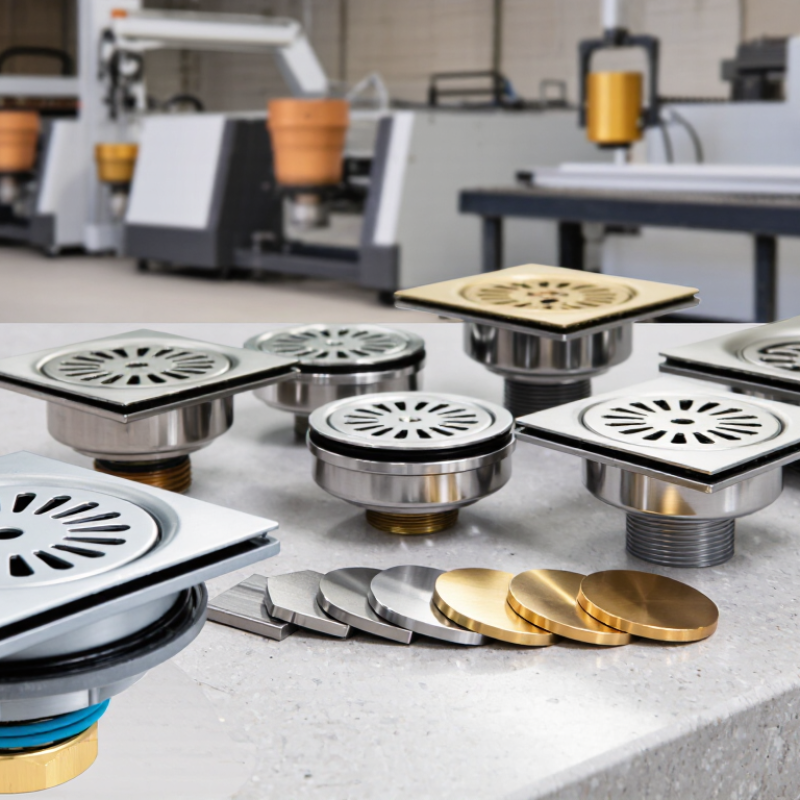
| Product Scope | - Bathroom pop-up waste sets
- Basin and lavatory drain assemblies
- Strainers, overflow covers, tailpieces, and connecting components
| Check component compatibility, assembly completeness, thread engagement, gasket placement, and drainage performance. | Single-piece or complete-set supply; optional overflow, push-button, pop-up, or grid-strainer configurations. |
| Common Drain Sizes | - Nominal 1¼ in / approximately 32 mm basin waste connections
- Nominal 1½ in / approximately 40 mm waste connections
- 32 mm and 40 mm metric outlet configurations
| Verify nominal size, thread profile, installation height, nut dimensions, and compatibility with the destination plumbing system. | Custom outlet diameter, tailpiece length, thread type, overflow slot position, and installation depth. |
| Primary Materials | - Stainless steel grades such as 304 and 316 for corrosion-resistant components
- Brass for machined or cast drain bodies and fittings
- EPDM, silicone, or other specified elastomers for seals
| Material certificates, alloy identification, dimensional inspection, surface inspection, and hardness or composition verification when specified. | 304 or 316 stainless steel; brass bodies; alternative seal compounds; material thickness and weight targets. |
| Surface Finishes | - Polished or brushed stainless steel
- Polished chrome-plated finish
- Matt, satin, or colored decorative finishes
| Check color consistency, gloss or texture uniformity, adhesion, coverage, visible defects, and resistance to handling marks. | Brushed, satin, polished, chrome, PVD-style decorative finishes, or customer-approved color samples. |
| Applicable Product Standards | - EN 274 for sanitary appliances and waste fittings where applicable
- ASME A112.18.2 for plumbing waste fittings where applicable
- Destination-market plumbing requirements must be confirmed before production
| Review the latest applicable edition, required dimensions, functional tests, marking rules, and test reports for the target market. | Testing and documentation can be aligned with European, North American, Australian, or other destination-market requirements. |
| Stainless Steel Treatment | Passivation may be specified for stainless-steel components to improve resistance to free iron contamination and corrosion initiation. | Process records, surface cleanliness, visual inspection, and passivation verification according to the agreed specification. | Pickling and passivation, electropolishing, brushed surface direction, and controlled surface roughness requirements. |
| Plating and Coating Control | Decorative nickel-chromium plating and other finishes should be controlled according to the agreed coating system and target market. | Coating thickness, adhesion, appearance, porosity, corrosion resistance, and batch-to-batch color consistency. | Specify coating stack, minimum thickness, gloss level, color tolerance, salt-spray test duration, and inspection method. |
| Corrosion Testing | Neutral salt-spray testing may be used as a comparative corrosion-resistance test for plated or coated surfaces. | Test method, exposure duration, rating criteria, and acceptance limits should be agreed before mass production. ASTM B117 and ISO 9227 describe test procedures, not universal acceptance levels. | Buyer-defined exposure time, corrosion rating, edge-treatment requirement, and sample approval process. |
| Leak and Drainage Testing | Finished assemblies should be checked for water tightness and unobstructed drainage after installation with the specified seals and fittings. | Leak test at the waste connection, seal inspection, pop-up or stopper operation, overflow function where included, and drainage-flow observation. | Custom test pressure or duration, water-flow requirement, stopper travel, actuation force, and overflow capacity criteria. |
| Dimensional Accuracy | Critical dimensions include outlet diameter, thread dimensions, body height, flange diameter, gasket thickness, and tailpiece length. | Use calibrated gauges, thread gauges, vernier calipers, height gauges, and approved inspection drawings. | Buyer drawings, 2D or 3D CAD files, tolerance tables, datum references, and first-article approval. |
| Seal and Gasket Performance | Sealing materials should be selected for contact with water, temperature range, compression, and chemical compatibility. | Check dimensions, compression, elasticity, surface defects, leakage after assembly, and compatibility with the drain body and basin. | EPDM, silicone, or other agreed compounds; custom profiles, colors, hardness, and gasket thickness. |
| Production Process Control | - Incoming material inspection
- CNC machining, stamping, casting, or forming as specified
- Deburring, polishing, finishing, assembly, and final inspection
| Use approved work instructions, process parameters, traceability records, in-process inspection, and final sampling plans. | Customer-approved control plans, special characteristics, inspection frequency, and process capability studies for critical dimensions. |
| Quality Management | ISO 9001 is a widely used quality-management framework for controlling documented processes, corrective actions, and continual improvement. | Confirm certificate validity, scope, issuing body, manufacturing site, document control, nonconformance handling, and corrective-action records. | Additional supplier audits, quality agreements, batch traceability, inspection reports, and third-party pre-shipment inspection. |
| Sampling and Inspection | ANSI/ASQ Z1.4 or an equivalent agreed sampling plan may be used for lot-based visual, dimensional, and functional inspection. | Define inspection level, AQL values, critical defects, major defects, minor defects, and rejection procedures before order confirmation. | 100% inspection for critical sealing or cosmetic features; reduced or tightened sampling for other characteristics. |
| Customization Capability | Customization commonly covers geometry, material, finish, logo-free packaging, assembly method, and installation accessories. | Approve drawings, samples, finish panels, materials, packaging artwork, and pre-production samples before mass production. | OEM drawings, private-label-neutral packaging, custom color, special overflow design, modified actuation mechanism, and accessory kits. |
| Packaging and Protection | Individual protection may include bags, sleeves, molded inserts, cartons, and moisture-resistant outer packaging. | Check scratch protection, component separation, carton compression, drop resistance, labeling accuracy, and quantity reconciliation. | Retail box, bulk carton, recyclable packaging, multilingual labels, barcode labels, installation instructions, and pallet specifications. |
| Documentation for Export Buyers | Typical documentation includes commercial invoice, packing list, product specification, inspection report, and material or test records when required. | Match documents to purchase-order requirements, shipment quantity, lot number, product revision, and destination-country rules. | Custom inspection templates, certificates of conformity, material declarations, test reports, installation guides, and multilingual documentation. |
| Pre-Production Approval | A controlled approval process normally includes technical drawing review, sample production, functional testing, and finish confirmation. | Record approved sample dimensions, materials, surface finish, packaging, and acceptance criteria before production release. | Golden sample, sealed reference sample, digital approval, third-party laboratory testing, and buyer witness inspection. |
| Lead-Time Planning | Production timing depends on tooling, material availability, plating or finishing capacity, sample approval, and order quantity. | Confirm sample date, production start, inspection date, estimated completion, and shipment readiness in a written schedule. | Separate schedules for standard items, modified items, new tooling, special finishes, and custom packaging. |