o
p
t
i
m
a
r
o
b
o
t
i
c
s

Make a Call

Make a Call
Blogs
Top Stadium LED Screen Options for Sports Venues
A stadium’s LED display does more than show the score. It shapes the live experience, from a close-up replay on the center-hung screen to a sponsor message moving along the perimeter ribbon. The right choice depends on venue size, viewing distance, sunlight, and the events a venue hosts. A bright outdoor board may suit an open football ground, while a finer pixel pitch can help indoor spectators read detailed graphics. There is no universal winner.
Technology leader Bill Gates wrote, “Content is king.” His remark was not about stadium displays, but it offers a useful reminder: even a powerful Stadium Led Screen needs clear, well-timed content. For venue teams, that means checking how score graphics, replays, and live information appear from the farthest seats—not only from the control room. Small details matter. Glare at 4 p.m. can flatten colors; a narrow viewing angle can make a replay harder to follow. Reliability matters, too. A screen that looks impressive on opening night but is difficult to service may become a costly compromise.
This guide compares common stadium LED screen options, including center-hung displays, end-zone boards, ribbon screens, and perimeter systems. It considers resolution, brightness, sightlines, control, and maintenance. Specs do not tell the whole story. Venue operators should test sample content at real viewing distances and ask how service access works during a busy season. A useful choice is not always the largest one. Sometimes, the best decision is the one a venue can operate consistently—and reassess when its needs change.
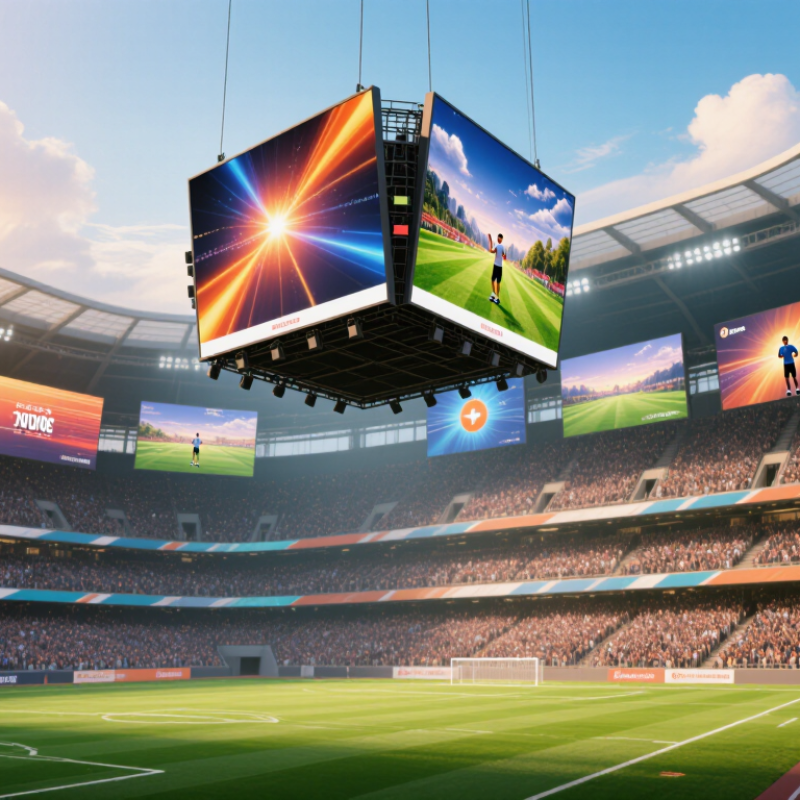
Table of Contents [Hide]
Types of LED Screens Used in Sports Venues
Sports venues use several LED screen types, each serving a different viewing distance and purpose.
Main video boards sit above the field or court and show replays, scores, and live camera feeds. Their size and pixel pitch should suit the farthest seats, not just the premium sections.
Distance matters. A screen that looks sharp up close may appear less detailed from the upper deck.
Ribbon displays run along seating tiers or fascia, carrying scores, prompts, and sponsor messages without blocking the action.
Perimeter LED boards line the playing surface and are designed for clear visibility from the stands and broadcast cameras.
Concourses may use smaller information screens for directions, schedules, and queue updates. For temporary events, mobile LED panels offer flexibility, though their placement and support structures need careful planning.
Brightness, refresh rate, viewing angle, and access for maintenance all affect performance.
A common mistake is assuming bigger is always better; it is not. The best arrangement depends on venue layout, ambient light, and what spectators need to see.
These choices deserve a site review, since even a well-specified display can be poorly placed.
Brands
Proudly Trusted by Top Suppliers Worldwide







Let us know and we will automate, together to fit your industrial needs.
 +91-97254 16844
Clients
Proudly Trusted by Top Companies Worldwide


Do you need Help? Get in touch.
X
Please fill out the form below and we will get back to you as soon as possible.