o
p
t
i
m
a
r
o
b
o
t
i
c
s

Make a Call


Make a Call
Blogs
Top 10 PCB Conveyor Manufacturers for Global Buyers
PCB production depends on more than advanced machines. Boards must move steadily between printers, pick-and-place systems, inspection stations, and reflow ovens. A poorly matched Pcb Conveyor can create bottlenecks, misalignment, or avoidable handling risks. Small details matter: adjustable rail width, smooth edge support, stable transfer speed, and reliable communication with neighboring equipment.
Market growth makes supplier selection increasingly important. Grand View Research valued the global printed circuit board market at approximately USD 73.6 billion in 2023 and forecast continued expansion through 2030. This estimate is a market forecast, not a guarantee for any individual factory. IPC’s industry research also tracks electronics manufacturing conditions and capacity, offering useful context for buyers assessing production plans. These reports describe the broader landscape; they do not replace equipment trials or factory audits.
This guide compares ten PCB conveyor manufacturers for global buyers. It considers product range, customization, integration support, service reach, and the practical demands of different production lines. A specification sheet can look convincing. The real test is a loaded board moving cleanly through a complete line, shift after shift. Buyers should verify actual board sizes, takt time, ESD controls, and interface compatibility before committing. And some trade-offs remain. A lower purchase price may bring longer commissioning or slower support, while a premium option may exceed a small line’s needs. The best choice depends on the process—not the brochure.
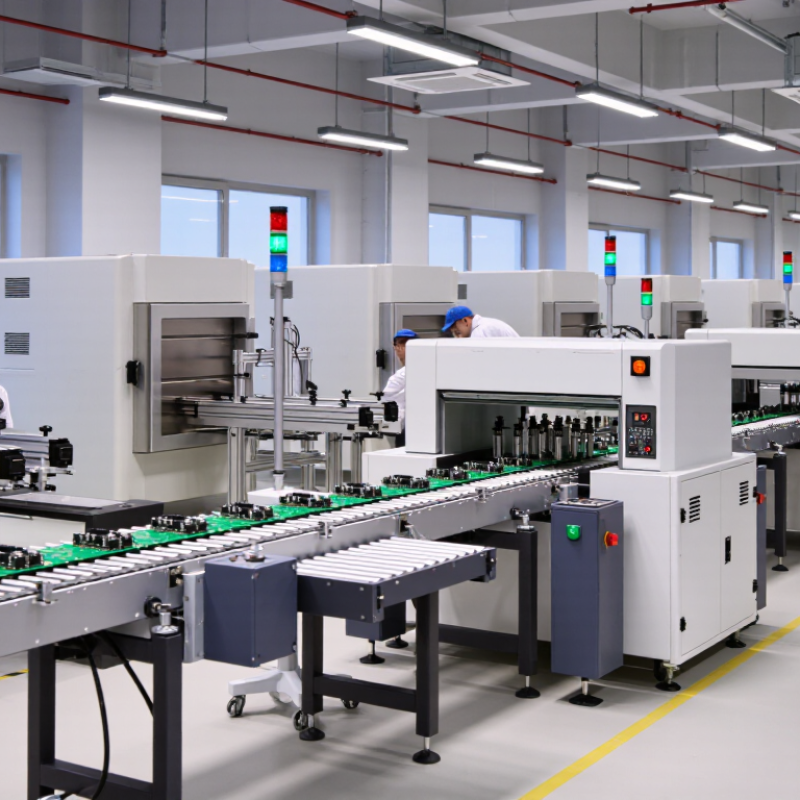
Table of Contents [Hide]
PCB Conveyors: Types, Functions, and Roles in SMT Production
PCB conveyors move circuit boards between process stations, but their roles differ. A basic link conveyor transfers boards from a solder-paste printer to a placement machine. Inspection conveyors provide a stable viewing area, often with adjustable rails and task lighting. Buffer conveyors hold boards when one machine runs slower than the next. Turn conveyors change board direction, while cooling conveyors help manage board temperature after reflow.
Small pauses matter. A sensor detects the board’s leading edge and signals the next station when transfer is safe. Rail width, belt speed, and transfer height must match the line; even a small mismatch can cause skewing or jams. A 1.6 mm board may travel easily, while a large panel can flex, so support and handling settings need checking. These details vary by board design.
In SMT production, conveyors connect printing, component placement, reflow, and inspection into a continuous flow. Buffers can reduce idle time, but they cannot fix a poorly balanced line. Operators should verify smooth transfers, sensor response, and board spacing during setup. It is tempting to focus on speed alone. That can be a mistake: gentle, repeatable handling is often more useful than maximum conveyor speed. Interface compatibility and maintenance access also deserve attention, though they are easy to overlook during equipment selection.
Brands
Proudly Trusted by Top Suppliers Worldwide







Let us know and we will automate, together to fit your industrial needs.
 +91-97254 16844
Clients
Proudly Trusted by Top Companies Worldwide


Do you need Help? Get in touch.
X
Please fill out the form below and we will get back to you as soon as possible.