o
p
t
i
m
a
r
o
b
o
t
i
c
s

Make a Call


Make a Call
Blogs
What Are the Top Types of Aluminum Solar Rails?
Choosing the right mounting hardware starts with the roof, not the catalog. Aluminum Solar Rails support solar modules and transfer their loads to roof attachments. Their profile, thickness, and allowed span affect how a system fits together. Small differences matter.
Common options include full-length standard rails, compact mini rails, and rail systems designed for specific roof types. Standard rails offer flexible attachment points along their length. Mini rails use shorter sections and may suit certain metal roofs, but their compatibility depends on the roof and module layout. Some systems use specialized profiles or fewer rail components. “Rail-less” designs are another category, though they still rely on mounting components that secure modules to the roof.
No single type is best for every project. A rail that looks sturdy in a catalog may not suit a particular roof, wind exposure, or module arrangement. Check manufacturer specifications for spans, clamps, fasteners, and compatible roof attachments. The installer should also account for local design conditions and the roof’s structural capacity. These details are less exciting than a sleek panel. They are more important.
This guide compares the main types of Aluminum Solar Rails and explains where each may fit. It looks at profile shape, installation considerations, material properties, and potential trade-offs. The goal is not to pick a winner by appearance. It is to help readers ask better questions and verify that the chosen system matches the project. Even a careful comparison has limits; final selection should follow the product documentation and site-specific engineering.
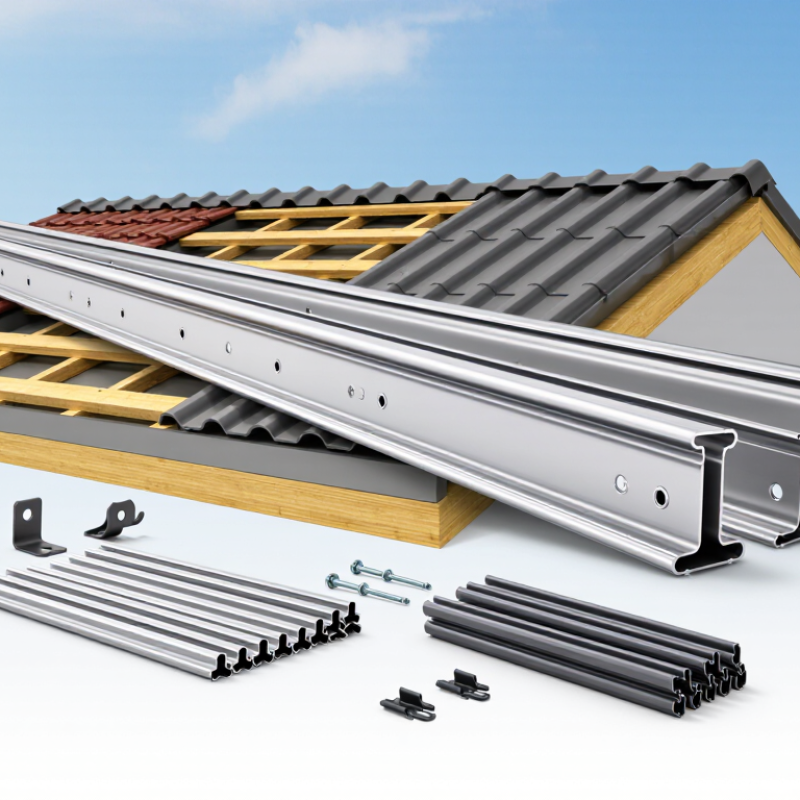
Table of Contents [Hide]
Understanding the Role of Aluminum Solar Rails
Aluminum solar rails form the structural link between photovoltaic modules and a roof or ground-mounted support system. They hold modules at a defined spacing and transfer gravity, wind, and snow loads to attachment points. They also help keep panel rows aligned. Small details matter: a poorly positioned clamp can create uneven pressure or leave a module less securely supported.
The scale makes dependable mounting important. IEA PVPS’s Snapshot of Global PV Markets 2024 reported more than 1.6 terawatts of cumulative solar PV capacity worldwide by the end of 2023. That figure does not measure rail quality, but it shows how widely mounting hardware is used. Rail profiles vary, including conventional framed rails and low-profile designs; the right choice depends on module dimensions, roof geometry, local loading, and installation method. Check the manufacturer’s engineering data and the project’s structural requirements.
Aluminum is light and naturally forms a protective oxide layer, but it is not maintenance-free. Contact with incompatible metals, trapped moisture, or loose fasteners can still cause problems. I would inspect joints and attachment points, especially after severe weather. Easy to overlook. Rails also support cable routing and bonding, though those functions must follow the equipment instructions. A tidy installation helps, but neatness alone does not prove structural adequacy.
Brands
Proudly Trusted by Top Suppliers Worldwide





Let us know and we will automate, together to fit your industrial needs.
 +91-97254 16844
Clients
Proudly Trusted by Top Companies Worldwide


Do you need Help? Get in touch.
X
Please fill out the form below and we will get back to you as soon as possible.