o
p
t
i
m
a
r
o
b
o
t
i
c
s

Make a Call


Make a Call
Blogs
What Is a Wet Grid Ball Mill and How Does It Work?
A Wet Grid Ball Mill is a heavy-duty grinding machine used in mineral processing plants. It reduces crushed ore inside a rotating cylinder filled with steel balls and water. The slurry moves through a discharge grid, while larger grinding media remain inside the mill. This simple separation improves continuous operation and limits unwanted over-grinding.
Barry A. Wills, a respected mineral-processing authority, has described grinding as “the most energy-intensive operation in mineral processing.” That observation explains why mill selection matters. A Wet Grid Ball Mill must balance drum speed, ball size, slurry density, feed rate, and discharge conditions. Even a small change can affect product fineness, power consumption, and recovery results.
This guide explains what a Wet Grid Ball Mill is and how it works. It follows the material path from feed inlet to grid discharge. It also examines the rotating shell, lifting liners, grinding balls, and slurry flow. Picture the process clearly: ore enters as coarse fragments, water forms a thick pulp, and steel balls strike the particles repeatedly. The result is not always perfectly uniform. Real plants face changing ore hardness, worn liners, blocked grids, and unstable water levels. Those details are easy to underestimate.
A reliable operation therefore requires practical observation, not specifications alone. Operators should inspect mill noise, motor load, discharge texture, and screen results. Experienced engineers also compare laboratory tests with field performance. This article will connect those measurements with the mill’s working principles, helping readers judge when a Wet Grid Ball Mill is suitable, efficient, and worth improving.
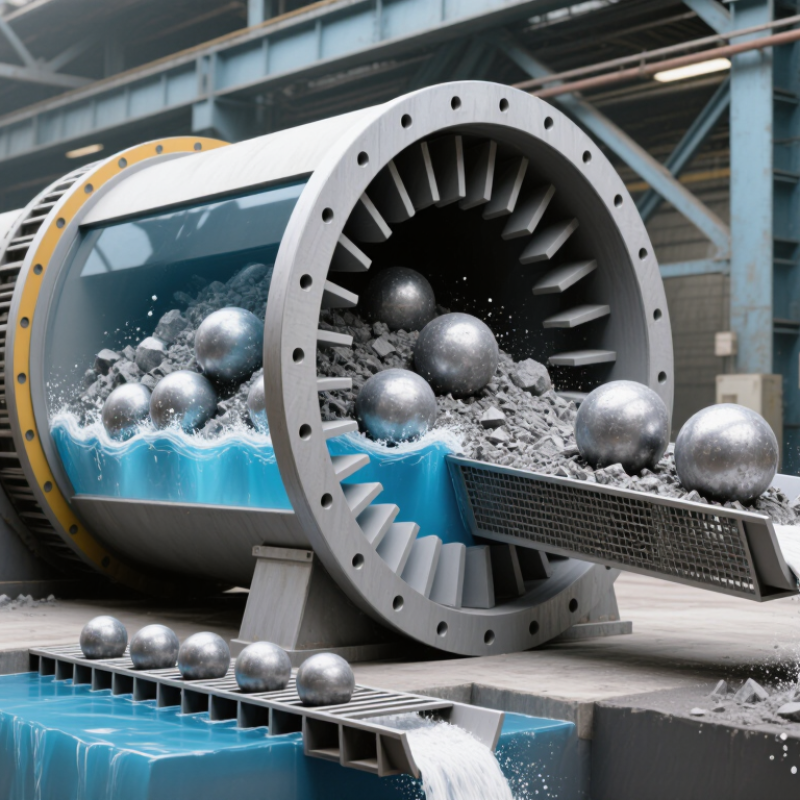
Table of Contents [Hide]
Wet Grid Ball Mill: Definition and Basic Purpose
A wet grid ball mill is a rotating cylinder filled with steel balls, ore, and water. Its basic purpose is to reduce crushed ore into a controlled slurry for later separation. Inside the shell, lifters raise the balls before impact and abrasion break the particles.
A discharge grid holds back larger grinding media and coarse particles. Pulp lifters then move the ground slurry through the grate. This design often suits primary grinding, especially when a high-throughput circuit needs stable discharge.
Water does more than prevent dust. It carries fine particles, moderates heat, and helps classification equipment receive a pumpable feed. However, excessive water can lower slurry density and weaken grinding action. The U.S. Department of Energy’s Mining Industry Energy Bandwidth Study estimated practical energy-saving potential of about 41% across mining operations. Grinding remains a major target because mill speed, ball charge, and slurry density strongly influence power use. The figure is useful, but not universal. Ore hardness changes everything.
Tips: Check mill feed size, pulp density, motor load, and discharge appearance together. A thin, watery stream may signal poor control. Record liner wear and particle-size results weekly. Operators should also question stable readings; a quiet mill can still produce the wrong product. A small sample taken at the discharge often reveals more than a dashboard value. The Global Mining Guidelines Group recommends disciplined monitoring and documented process control for safer, more reliable plant performance.
Brands
Proudly Trusted by Top Suppliers Worldwide







Let us know and we will automate, together to fit your industrial needs.
 +91-97254 16844
Clients
Proudly Trusted by Top Companies Worldwide


Do you need Help? Get in touch.
X
Please fill out the form below and we will get back to you as soon as possible.