o
p
t
i
m
a
r
o
b
o
t
i
c
s

Make a Call


Make a Call
Blogs
What Is a Rail Web Broadband Damper?
A Rail Web Broadband Damper is a trackside device designed to reduce vibration and noise along the rail web. The rail web is the vertical section between the head and foot. It flexes when wheels pass over the track. That movement can radiate sound into nearby streets, platforms, buildings, and tunnels.
Unlike a narrow-band solution, a broadband damper works across a wider range of vibration frequencies. Its performance usually comes from a carefully selected combination of steel, elastomeric material, and clamping force. These parts absorb energy as the rail bends. The result can be a quieter and more stable track environment, although results depend heavily on rail condition and installation quality.
Railway acoustics specialist Dr. David Thompson offers a useful principle: “A damper works only when its design matches the vibration problem.” That warning matters. A Rail Web Broadband Damper is not a universal cure. It cannot correct poor rail grinding, loose fasteners, wheel defects, or a badly designed track system.
Field experience shows why measurement must come first. Engineers may place sensors near the rail web, record passing-wheel frequencies, and compare vibration before and after installation. Small details matter. A two-millimetre gap can change contact pressure. Dirt can affect long-term performance.
The terminology can also be confusing. “Broadband” does not mean every frequency disappears. It means the damper targets a broader operating range. That distinction is easy to miss.
A reliable assessment should consider noise limits, maintenance access, climate, rail profile, and lifecycle cost. The best solution is measured, installed carefully, and checked again after service begins.
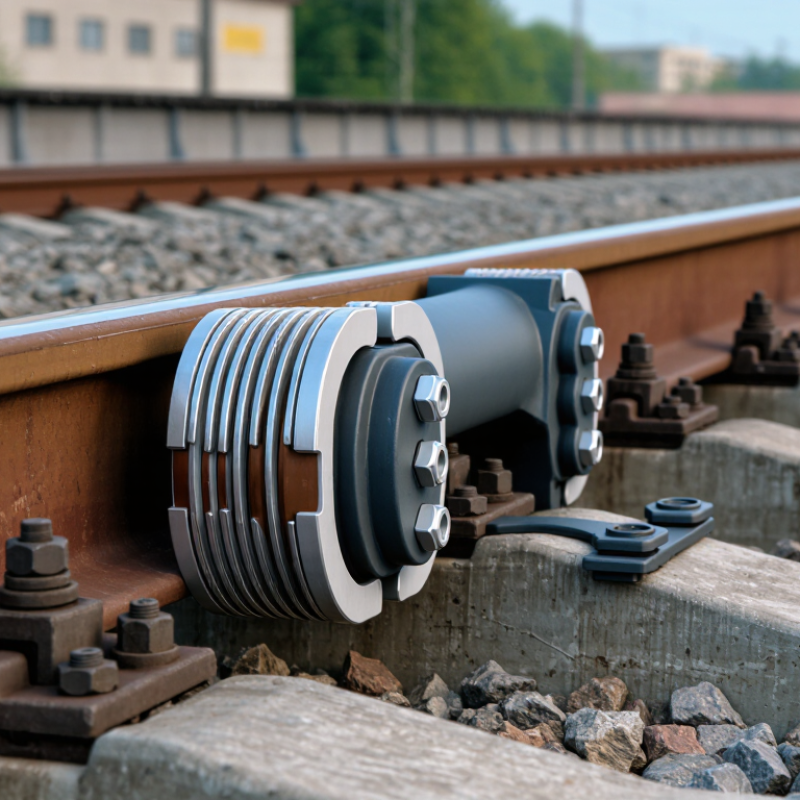
Table of Contents [Hide]
Definition and Purpose of a Rail Web Broadband Damper
A rail web broadband damper is a vibration-control device fixed to the vertical web of a rail. It normally uses a constrained mass, resilient layers, or both. The device absorbs bending energy across a broad frequency range. This differs from a narrow-band damper, which targets one dominant frequency.
Its purpose is practical: reduce rail vibration, rolling noise, and structure-borne noise near sensitive buildings. The rail web carries bending motion created by wheel and rail contact. When the damper moves out of phase, it dissipates part of that energy as heat. The European Environment Agency’s Environmental Noise in Europe 2020 report estimated that about 6.5 million people in Europe were exposed to railway noise above 55 dB Lden. The figure shows the scale of the problem, though it does not prove that every site needs a damper. Track form, wheel condition, speed, and ground conditions all matter. A tidy laboratory result may weaken outdoors.
Tips: Check the target frequency range before selection. Inspect fasteners, clearance, corrosion, and drainage during routine maintenance. Measure noise before and after installation. Use standardized procedures, such as those referenced in EN 16272, so results remain comparable. Do not judge performance from one quiet night. Weather and traffic patterns can distort readings. In practice, broadband dampers can help, but they are not a magic fix. Their value depends on correct placement and verified field data.
| Data Dimension | Typical Description or Value | Definition, Function, or Practical Significance |
|---|---|---|
| Basic Definition | A passive rail-vibration control device | A rail web broadband damper is a mechanical damping assembly fitted to the web of a rail to reduce vibration and structure-borne noise generated during wheel–rail contact. |
| Primary Installation Location | The vertical web between the rail head and rail foot | The device is normally positioned along the rail web, where it can interact with bending and flexural vibration modes without changing the running surface of the rail. |
| Main Operating Principle | Energy dissipation through damping | Relative motion between the rail and the damper converts part of the rail’s vibrational energy into heat, reducing vibration amplitudes over a broad frequency range. |
| Meaning of “Broadband” | Effective across multiple frequency bands | Unlike a narrowly tuned absorber designed for one dominant frequency, a broadband damper is intended to provide useful attenuation across a wider range of rail vibration frequencies. |
| Typical Frequency Coverage | Approximately 100–5,000 Hz, depending on design and rail conditions | The effective range varies with rail section, fastening stiffness, damper mass, damping material, installation quality, and vehicle operating conditions. This range is indicative rather than universal. |
| Common Damper Construction | Mass element combined with an elastomeric or viscoelastic damping interface | The mass and resilient interface are designed to move relative to the rail and dissipate vibration energy. Some designs use enclosed or preloaded assemblies for environmental protection and consistent contact. |
| Typical Rail Compatibility | Grooved rail, flat-bottom rail, or other compatible rail profiles | Compatibility depends on the rail geometry, available web clearance, fastening arrangement, clearance envelope, and the damper’s attachment method. |
| Attachment Methods | Clamping, bolting, or purpose-designed rail-side fastening | The attachment must maintain stable contact with the rail while allowing the damper to operate as designed. Installation should follow the applicable rail infrastructure requirements. |
| Primary Purpose | Reduction of rail vibration and rolling noise | The damper helps reduce vibration radiated by the rail and can lower airborne noise and structure-borne vibration in nearby buildings, platforms, tunnels, and track-support structures. |
| Noise Sources Addressed | Rail-radiated rolling noise and vibration-related noise | It is most effective when rail vibration is a significant contributor to overall railway noise. It does not directly eliminate wheel roughness, rail corrugation, aerodynamic noise, or poorly maintained track conditions. |
| Expected Acoustic Benefit | Application-specific; commonly assessed in decibels (dB) | The achievable reduction depends on train speed, wheel and rail roughness, track support, acoustic environment, damper coverage, and measurement position. Performance should be verified through field or laboratory testing. |
| Passive or Active System | Passive | A passive damper requires no external power, sensors, or control system during normal operation, which can simplify installation and maintenance. |
| Effect on Rail Geometry | No intentional change to the running surface | The damper is attached to the rail web rather than placed on the rail head, so it is designed to control vibration without altering wheel contact geometry. |
| Effect on Track Capacity | Normally compatible with existing traffic operation | Because the device is passive and rail-mounted, it generally does not impose an operational capacity limit by itself. Clearance, inspection, maintenance, and safety requirements must still be checked. |
| Key Design Parameters | Mass, stiffness, loss factor, attachment force, and rail compatibility | These parameters determine the damper’s dynamic response and influence the frequency range, attenuation level, durability, and suitability for a particular track form. |
| Environmental Requirements | Resistance to moisture, dust, temperature variation, and rail-service contamination | Materials and protective housings should withstand outdoor railway conditions, including water exposure, dirt, vibration, ultraviolet radiation, and temperature changes. |
| Inspection Considerations | Fastener security, position, damage, wear, and clearance | Routine inspection should confirm that the damper remains securely attached, does not interfere with railway equipment, and has no visible cracking, deformation, corrosion, or material degradation. |
| Best-Practice Application | Use with rail and wheel condition management | Rail web dampers are most effective as part of a broader noise and vibration strategy that may include rail grinding, wheel maintenance, resilient fasteners, barriers, or other track treatments. |
| Important Limitation | Performance is not universal | Actual results must be determined for the specific rail profile, track structure, vehicle fleet, speed range, noise source, and installation arrangement. A site assessment and measured verification are recommended before large-scale deployment. |
Brands
Proudly Trusted by Top Suppliers Worldwide







Let us know and we will automate, together to fit your industrial needs.
 +91-97254 16844
Clients
Proudly Trusted by Top Companies Worldwide


Do you need Help? Get in touch.
X
Please fill out the form below and we will get back to you as soon as possible.