o
p
t
i
m
a
r
o
b
o
t
i
c
s

Make a Call


Make a Call
Blogs
Why Choose a Trash Cabinet for Your Kitchen?
Why Choose a Trash Cabinet for Your Kitchen?
Kitchen waste is rarely a small problem. It collects beside the sink, smells quickly, and interrupts daily movement. A well-planned Trash Cabinet gives that waste a defined, concealed, and accessible location.
The U.S. Environmental Protection Agency reported that Americans generated about 292.4 million tons of municipal solid waste in 2018. That equals approximately 4.9 pounds per person each day. UNEP’s Food Waste Index Report 2024 estimated that households generated 631 million tonnes of food waste in 2022. Much of that waste begins in the kitchen.
Small design choices matter.
A pull-out cabinet can separate general waste, recycling, and compost near the preparation area. It can also reduce exposed bags, dripping containers, and unnecessary walking. However, cabinet storage does not reduce waste by itself. That limitation deserves attention. Better organization may even encourage larger containers and less frequent disposal.
William McDonough, a leading circular-design thinker, often states, “There is no such thing as away.” His principle suits kitchen planning. Waste does not disappear after the door closes.
Public reports rarely isolate Trash Cabinet performance as a separate category. Therefore, claims about guaranteed odor control or dramatic waste reduction should be treated cautiously. Real results depend on ventilation, liner quality, cleaning habits, and local recycling rules.
A practical Trash Cabinet should fit the household’s routine. Measure the opening carefully. Check the bin capacity. Leave room for cleaning. A cabinet that looks elegant but cannot hold a full week’s waste is not a successful solution. Good design is quieter, cleaner, and easier to question.
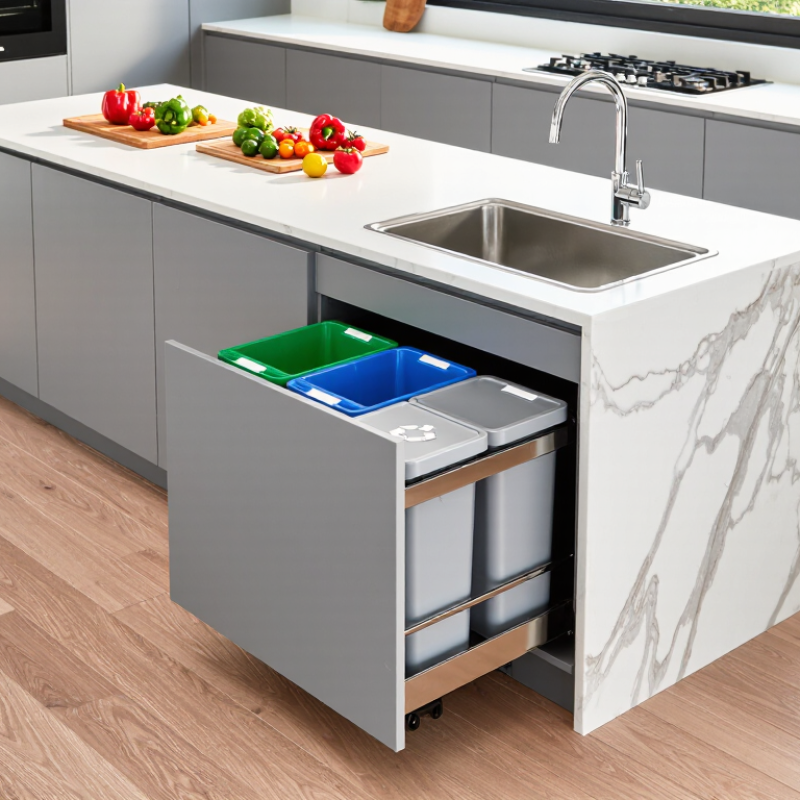
Table of Contents [Hide]
What Is a Kitchen Trash Cabinet?
Why Choose a Trash Cabinet for Your Kitchen?
A kitchen trash cabinet is a built-in storage unit designed to hide waste bins behind a cabinet door. Many models use pull-out tracks, while others use tilt-out fronts or removable containers. This design keeps bags, odors, and visual clutter away from food preparation areas. It also places waste disposal near the sink, where daily kitchen cleanup usually happens.
The U.S. Environmental Protection Agency reports that food waste represented about 24% of municipal solid waste in its 2018 Facts and Figures report. A dedicated cabinet can support better separation of food scraps, recyclables, and general waste. It cannot reduce waste by itself. That part still depends on household habits. The 2024 Houzz U.S. Kitchen Trends Study also found that 76% of renovating homeowners upgraded their kitchen cabinets. This suggests that storage planning remains central to modern kitchen design. However, a trash cabinet may feel cramped when the opening is narrow or the bin is too shallow.
Tips: Measure the bin, door swing, and plumbing space before ordering. Choose smooth, full-extension hardware for easier cleaning. Add a washable liner or removable container. Keep the cabinet away from direct heat. Test the pull-out motion with one hand. Small details matter. A slightly imperfect fit can cause daily frustration.
Brands
Proudly Trusted by Top Suppliers Worldwide







Let us know and we will automate, together to fit your industrial needs.
 +91-97254 16844
Clients
Proudly Trusted by Top Companies Worldwide


Do you need Help? Get in touch.
X
Please fill out the form below and we will get back to you as soon as possible.