o
p
t
i
m
a
r
o
b
o
t
i
c
s

Make a Call


Make a Call
Blogs
Why Choose a DTH Boring Machine for Global Projects?
Global infrastructure projects face changing ground conditions, tight schedules, and demanding environmental requirements. A Dth Boring Machine offers a practical solution for drilling through hard rock, fractured formations, and mixed geological layers. Its down-the-hole hammer delivers impact energy close to the bit, which can support accurate drilling and consistent hole quality.
Field experience shows that machine selection cannot rely on capacity figures alone. Engineers must examine rock strength, water presence, hole diameter, drilling depth, access limits, and local maintenance resources. A powerful rig may perform poorly when transport routes are narrow or spare parts are unavailable. Small details matter. For example, dust control, compressor output, and rod handling can influence daily productivity more than advertised drilling speed.
Reliable results also depend on trained operators, documented inspections, and compliance with applicable safety standards. Manufacturers with verified testing procedures and responsive technical support can reduce avoidable downtime during international deployments. Still, no Dth Boring Machine fits every project. Geological surveys may be incomplete, and early assumptions sometimes prove wrong. That weakness should be recognized, not hidden.
A careful procurement process combines site data, trial drilling, lifecycle cost analysis, and realistic production estimates. It also considers fuel use, tooling wear, noise control, and service access after delivery. When these factors are reviewed honestly, the equipment becomes more than a drilling purchase. It becomes part of a dependable project system, designed for safer work, measurable performance, and long-term value across different regions.
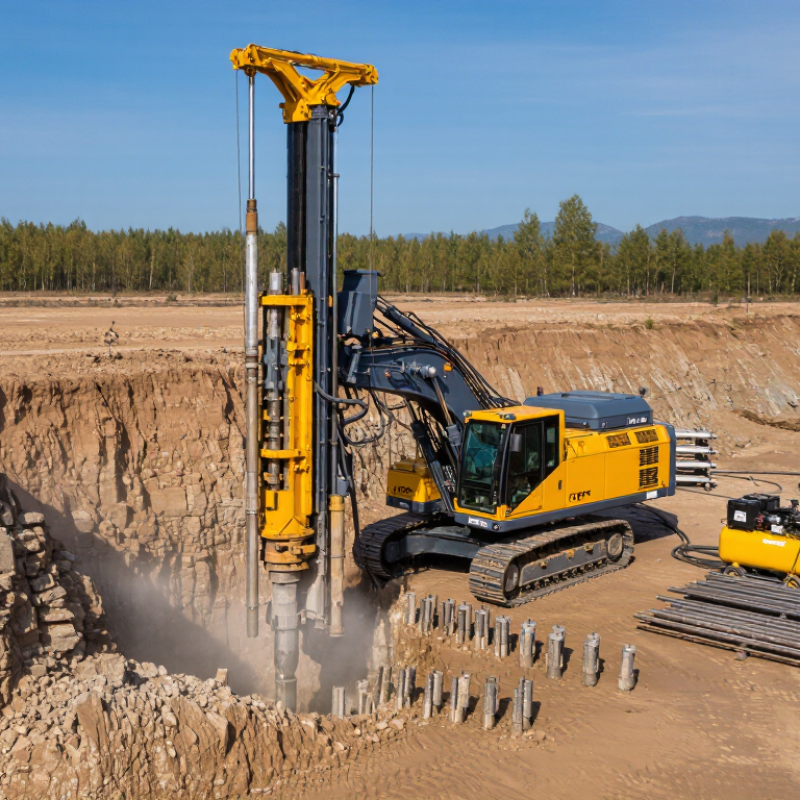
Table of Contents [Hide]
What Is a DTH Boring Machine?
A DTH boring machine is a drilling system that places a pneumatic hammer directly at the bottom of the hole. Compressed air travels through hollow drill rods and powers the hammer against the rock. Each rapid impact breaks the formation into smaller fragments. Air then carries cuttings back to the surface. The process is direct and powerful.
Unlike a surface hammer, the DTH hammer keeps its energy close to the drilling face. This design helps maintain penetration in hard rock and supports relatively straight holes. Operators commonly use DTH machines for foundation work, water wells, mining, anchoring, and geothermal investigations. I have found that stable feed pressure matters as much as hammer power. Poor alignment can produce crooked holes, uneven wear, and expensive delays.
The machine usually includes a crawler or truck-mounted frame, compressor, rotary head, drill rods, and dust-control equipment. Ground conditions still decide the result. Fractured rock may cause lost circulation, while soft layers can reduce hole stability. DTH drilling is not magic. It can be noisy, air-hungry, and less efficient where groundwater or loose soil dominates. Experienced crews monitor vibration, air pressure, penetration speed, and return flow throughout the shift. They also inspect threads and flushing passages before damage becomes serious. A practical weakness remains: site estimates are sometimes too optimistic. Careful geological testing should guide equipment selection for each project.
Why Choose a DTH Boring Machine for Global Projects? - What Is a DTH Boring Machine?
| Data Dimension | Typical Data or Range | Why It Matters for Global Projects |
|---|---|---|
| Operating Principle | A down-the-hole hammer delivers impact energy directly at the bottom of the borehole, while compressed air removes cuttings. | Direct impact improves drilling efficiency in hard and abrasive formations compared with systems that keep the hammer at the surface. |
| Common Hole Diameter | Approximately 90–300 mm for many surface drilling applications. | The range supports applications such as water wells, geotechnical investigation, anchoring, quarrying, and controlled blasting. |
| Typical Drilling Depth | Common surface-rig projects may reach about 30–150 m, depending on ground conditions, tooling, and rig configuration. | Provides flexibility for both shallow construction work and deeper exploration or water-well projects. |
| Suitable Rock Conditions | Especially effective in medium-hard to very hard, competent rock; performance depends on rock abrasiveness, fractures, and weathering. | Makes DTH technology suitable for varied geological environments encountered across different regions. |
| Compressed-Air Pressure | Approximately 7–35 bar, depending on hammer design, hole diameter, and required penetration performance. | Allows equipment selection to be matched with locally available compressors and site power conditions. |
| Air Flow Requirement | Often about 10–35 m³/min for surface DTH work; the actual requirement varies by hammer size and operating pressure. | Adequate airflow is essential for cooling the hammer and carrying drilled cuttings out of the hole. |
| Drilling Direction | Vertical, inclined, and, with suitable rig configuration, near-horizontal drilling. | Supports different site layouts, including foundations, slopes, blast patterns, and exploration programs. |
| Penetration Performance | Highly variable; influenced by rock strength, bit design, hammer energy, air pressure, feed force, and operator settings. | A properly matched system can maintain consistent drilling output across demanding ground conditions. |
| Hole Accuracy | Generally good in competent formations; accuracy is affected by rod deflection, ground fractures, deviation, and machine setup. | Improves the repeatability of anchor holes, blast holes, and investigation boreholes when alignment is properly controlled. |
| Cuttings Removal | Compressed air lifts rock cuttings through the annular space between the drill string and borehole wall. | Fast evacuation helps maintain bit efficiency and provides useful information about changing geological layers. |
| Mobility Requirements | Available as crawler-mounted, truck-mounted, trailer-mounted, or skid-mounted configurations. | Different chassis options help adapt the machine to remote sites, rough terrain, roads, and restricted work areas. |
| Main Applications | Water wells, mineral exploration, geotechnical drilling, quarrying, controlled blasting, foundation work, and rock anchoring. | One machine platform can serve multiple industries and project types across international markets. |
| Key Selection Factors | Rock type, target hole size, required depth, compressor capacity, rig mobility, tooling availability, and local service capability. | Correct matching improves productivity, reduces consumable wear, and supports reliable operation in different countries. |
Note: Values shown are typical industry ranges for surface DTH drilling and may vary according to machine configuration, hammer model, tooling, geology, altitude, and operating conditions.
Brands
Proudly Trusted by Top Suppliers Worldwide







Let us know and we will automate, together to fit your industrial needs.
 +91-97254 16844
Clients
Proudly Trusted by Top Companies Worldwide


Do you need Help? Get in touch.
X
Please fill out the form below and we will get back to you as soon as possible.