o
p
t
i
m
a
r
o
b
o
t
i
c
s

Make a Call


Make a Call
Blogs
Why Choose Microfluidic Chips for Your Business?
Microfluidic Chips are changing how businesses design diagnostics, drug research, and analytical instruments. A tiny cartridge can guide fluids through channels thinner than a human hair. It can reduce sample volume, shorten testing time, and support repeatable automation. These advantages matter when laboratories face rising reagent costs and pressure for faster decisions.
George M. Whitesides, a leading microfluidics researcher, defined the field clearly: “Microfluidics is the science and technology of systems that process or manipulate small amounts of fluids.” His explanation highlights the core business value. Precise fluid control can turn a complex laboratory workflow into a compact, scalable platform. For product teams, this may mean smaller instruments, lower waste, and easier integration with optical or electronic sensors.
Market evidence supports this momentum, though estimates are not identical. Grand View Research valued the global microfluidics market at approximately USD 28.35 billion in 2023. Its report projects a 13.2% compound annual growth rate from 2024 to 2030. Some estimates disagree. That difference deserves attention before investment decisions are made. Still, the direction is difficult to ignore. Companies choosing Microfluidic Chips should assess manufacturing yield, material compatibility, calibration, and user training. A chip may look elegant on a prototype bench. Production can be less forgiving. The strongest business case combines measurable throughput gains with documented validation, reliable supply chains, and realistic total ownership costs.
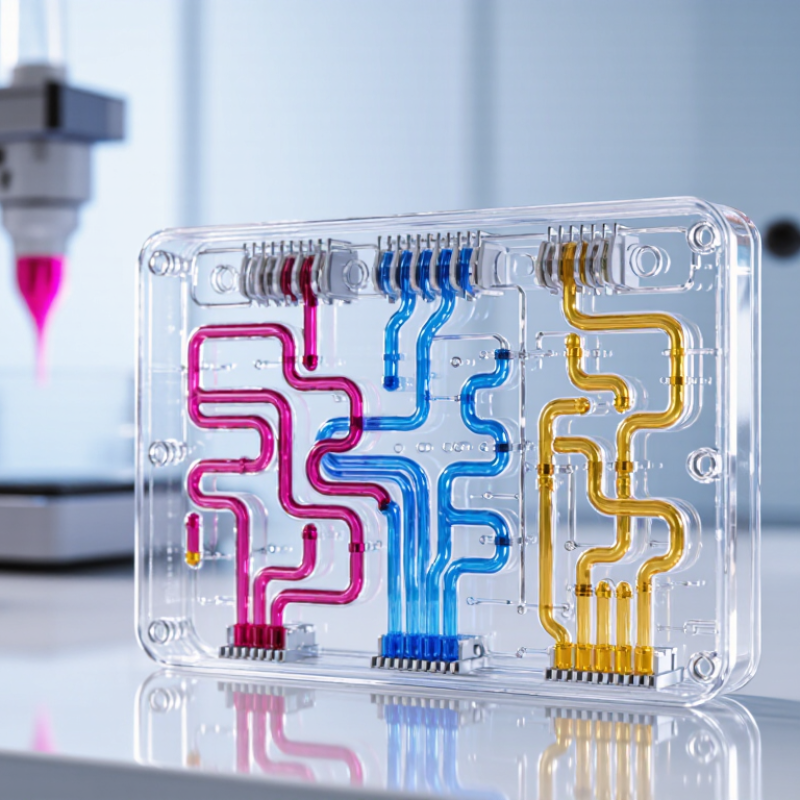
Table of Contents [Hide]
What Are Microfluidic Chips and How Do They Work?
Microfluidic chips are small devices that guide liquids through channels thinner than a human hair. They usually contain inlets, chambers, valves, mixers, and detection areas. A typical chip can handle tiny samples, sometimes only a few microliters. Pumps or pressure differences move the liquid through the channels. Because the flow is usually laminar, streams travel side by side instead of turbulently mixing. Mixing often depends on diffusion or carefully designed channel patterns. Sensors then measure color, electrical signals, fluorescence, or other changes.
For a business, this design can reduce reagent use, shorten testing time, and support compact instruments. A clinic may process a sample near the point of care. A laboratory may run several controlled reactions on one disposable chip. In practice, results depend on channel geometry, surface treatment, temperature, and operator training. Chips are not magic. Bubble formation, blocked channels, or uneven sample loading can damage reliability. I have seen how a simple handling error can matter more than an advanced sensor. Validation under real working conditions remains essential.
Tips: Start with one measurable workflow, not a broad promise. Test real samples early. Record flow rates, storage conditions, and failure causes. Build quality checks into every batch. A slightly slower chip with stable results may create more business value than a faster design that requires constant troubleshooting.
Brands
Proudly Trusted by Top Suppliers Worldwide







Let us know and we will automate, together to fit your industrial needs.
 +91-97254 16844
Clients
Proudly Trusted by Top Companies Worldwide


Do you need Help? Get in touch.
X
Please fill out the form below and we will get back to you as soon as possible.