o
p
t
i
m
a
r
o
b
o
t
i
c
s

Make a Call


Make a Call
Blogs
Why Choose a New Energy Car Production Line?
Choosing a New Energy Car Production Line is a strategic decision, not merely a machinery purchase. It must connect body assembly, battery-pack installation, software checks, and final inspection. Small gaps matter. A misaligned fixture or inconsistent fastening torque can slow an entire shift.
The IEA’s Global EV Outlook 2024 reports that electric-car sales reached nearly 14 million in 2023, representing about 18% of worldwide car sales. The agency expected sales to approach 17 million in 2024, or more than one in five cars sold. That is a fast-moving market. But forecasts are not factory orders. Regional demand, charging access, and changing customer preferences can alter the model mix.
A well-designed line can help manufacturers respond through modular stations, adaptable tooling, and clear material routes. Traceability also matters: teams need reliable records for critical assembly steps, quality checks, and rework. When assessing a supplier, manufacturers should examine verified cycle times, changeover requirements, maintenance support, and worker training—not just headline capacity. Ask to see how the proposed layout handles a real production scenario. Yet no line is universal. A plant built for one battery format or vehicle platform may need costly changes when products evolve. This is easy to underestimate. Careful planning, realistic demand assumptions, and staged commissioning make the investment more resilient, though they cannot remove every production risk.
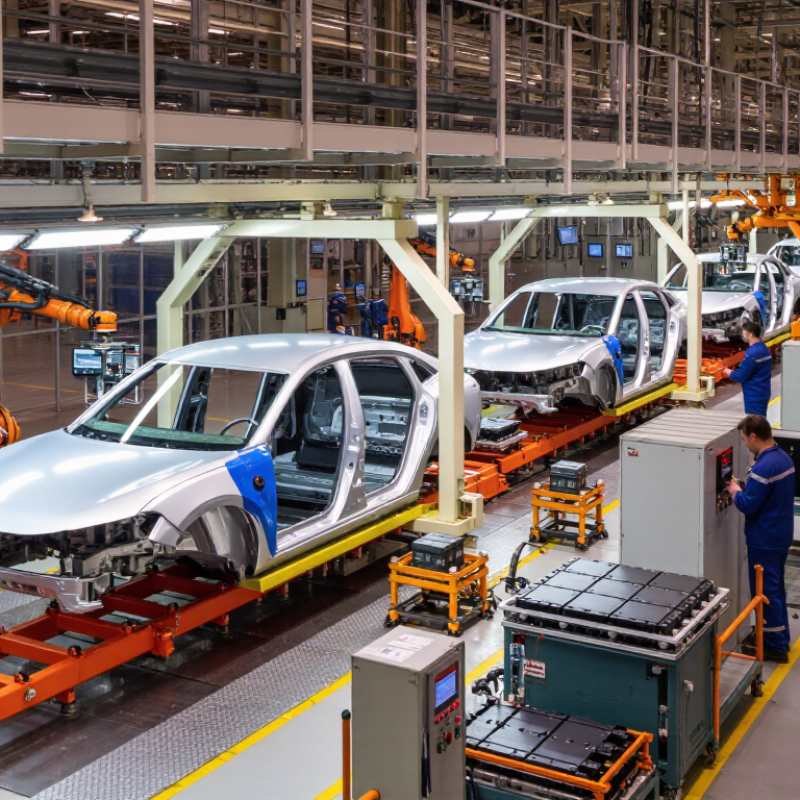
Table of Contents [Hide]
What Defines a New Energy Car Production Line?
A new energy car production line is a connected system for building vehicles powered by batteries or other electric-drive technologies. It combines familiar body and paint operations with specialized stations for battery packs, electric motors, power electronics, and high-voltage wiring. The defining feature is not one machine. It is how these processes work together.
At a battery station, workers or automated tools position modules, tighten fasteners to specified torque, and record inspection results. Sensors can flag an unusual temperature or a missed connection before the vehicle moves forward. Traceability matters. Each pack and key component should be linked to its production data, making faults easier to investigate. The line also needs controlled handling areas and clear procedures for high-voltage components. Small details count.
A well-planned line tests more than whether a car starts. End-of-line checks may assess charging, braking, steering, thermal management, and communication between electronic systems. Flexible fixtures can help accommodate different vehicle sizes, though flexibility adds setup complexity. That trade-off deserves attention. No layout is perfect from day one; trial builds often reveal awkward tool access, slow handoffs, or inspection steps that need redesign. Regular review keeps the process grounded in actual production conditions.
Brands
Proudly Trusted by Top Suppliers Worldwide







Let us know and we will automate, together to fit your industrial needs.
 +91-97254 16844
Clients
Proudly Trusted by Top Companies Worldwide


Do you need Help? Get in touch.
X
Please fill out the form below and we will get back to you as soon as possible.