o p t i m a r o b o t i c s

Blogs

2026 Best Industrial Robots for Global Buyers?

Choosing the best industrial robots for global buyers in 2026 requires more than comparing payloads, speeds, and prices. Factory conditions matter. A six-axis robot may excel beside a welding cell, while a collaborative robot may suit a compact assembly line with frequent human interaction. The right choice depends on repeatability, reach, cycle time, software, maintenance, and workforce skills. Joseph F. Engelberger, widely recognized as the father of industrial robotics, said, “I can’t define a robot, but I know one when I see one.” His observation still feels relevant. A robot’s value appears in real production, not only in a brochure.

This guide examines leading industrial robots through practical buying criteria. It considers automotive plants, electronics workshops, warehouses, food facilities, and general manufacturing sites. Energy use, spare-parts access, programming difficulty, safety integration, and after-sales support receive equal attention. Small details matter. A difficult interface can waste hours each week. An unavailable replacement component can stop a production line for days. No ranking can fit every factory. That is the uncomfortable part. Buyers may also overestimate speed and underestimate training, integration, and facility redesign. We will compare established manufacturers and newer solutions without treating brand reputation as proof of performance. Test data, service records, and a controlled pilot should guide final decisions. The best robot is not always the strongest or cheapest. It is the system that delivers stable results, protects workers, and remains supportable as production changes. Real factories are messier than specifications. That deserves careful reflection.

2026 Best Industrial Robots for Global Buyers?

What Industrial Robots Are and How They Work

2026 Best Industrial Robots for Global Buyers?

What Industrial Robots Are and How They Work

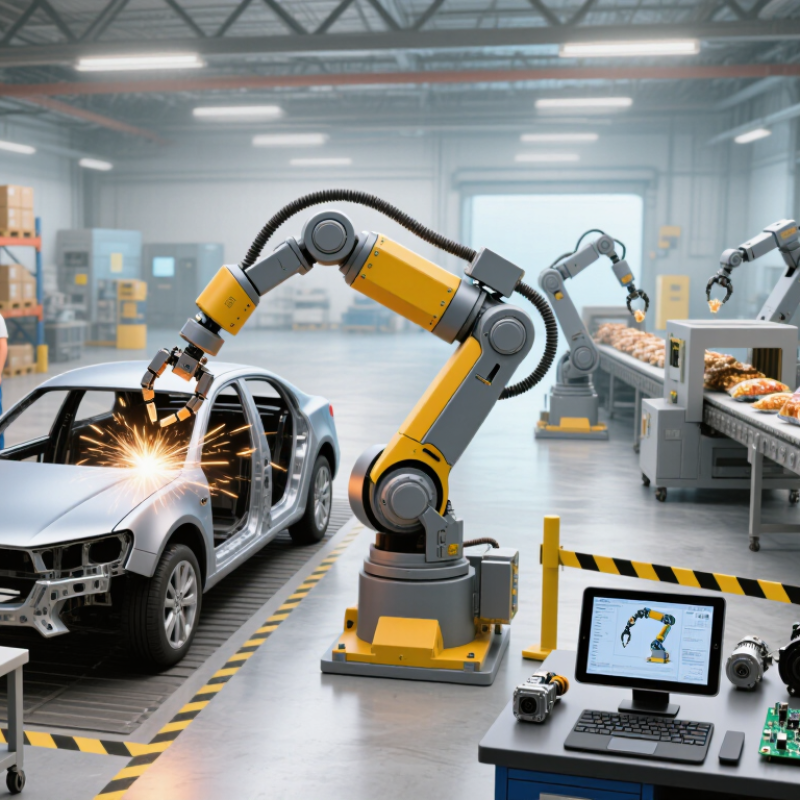
Industrial robots are programmable machines that move tools or parts with controlled accuracy. They commonly perform welding, assembly, packaging, painting, inspection, and material handling. A typical robot has a rigid arm, several joints, a controller, sensors, and an end effector. The end effector may be a gripper, suction tool, welding head, or cutting device. In practical factories, the robot is only one part of a larger work cell.

The controller converts programmed coordinates into joint movements. Encoders report each joint’s position, while sensors can detect force, distance, temperature, or object presence. The system compares expected movement with real feedback and adjusts its action. A vision camera may locate a part on a moving conveyor. A safety scanner can stop motion when a person enters a restricted area. Small errors matter.

Choosing a robot requires more than checking payload and reach. Buyers should examine cycle time, repeatability, available floor space, power requirements, software support, and local service skills. The gripper must match the product’s shape, weight, and surface. A strong arm can still fail with a poor tool design. I have seen automation plans overlook maintenance access, creating expensive delays later. No setup is perfect. Teams should test real parts, document risks, and verify machine guarding against applicable local requirements before production.

Key Types of Industrial Robots for Different Manufacturing Tasks

Choosing the right industrial robot starts with the manufacturing task, not the robot’s advertised payload. Articulated robots suit welding, painting, machine tending, and complex handling because their multiple joints provide broad movement. SCARA robots deliver fast, repeatable assembly and screwdriving on horizontal work surfaces. They are precise. Delta robots excel at high-speed picking, sorting, and lightweight packaging. Their ceiling-mounted design reduces floor congestion.

Cartesian robots use linear axes for predictable movement, making them practical for machining, dispensing, and large-format handling. Collaborative robots can support smaller assembly, inspection, and palletizing tasks near trained workers. However, their actual performance depends on tooling, speed limits, risk assessment, and workspace design. A collaborative label does not remove the need for safeguards.

Match the robot to payload, reach, cycle time, accuracy, environment, and end-effector requirements. A food-processing cell may need corrosion-resistant surfaces and frequent washdown protection. A welding cell needs stable positioning, cable management, and fume-control planning. Check controller compatibility, spare-part access, maintenance skills, and local conformity requirements before purchase. A useful factory trial should measure complete cycle time, not just arm speed. Paper specifications can mislead. An overlooked gripper change may add seconds to every cycle, while poor fixture design can cancel the robot’s accuracy. Leave room for future tooling and process changes. That small allowance is often forgotten.

2026 Best Industrial Robots for Global Buyers? - Key Types of Industrial Robots for Different Manufacturing Tasks

Robot Type Typical Axes Typical Payload Typical Reach / Work Area Typical Repeatability Best-Suited Manufacturing Tasks Main Advantages Key Limitations
Six-Axis Articulated Robot 4–6 or more 3–500+ kg 0.6–4.0+ m spherical envelope Typically ±0.02–0.10 mm Arc welding, spot welding, machine tending, assembly, painting, palletizing, material handling Highest flexibility; can approach parts from many angles; supports complex tool orientations Higher purchase and integration cost; requires more programming and safety engineering
SCARA Robot 4 1–20 kg 0.3–1.2 m radial reach Typically ±0.01–0.03 mm High-speed pick-and-place, screwdriving, insertion, small-part assembly, dispensing Fast horizontal motion; compact footprint; strong repeatability; relatively simple setup Limited orientation and access compared with six-axis robots; less suitable for large or irregular parts
Delta / Parallel Robot 3–4 0.1–6 kg Usually 0.4–1.6 m diameter work area Typically ±0.1–0.5 mm Food packaging, sorting, inspection, lightweight assembly, high-speed product transfer Very high cycle rates; low moving mass; excellent for repetitive overhead handling Small payload; restricted workspace; installation often requires an overhead frame and precise vision integration
Cartesian / Gantry Robot 3–6 linear or rotary axes 1–2,000+ kg, depending on frame design Rectangular travel; commonly 0.5–20+ m per axis Typically ±0.02–0.20 mm CNC machine loading, large-part handling, pallet transfer, dispensing, cutting, 3D printing Scalable work envelope; straightforward programming; suitable for long linear travel and heavy loads Large structural footprint; limited flexibility around obstacles; custom engineering may be required
Cylindrical Robot 3–4 5–100 kg Cylindrical envelope; commonly up to 1–2 m radial reach Typically ±0.05–0.20 mm Machine loading, simple assembly, handling around a central workstation, basic welding Efficient use of floor space; good vertical movement; relatively simple mechanical layout Less common for complex modern applications; limited tool orientation and obstacle avoidance
Collaborative Robot Typically 6 3–30 kg 0.5–2.0 m reach, depending on configuration Typically ±0.02–0.10 mm Low-volume assembly, inspection, screwdriving, light machine tending, packaging, assisted material handling Flexible deployment; easier redeployment; generally lower integration complexity; designed for monitored human-robot operation Usually slower and lower-payload than conventional industrial robots; collaborative operation still requires a documented risk assessment
Robotic Palletizer 4–5 40–700+ kg including tooling Typically 2.0–3.5 m reach Typically ±0.05–0.20 mm Case palletizing, bag stacking, layer forming, depalletizing and warehouse transfer High throughput; consistent stacking patterns; reduces manual lifting and ergonomic risk Requires suitable conveyors, grippers, pallet fixtures and safety guarding; optimized mainly for handling applications
Mobile Industrial Robot / AMR Mobile base plus optional 4–7-axis arm Base payload commonly 100–2,000+ kg; arm payload varies Facility-wide navigation; route length is application-dependent Positioning commonly ±10–50 mm; docking accuracy can be higher with fixtures Line-side delivery, warehouse transport, work-in-process movement, autonomous inspection and flexible material flow Flexible routing; scalable factory logistics; reduces fixed conveyor infrastructure Needs reliable maps, traffic management, charging strategy and clear access routes; generally not intended for high-precision machining

Note: Specifications are representative industry ranges for 2026 planning and vary by configuration, tooling, speed, workpiece, environment and safety requirements. Payload values include the end-of-arm tool where specified by the equipment supplier.

How to Compare Robot Payload, Reach, Speed, and Precision

2026 Best Industrial Robots for Global Buyers?

Robot selection often fails when buyers compare headline speed alone. Payload means more than the product weight. It includes the gripper, cables, and changing inertia during motion. Reach must match the real workspace, not an ideal drawing. A longer arm may reduce stiffness at full extension.

Speed should be tested with the intended payload and path. A robot rated for fast wrist motion may still lose cycle time during acceleration, settling, or collision avoidance. Precision also needs careful wording. ISO 9283 separates pose accuracy from pose repeatability. For many assembly tasks, repeatability matters more than impressive speed. The International Federation of Robotics reported 541,302 industrial robot installations worldwide in 2023, showing how widely these performance choices now affect factories. Still, report figures are not factory results.

Tips: Request a sample-cell trial. Use the actual fixture, gripper, payload, and longest reach. Measure cycle time over at least 100 cycles. Check drift after warm-up. Ask for test conditions, not only maximum specifications.

A practical comparison table should record payload at full reach, reach at useful payload, average cycle time, repeatability, and service limits. Watch wrist load carefully. Small errors here can create vibration, scrap, or slower programming. Field tests often expose uncomfortable gaps between catalog data and production behavior. That is not a failure; it is useful evidence. The cheapest robot may become expensive when calibration, guarding, and integration time are included. Rescue the spreadsheet with real parts.

Leading Industrial Robot Brands and Their Global Applications

In 2026, leading industrial robot brands compete through reliability, software, and local service. Global buyers should examine proven applications, not impressive demonstrations alone. In automotive plants, six-axis robots handle welding, painting, and heavy part movement. In electronics facilities, compact robots perform precise assembly beside human operators. Food producers often need hygienic designs, rapid cleaning, and gentle handling. Warehouse systems depend on fast picking, palletizing, and dependable vision guidance.

My experience with factory evaluations shows that integration quality often matters more than arm speed. Check payload performance at the robot’s full reach, not only in brochures. Review uptime data from similar climates and production shifts. Service teams, spare-part access, training, and software support deserve equal attention. A robot may be excellent but unsuitable for a dusty workshop or unstable network. That matters. Buyers should also confirm safety functions, risk assessments, and regional certification requirements before installation. These checks reduce delays and unexpected maintenance costs.

Tips: Compare at least three application references from different regions. Request a live cycle-time test using your actual parts. Measure noise, energy use, changeover time, and recovery steps. Keep operators involved during trials; they often notice awkward access points first. Do not ignore small failures. Repeated minor faults can expose weak integration or poor training. No selection is perfect, and initial assumptions may need revision after real production data appears.

How to Select, Install, and Maintain an Industrial Robot System

2026 Best Industrial Robots for Global Buyers?

Selecting an industrial robot system starts with the process, not the robot catalogue. Define payload, reach, cycle time, repeatability, wrist movement, and environmental exposure. A six-axis arm may suit welding, while a delta robot may handle lightweight packaging faster. Measure the real workpiece, including grippers and cables. Small errors here become expensive redesigns.

Installation should begin with a documented risk assessment and a clear cell layout. Check floor strength, anchor positions, guarding, emergency stops, and access for technicians. Keep power, compressed air, and network connections easy to inspect. During commissioning, test slow movements before production speed. Verify collision zones, tool center points, and recovery procedures with trained operators. Local electrical and machinery safety requirements must guide the final setup.

Maintenance needs more than a calendar reminder. Record motor temperatures, unusual vibration, lubrication dates, fault codes, and cycle counts. Inspect gripper fingers and cable jackets weekly when dust or sharp edges are present. Replace worn parts before accuracy drops. A clean log supports reliable decisions. However, predictive data is not magic. A sensor can miss a loose connector, and a perfect simulation cannot reproduce every factory surprise. Leave time for manual inspection. That is where many weak plans fail.

Brands

Proudly Trusted by Top Suppliers Worldwide

Let us know and we will automate, together to fit your industrial needs.

Clients

Proudly Trusted by Top Companies Worldwide

Do you need Help? Get in touch.

X

Please fill out the form below and we will get back to you as soon as possible.

    Subscribe our newsletter & get updates